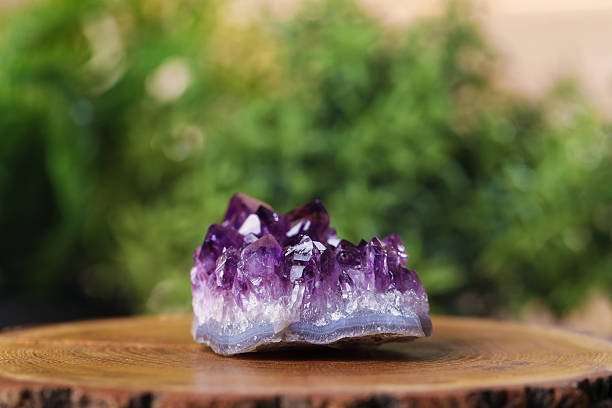

Amethyst, with its deep and captivating purple hue, has been a highly revered gemstone since ancient times.
Quick Authenticity Checklist
Before you buy, use gentle checks that do not damage the piece. Start with light, color, inclusions, and seller transparency before considering any physical test. For value after authenticity, compare the stone with our amethyst quality grades guide.
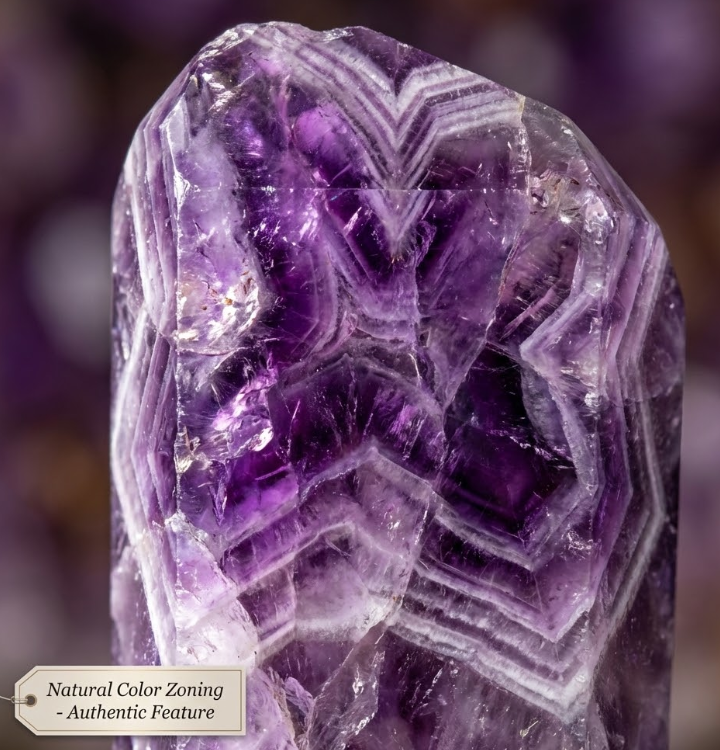
- Color zoning: real amethyst often shows uneven bands or lighter tips, not a flat purple wash.
- Clarity: natural pieces may include veils, tiny fractures, or growth marks.
- Temperature feel: quartz usually feels cool at first and warms slowly in the hand.
- Bubbles: round air bubbles are a strong warning sign for glass or resin.
- Scratch risk: avoid testing jewelry, polished faces, or display geodes. A scratch test can permanently damage the item.
- Price clue: a very large, perfectly colored piece at a very low price deserves extra checking.
- Seller transparency: look for clear photos, size, weight, material notes, and a return policy.
It is not only considered a symbol of spirituality and wisdom, but is also frequently used in Feng Shui to attract wealth and prosperity. Furthermore, its unique natural beauty makes it a favorite among countless collectors.
However, this very high demand has led to a market flooded with all sorts of imitations and modified products. From cheap glass and resin to lab-synthesized crystals, and even heat-treated imitations of “citrine,” buyers eager to own a genuine natural amethyst crystal are left confused and disappointed.
I’ve been looking at fakes long enough to know what to check for. Here’s what I actually do when a stone lands on my desk.I’m not interested in drama — I just want you to know what you’re looking at, providing you with transparent, truthful, and reliable professional knowledge.
This article will take you deep into the mysteries of natural amethyst and provide a series of collector-level home identification methods to help you distinguish between genuine and fake amethyst and protect your investments.
Understanding Genuine Amethyst: Geological Basis Before Identification
Before attempting to identify natural amethyst, it is essential to understand its nature.
The Miracle of Silicon Dioxide (SiO₂): The Mineralogical Nature of Amethyst
Amethyst belongs to the quartz family, and its main chemical component is silicon dioxide (SiO₂).
This mineral is widely found in the Earth’s crust, but only under specific geological conditions, when quartz crystals containing trace amounts of iron ions (Fe³⁺) are exposed to natural radiation (usually radioactive elements in the Earth’s crust), will they develop the purple color we see. This unique formation mechanism gives amethyst its unique natural properties.
Hexagonal crystal structure: a masterpiece of nature
Natural amethyst has a hexagonal crystal structure. This means that it exhibits a hexagonal prismatic growth habit at the microscopic level.
Although it is not easily observed in cut and polished finished products, this hexagonal crystal characteristic is strong evidence of its natural identity in raw or unprocessed crystal clusters.
The Formation of Color: The Secrets of Iron Ions and Radiation (Why Does Color Fade?)
The purple color of amethyst originates from iron ions (Fe³⁺) that replace silicon in its crystal lattice, forming “color centers” after exposure to natural radiation. This color center structure is sensitive to ultraviolet light.
Professional care advice: Amethyst must be kept away from strong sunlight for extended periods, as ultraviolet rays can damage the color centers of iron ions, causing the color to gradually fade and even turn gray. This reflects the sensitivity of natural crystals to their environment.
5 Home Tests to Verify Your Amethyst Crystal
Here are five tests you can easily do at home to help you identify natural amethyst.
Test 1: Visual Inspection – Color Bands, Inclusions, and Deadly Bubbles
This is the most intuitive and important method of identification. Please observe carefully under bright but indirect natural light.
Color Zoning: Nature’s fingerprints During the formation of natural amethyst, subtle changes in the geological environment and the distribution of trace elements often result in bands or areas of varying shades of color, which is known as color zoning.”Color zoning isn’t just a marker of authenticity — it’s also one of the key factors that determines a stone’s grade and value. Once you know your crystal is real, the next question is: how good is it? Our amethyst quality grades guide breaks down the difference between AAA, AA, and A-grade stones with visual examples.”
Authentic characteristics: The colors transition naturally and irregularly, with alternating shades (purple, white, or blue), like the brushstrokes of nature.
Warning about counterfeits: If the color of amethyst is completely uniform without any variation in depth, or even presents an overly saturated or unnatural “dead” purple, it is very likely to be dyed glass or a synthetic product.
Inclusions: The natural story within a crystal. Naturally formed crystals are almost never perfect. They often contain tiny natural “defects” or “growth marks”.
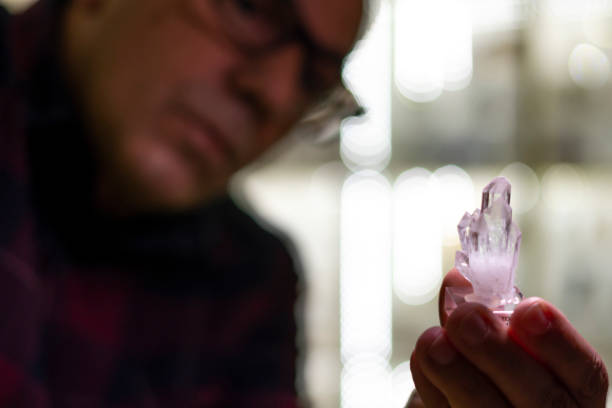
Authentic characteristics: Under a magnifying glass (or even with close observation of the naked eye), you may see tiny “cotton-like” inclusions, natural ice cracks, or hair-like needle-like inclusions (feather-like, needle-like, growth lines). These are marks formed by the crystal during a long geological process.
Counterfeit warning: If the crystal appears unnaturally flawless under a magnifying glass, or if the inclusions exhibit a regular, mechanized shape, it should be viewed with suspicion.
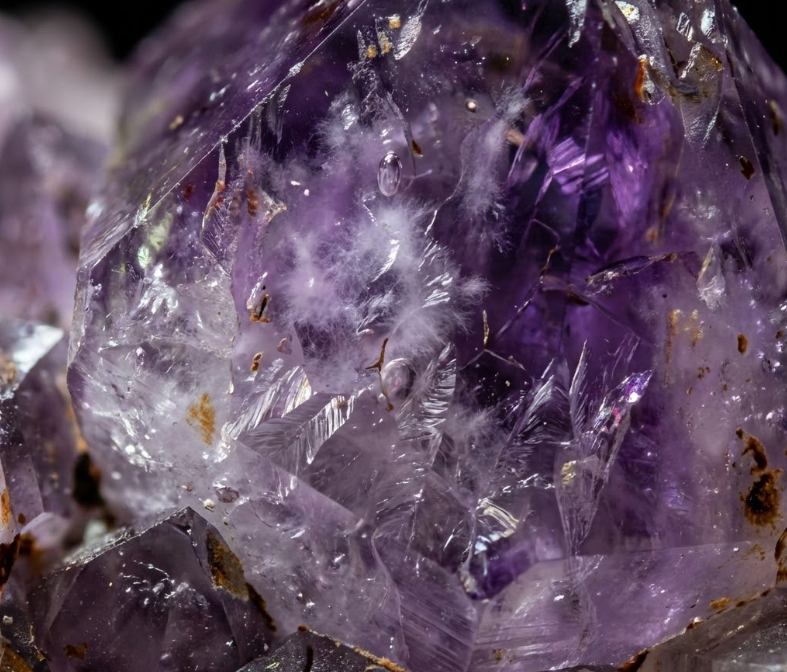
Bubbles: A Dead Giveaway for glass or resin imitations. This is the most important and clearest indicator for identifying counterfeit goods. During the manufacturing process, glass or resin imitations are very prone to developing round or oval air bubbles inside.
Authentic characteristics: Natural amethyst will never have round or oval air bubbles visible to the naked eye.
Counterfeit warning: If your amethyst contains clearly visible, round or oval bubbles, it is 100% a glass or resin imitation.
Expert Insight: Beware of “Artificial Perfection” In the world of gemstones, “flawless” often implies “human intervention.” Those deep purple beads with an unbelievably uniform color, an internal purity devoid of any inclusions, and an overly perfect cut are 99% likely to be synthetic or glass. The beauty of natural gemstones lies in their unique “imperfections,” the masterpieces of nature, not mass-produced factory goods.
Test 2: Touch and Weight – Experiencing the Subtlety of Natural Minerals
Pick up the amethyst, weigh it in your hand, and feel its weight and temperature.
Density and specific gravity: The “heavy feel” of genuine amethyst. Natural amethyst (quartz) has a specific gravity of approximately 2.65. This means it will have a noticeable “heavy feel” in your hand.
Authentic product characteristics: It feels heavier and more substantial than glass or plastic of the same size. At room temperature, it feels cool and takes some time to warm up with hand warmth.
Counterfeit warning: Glass or plastic counterfeits usually feel lighter and warm up quickly when touched.
Plastics and Resins: Lightweight Imitations Plastic and resin are much less dense than quartz, and their textures are vastly different. Once you’ve experienced the weight and coolness of natural amethyst, it’s hard to be fooled by these lightweight imitations.
Test 3: Hardness Test – Mohs 7 (toughness)
Amethyst has a Mohs hardness of 7. This is an important physical property that can be used as an aid in identification.
Mohs hardness 7: Can scratch glass, but will not be scratched by a steel knife. A Mohs hardness of 7 means that amethyst can easily scratch softer materials such as glass and steel (Mohs hardness approximately 5.5-6.5).
Authenticity characteristics: Gently scratch a piece of discarded glass with the sharp edge of an amethyst crystal. If a clear scratch is left, it is very likely authentic. Meanwhile, ordinary knives or needles cannot leave scratches on the surface of amethyst.
Counterfeit warning: If amethyst cannot scratch glass, or is easily scratched by a steel knife, it is likely a glass or resin imitation with lower hardness.
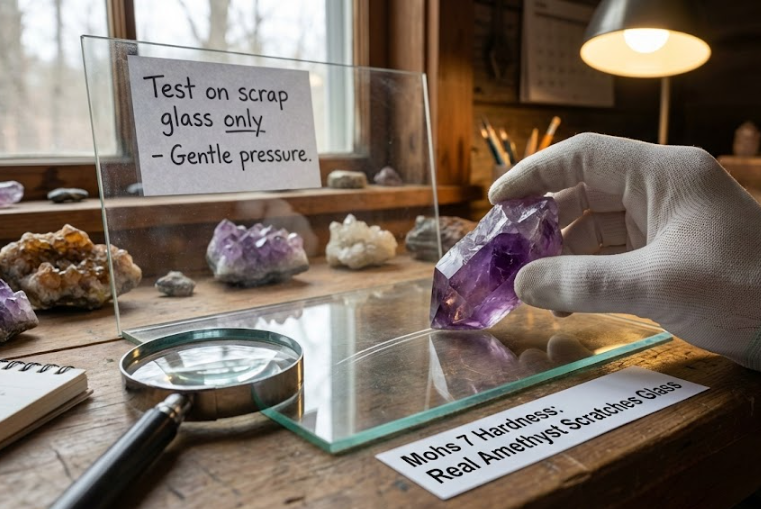
Careful operation of scratch testing Please perform this test with extreme caution! Choose a piece of inconspicuous discarded glass and gently test only with the inconspicuous edge of the amethyst. Never test on your precious jewelry or geode, as this may cause irreversible damage. This test is only a supplementary method.
Test 4: Temperature Sensitivity – Revealing the Truth About Heat Treatment and Fading
Natural amethyst exhibits a certain degree of stability to short-term temperature changes.
Brief heating reaction: Stability of natural crystals Hold the amethyst in your hand for a few minutes and feel the temperature change.
Authentic characteristics: Natural amethyst should maintain its color and structure when briefly heated (such as by holding it in your hand) and should not heat up rapidly.
Counterfeit warning: If amethyst heats up quickly when slightly heated, or develops an odor (plastic), or even changes color significantly, it is likely a counterfeit made of plastic, resin, or poorly dyed.
90% “Citrine”: A product of high-temperature heating of amethyst. This is a little-known industry fact: 90% of the natural citrine on the market is actually amethyst that has been heated to 400-500 degrees Celsius. At high temperatures, the iron ion color centers inside amethyst are altered, producing a yellow hue. While this is a market-accepted enhancement method, as staunch authenticators, we believe it’s essential for you to know its true nature. Genuine natural citrine is extremely rare and commands a much higher price than heat-treated citrine.
Test 5: Structure and Origin Clues – Identifying Authenticity from the Source
For raw minerals or geodes, structure and origin are key to distinguishing authenticity and determining value.
[Raw Integrity] The “Natural Integrity” of Geodes: Beware of Cement and Glue Repairs Natural geodes are mined from rocks, and their backs and sides usually retain natural rock layers or “Basalt Rind“.
Authentic characteristics: True collectors highly value “Natural Matrix.” If a geode has a natural cement-like or rock-like skin, it is a symbol of its identity, not a flaw. We guarantee the raw integrity of the geodes we sell.
Counterfeit Warning: Cheap geodes on the market often have cracks and damage on the back or sides repaired with cement and glue, or even painted over to make them look more “complete”. Carefully examine the repair marks; be wary if you see unnatural-colored seams, glue overflow, or cement chunks.
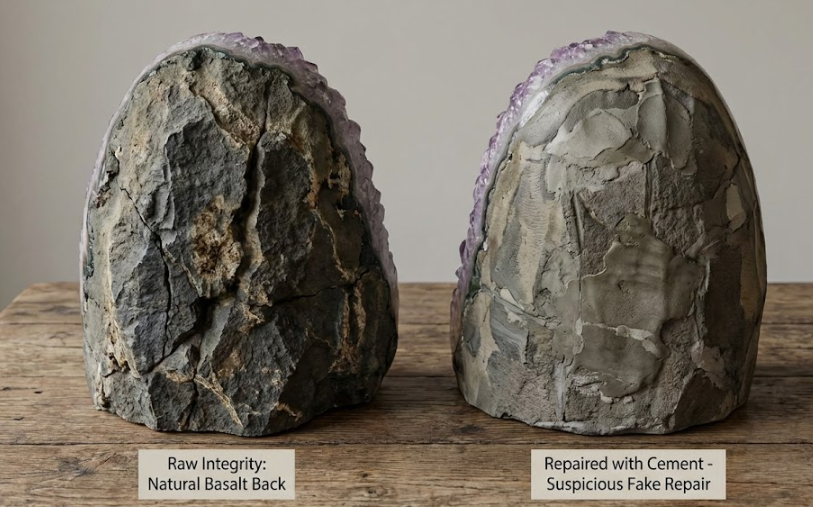
Origin Characteristics and Value Chain: Uruguay vs. Brazil vs. Bolivia
| Origin | Characteristics | Value | Feng Shui Application |
|---|---|---|---|
| Uruguayan amethyst | The crystals are extremely fine, the color is as deep as ink, purple with red, and the saturation is extremely high with almost no gray tone. | Due to its rarity and exceptional color, it is the most valuable and is more suitable for high-end collectors. | It has a strong ability to gather energy and is suitable for placement in the wealth corner to attract wealth and prosperity. |
| Brazilian amethyst | The crystals are relatively large and come in a variety of colors, ranging from light purple to dark purple, and are often used for large geodes. The color is usually not as deep as that of Uruguayan geodes and may have a white or gray tint. | High production volume, high cost performance, suitable as a large-scale decorative item for warding off evil spirits in the home. | — |
| Bolivian Amethyst | Often accompanied by ametrine properties, that is, purple and yellow areas appear simultaneously in the same crystal. | — | — |
Inclusions: Nature’s Gift Some natural amethysts are accompanied by other minerals, such as calcite, pyrite, and even titanium quartz. These associated minerals not only increase the uniqueness of the crystal, but are sometimes also believed to enhance its energy properties (for example, titanium quartz increases energy conductivity).
Expert-level appreciation and collection: Beyond authenticity
Synthetic amethyst: A laboratory product. Synthetic amethyst is chemically identical to natural amethyst in its crystal structure, but it is rapidly grown in a laboratory environment. While it can achieve a flawless appearance, it lacks the “earthly energy” and sedimentation that natural crystals accumulate over millions of years of geological evolution. For those seeking energy healing and feng shui benefits, synthetic crystals cannot provide the profound power inherent in natural crystals.
Exclusive Rating System We abandon the vague “AAA grade” description and instead use a unique grading system based on the following dimensions to give you a clear understanding of the value of your collection:
- Origin: Clearly indicates the specific mining area, such as Uruguay or Brazil.
- Color Intensity: Provides a detailed description of color saturation, such as “deep purple” or “lavender purple,” and indicates whether there is a grayish tone.
- Crystal clarity: distinguishes between natural inclusions and impurities that affect appearance.
- Associated minerals (Inclusions): A detailed description of the types of associated minerals and their impact.
The energy field physics and applications of amethyst The energy of amethyst is not superstition, but is based on the vibration frequency of the crystal.
Corresponding Chakras: Primarily corresponds to the Third Eye Chakra and the Crown Chakra. Represents intuition, insight, and inner peace.
Note: Amethyst’s energy is primarily associated with calm and clarity, rather than the commonly believed “romance” (rose quartz) or “wealth” (citrine). Its role in wealth is more about “gathering energy” and “enhancing wisdom for making informed decisions.”
Feng Shui Applications:
- Wealth Corner: Requires an amethyst geode in the shape of a “treasure basin” (Geode/Cave) to absorb and gather energy.
- Wisdom Corner/Academic Area: Requires an “Amethyst pillar” shape (Point/Generator) with the tip pointing upwards to enhance focus and thinking ability.
Professional care for collectible-grade amethyst
- [Important Taboo] Avoid washing with water: It is absolutely forbidden to wash raw stones containing iron ore or other easily oxidized associated minerals with water, as moisture will cause the iron ore to rust.
- Recommended purification methods: Experienced users prefer to use Sound Cleaning (tuning fork/singing bowl purification) or Smoke Cleansing, which do not damage the crystal.
Conclusion: Reject blind boxes, find your energy anchor.
In the world of amethyst, distinguishing between genuine and fake is not only a skill, but also a commitment to trust and authenticity.
At [Buy Amethyst Crystal]
We refuse to be mere “porters” of nature; we are “curators of geological aesthetics.” We understand that what you are looking for is not just SiO₂ crystals, but an “energy anchor” that resonates with your soul.
Since every piece of natural amethyst possesses its own unique soul—whether it’s the profound depth of a Uruguayan midnight or the distinctive agate rim—then the perfunctory “random shipping” approach should not be accepted. We reject Amazon-style “blind box shopping” and insist on “one item, one picture, one video.” Every high-definition close-up and every 360° live-action video is the minimum respect we can show to each unique piece.
Do not let industrial replicas occupy your sacred space.
Explore the Uruguayan original skin amethyst geode series – what you see is what you get.
View natural amethyst crystal rough stones – feel the primal energy.



 Crystal Cluster
 Crystal Tower
 amethyst crystal ball
 Amethyst Caves for Sale
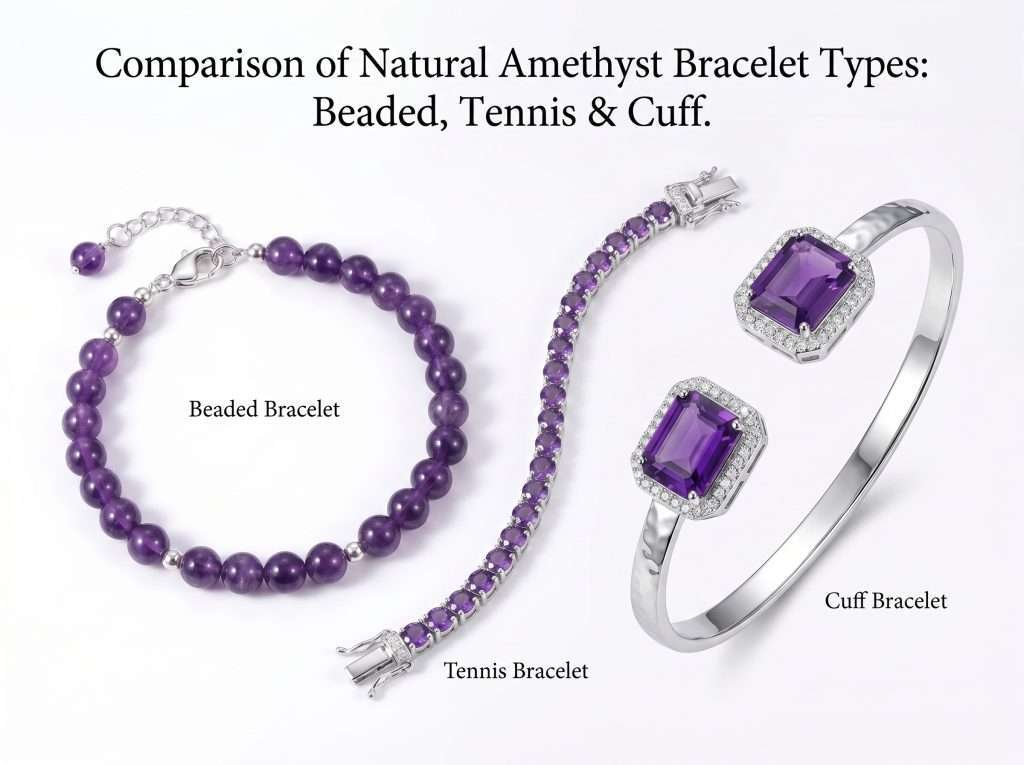
 Amethyst Bracelets
 Amethyst Earrings
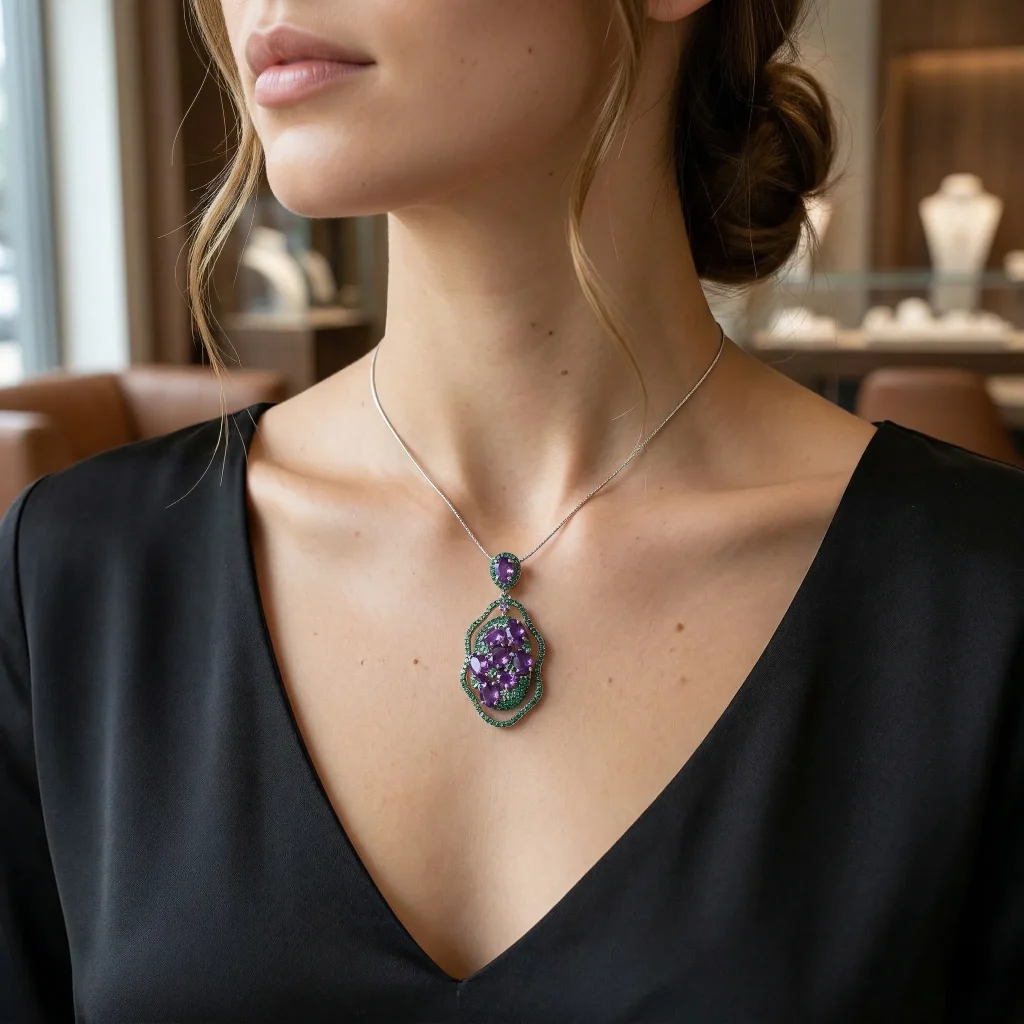
 Amethyst Necklaces
 Amethyst Rings
 amethyst crystal healing
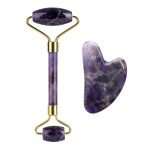 Amethyst Beauty & Wellness
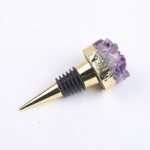 Crystal Home Decor
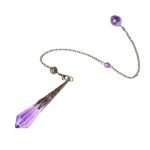 Spiritual & Divination Tools