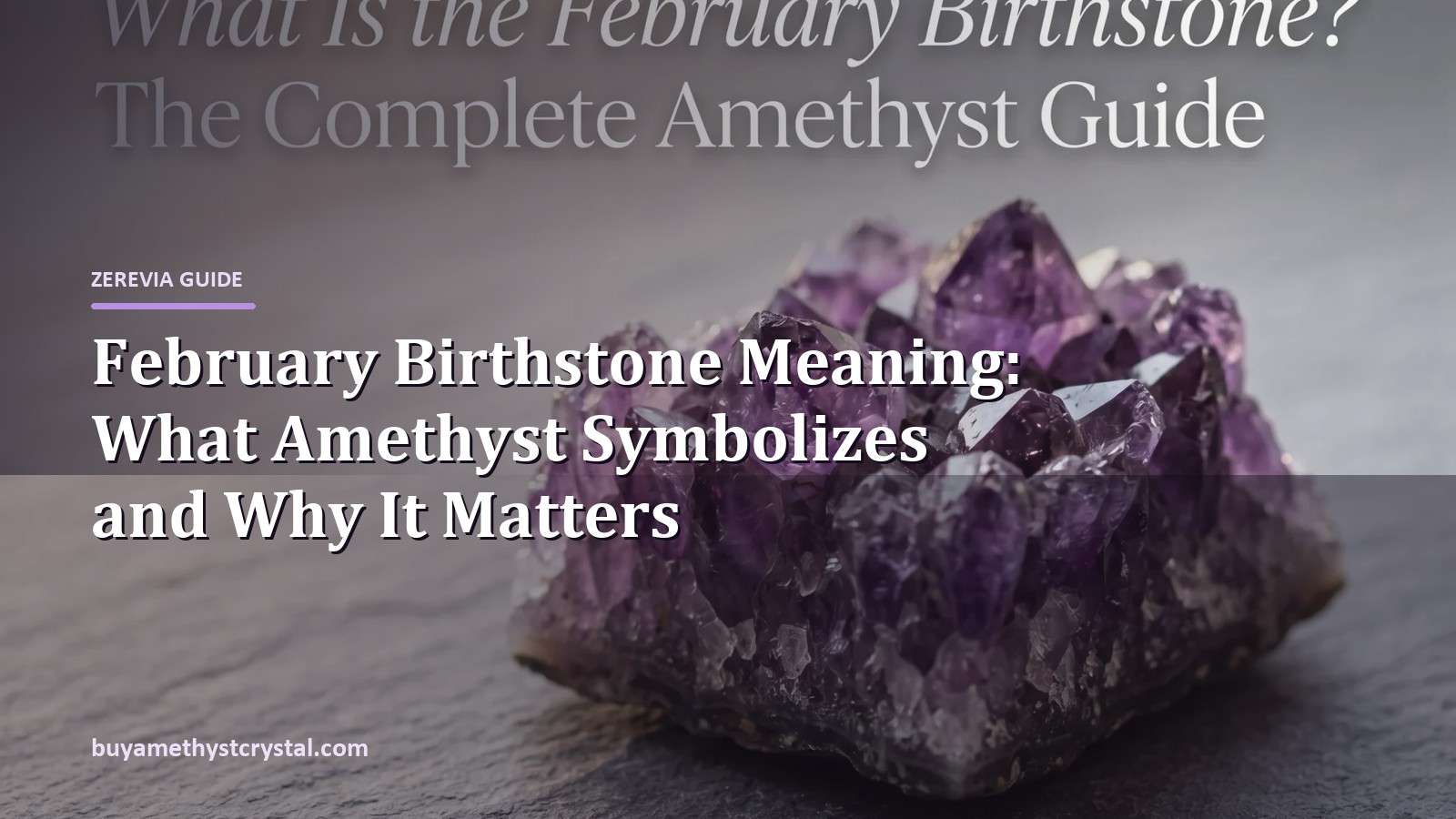
February Birthstone Meaning: What Amethyst Symbolizes and Why It Matters
Every February, a question resurfaces with reliable regularity: what is the meaning of the February birthstone? The answer is amethyst — a violet variety of quartz (SiO₂, Mohs hardness 7) that has carried symbolic weight for roughly two thousand years. The February birthstone meaning centers on clarity, composure, and a kind of grounded steadiness that has nothing to do with escapism. If you are choosing a February birthstone gift or looking for a stone that fits a personal milestone, understanding what amethyst actually represents — and where that meaning comes from — will help you make a more honest choice.
Before we go further: if you want a broader look at how people use amethyst in daily life, our guide to amethyst healing properties and traditional uses covers ritual practices, buyer experience, and practical care in more detail.
What Is the Meaning of the February Birthstone?
Amethyst is the official February birthstone, recognized by gemological organizations including the Gemological Institute of America and the American Gem Trade Association. The name itself comes from the Greek amethystos, traditionally translated as “not intoxicated” — a reference to the ancient belief that wearing the stone could help a person stay clear-headed during decision-making or social drinking.
That Greek origin gives us the oldest layer of February birthstone amethyst meaning: sobriety in the literal sense, composure in the broader one. Over centuries, the meaning shifted. Medieval Christians associated amethyst with piety and devotion. In the Renaissance, it became connected to contemplative traditions. Today, the meaning of the February birthstone is most often described as personal calm, honest self-reflection, and a kind of quiet groundedness — not a shortcut to peace, but a reminder that steadiness is something you can practice.
For me, the meaning became real only after I understood what the stone actually is. I finished the GIA coursework chapter on color mechanisms one evening and read about Fe³⁺ — trivalent iron ions, sitting inside the quartz crystal lattice, activated by natural radiation over millions of years. There was a real chemical reason why this stone was purple, not because it wanted to be purple. I remember finding that oddly comforting. Not mystical. Just specific.
If you want to dig deeper into how amethyst’s meaning has developed across different traditions and practical contexts, our guide to amethyst meaning and uses covers that in more depth.
February Birthstone Color Meaning: Why Purple Matters
The February birthstone color meaning starts with a geological fact. Amethyst’s purple comes from Fe³⁺ ions trapped inside the quartz structure, altered by natural gamma radiation over geological time. This is not a dye or a treatment. The color grew with the crystal, sometimes over tens of millions of years.
That purple spans a wide range:
| Color Range | Common Source | Traditional Association |
|---|---|---|
| Pale lavender | Often Brazilian material | Gentleness, openness, approachability |
| Medium violet | Both Brazilian and Uruguayan | Composure, balance, reflective calm |
| Deep emperor purple | Predominantly Uruguayan | Introspection, sovereignty, personal authority |
A note on sourcing: Brazilian amethyst tends to come in larger pieces with a wider color distribution, from lavender to mid-purple. Uruguayan crystals are typically smaller but denser, with a deeper, more saturated color that sometimes reaches that near-indigo emperor purple. If you are choosing by color depth — which is one of the most reliable ways to choose — knowing the origin difference helps. Our amethyst quality and value guide goes further into how color, clarity, and origin interact.
Culturally, purple has been linked to royalty since antiquity — partly because Tyrian purple dye was scarce and expensive, partly because the color simply commands a room. In Christian tradition, bishops wore amethyst as a symbol of clear-minded devotion. In modern personal practice, deep purple is often associated with the kind of composure that comes from sitting with something uncomfortable rather than running from it. Lighter lavender, by contrast, tends to be read as a softer, more open quality.
One more detail that matters for buyers: natural color zoning — patches where the purple is deeper in some areas and lighter in others — is not a flaw. It is evidence that the stone formed in the earth over real geological time, with shifting conditions affecting how the Fe³⁺ settled. If a stone looks perfectly uniform in purple throughout, that is worth questioning.
Amethyst Meaning in History and Cultural Tradition
Understanding the February birthstone meaning requires looking at how different eras interpreted the same stone.
Ancient Greece and Rome. The Greeks associated amethyst with Dionysus, the god of wine. The story goes that amethyst could prevent intoxication — a meaning that extended beyond drinking to encompass any situation where a person might lose their composure. Greek and Roman soldiers reportedly carried amethyst for steadiness in battle. Whether or not it “worked,” the tradition reveals what those cultures valued: not the absence of difficulty, but the ability to remain clear inside it.
Medieval Europe. Amethyst became a clergy stone. Bishops wore it in their rings, and it appeared in church decoration, symbolizing piety and sober-minded devotion. The february birthstone meaning during this period was deeply tied to religious sincerity — the idea that the stone’s purple reflected a mind oriented toward clarity rather than indulgence.
Renaissance and chakra traditions. In the contemplative traditions that developed across South Asia and later influenced Western spiritual practice, amethyst became associated with the Ajna (Third Eye) and Sahasrara (Crown) chakras — the energy centers traditionally linked to insight and broader awareness. This connection made amethyst a stone of the forehead, placed there during meditation or reflection.
Formal birthstone adoption. The modern list of birthstones was formalized in 1912 by the National Association of Jewelers, with amethyst assigned to February. The list has been updated since, but amethyst has held its place for over a century.
What strikes me about this history is that the core meaning has stayed remarkably consistent. Whether you call it sobriety, piety, or personal calm, the February birthstone has always been about the same thing: the ability to stay present without getting pulled off course. In a conversation I once had with someone who did not believe in stones at all, I said that I did not know whether amethyst had any mysterious power. But I knew that when I had a real piece of something on my nightstand — something that came from a specific place and had been treated with care — I spent a minute or two looking at it before bed instead of scrolling. That had value to me. He paused. Then he said, “Okay, that I can accept.”
For a fuller look at how amethyst meaning connects to feng shui traditions and environmental placement, see our guide to amethyst in feng shui and history.
February Birthstone Meaning and Astrology
February sits across two zodiac signs, and the February birthstone meaning in astrology shifts depending on which half of the month you are in.
Aquarius (January 20 – February 18). In astrological tradition, amethyst is considered a guardian stone for Aquarius. The association is with intellectual clarity and independent thinking — qualities that align with Aquarius’ air-sign nature. If you are choosing a February birthstone meaning gift for someone born under Aquarius, tradition suggests that amethyst complements their natural orientation toward clear, original thought.
Pisces (February 19 – March 20). For the Pisces half of February, the astrological tradition links amethyst to emotional depth and intuitive awareness. Pisces is a water sign, and amethyst’s traditional association with the Third Eye chakra fits the cultural idea that Pisces energy is perceptive and emotionally attuned.
These astrological connections are cultural and interpretive. They are not scientific claims, and they do not need to be. For many buyers, choosing by zodiac adds a layer of personal meaning to a birthstone gift — an extra reason why this particular stone, given to this particular person, feels right. If astrology is part of how you think about meaning, it is a valid framework for narrowing your choice.
How February Birthstone Meaning Shows Up in Everyday Ritual
The history and symbolism are useful, but meaning becomes real when it enters someone’s daily life. Here is how the February birthstone and meaning connect in practice for real buyers.
The nightstand stone. This is where it started for me. I bought a twelve-dollar amethyst labeled “for calm nights” after a difficult personal transition. It was not an impressive specimen — the color was pale, the matrix was gray, and it looked like it had been sitting in that wooden box for a long time. I put it on my nightstand. That night was the first time in months I slept through without waking at three a.m. That proves nothing. But it was the thing that made me start looking into whether the stone was real, and I never quite stopped.
Many buyers tell us something similar: they place amethyst somewhere visible — a desk, a shelf, a windowsill away from direct sunlight — as a physical anchor. Not a medical treatment. A reminder. A thing that exists in a room where you also exist, and that asks nothing of you.
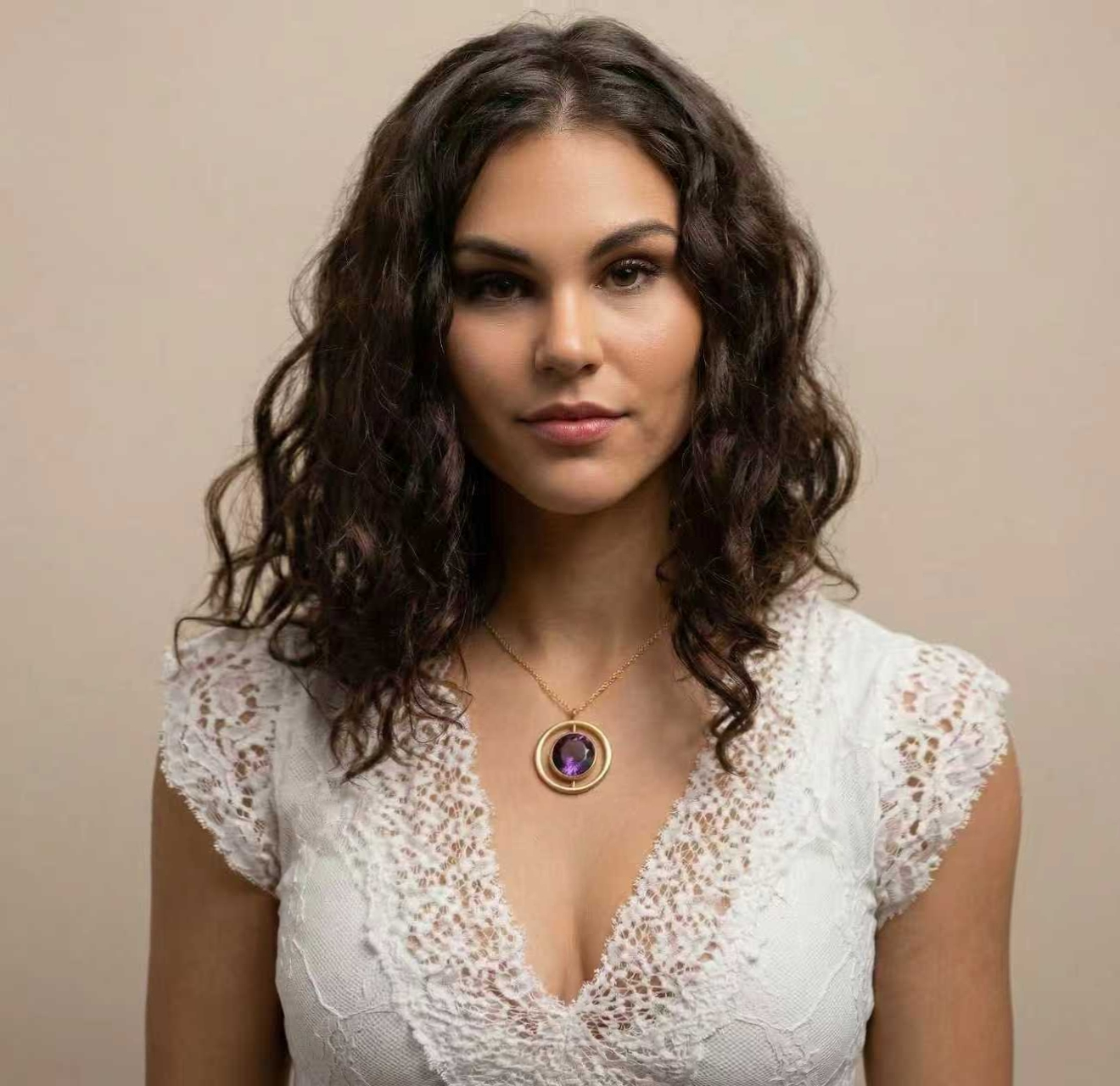
Birthstone jewelry as a daily reference. A necklace, ring, or pair of earrings set with February amethyst becomes a wearable connection to the meaning. For someone born in February, it is a personal symbol. For a gift buyer, it is a way to give something that carries an extra layer of significance — especially for milestone birthdays like a 21st, 30th, or 40th, where the gift is meant to mark a transition.
Intention setting and cleansing. In crystal tradition, some people practice a simple ritual: hold the stone, think about what you want to carry into the day, and place it somewhere deliberate. A moonlight bath — leaving the stone on a windowsill overnight during a full moon — is the most commonly practiced cleansing ritual, and it is the safest for the stone. Direct sunlight, on the other hand, is something to avoid. UV radiation can cause the Fe³⁺ ions to revert, permanently fading the purple. I learned this the hard way when a buyer messaged to say her deep purple crystal tower had turned lavender after a few months on a south-facing windowsill. The color was gone and it was not coming back. I added UV care warnings to every product description that day.
For more on traditional practices and how people use amethyst in daily life, our guide to amethyst healing properties covers ritual use, buyer experience, and care in detail.
Choosing a February Birthstone Gift That Carries Meaning
Once you understand the meaning, the next step is choosing a piece that fits the occasion. Here is a practical framework.
Start with use case.
- Daily jewelry: A ring, pendant, or pair of earrings in 925 sterling silver with 100% natural amethyst. Sterling silver is nickel-free, which means no green fingers and no irritation for most wearers. For rings, look for adjustable sizing if you are not sure of the recipient’s size.
- Home display: A raw crystal, cluster, or geode with documented Brazilian or Uruguayan origin. These pieces are photographed as WYSIWYG — what you see is what you get — so the specific item in the photo is the one you receive. Size, color depth, and natural color zoning will vary piece to piece, and that is part of the point.
- Desk or nightstand stone: A tumbled stone, palm stone, or small crystal tower. Portable, affordable, and easy to place somewhere intentional.
Color depth as a meaning cue. Deeper purple carries more visual weight and, in traditional association, is linked to introspection and composure. Lighter lavender reads as gentler and more open. Neither is better — it depends on what fits the person and the moment.
Care matters. Whatever form you choose, two rules apply: avoid direct sunlight (UV fading is irreversible), and avoid harsh chemicals. For jewelry, a soft cloth is enough for cleaning. For raw specimens, a dry brush. If you want to learn more about the different forms amethyst comes in — from cathedral geodes to crystal slices — our amethyst forms and shapes guide covers each type with its own set of use cases and care notes.
Gift presentation. A birthstone gift often includes a meaning card explaining the February birthstone significance and a gift box. These small additions help the recipient understand that the gift was chosen with intention, not picked at random.
Frequently Asked Questions
What is the meaning of the February birthstone?
The February birthstone is amethyst, a purple quartz whose name comes from the Greek amethystos, meaning “not intoxicated.” Its meaning has evolved from literal sobriety in ancient Greece to personal composure, clarity, and grounded self-reflection in modern tradition. It is not a medical treatment or a guarantee — it is a symbol with two thousand years of cultural weight behind it.
What color is the February birthstone and what does the color mean?
Amethyst ranges from pale lavender to deep emperor purple. The color comes from Fe³⁺ ions in the quartz lattice, activated by natural radiation. Purple has historically been associated with royalty, spiritual awareness, and personal composure. Deeper purple is traditionally linked to introspection; lighter lavender to openness and gentleness.
Is amethyst the only birthstone for February?
Yes. Amethyst is the primary and officially recognized February birthstone. Some modern alternative lists exist, but amethyst has been the standard since the birthstone list was formalized in 1912 and remains the only stone recognized by major gemological organizations for February.
What is the February birthstone meaning for astrology?
February spans Aquarius (January 20 – February 18) and Pisces (February 19 – March 20). In astrological tradition, amethyst is linked to intellectual clarity for Aquarius and emotional depth for Pisces. These are cultural and interpretive associations, not scientific claims — but they add a meaningful layer when choosing a birthstone gift by zodiac sign.
Can I wear amethyst jewelry every day?
Yes. Amethyst has a Mohs hardness of 7, which makes it durable enough for daily wear in rings, necklaces, earrings, and bracelets. Two precautions: avoid direct sunlight (UV can cause irreversible fading) and avoid harsh chemicals. Settings in 925 sterling silver are nickel-free and suitable for most skin types.
Browse our collection of documented-origin amethyst — from raw crystals with WYSIWYG photos to birthstone jewelry set in 925 sterling silver.
 Crystal Cluster
 Crystal Tower
 amethyst crystal ball
 Amethyst Caves for Sale
 Amethyst Bracelets
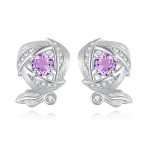 Amethyst Earrings
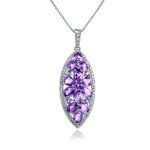 Amethyst Necklaces
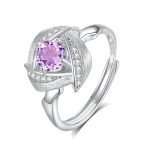 Amethyst Rings
 amethyst crystal healing
 Amethyst Beauty & Wellness
 Crystal Home Decor
 Spiritual & Divination Tools