Where Are Amethysts Found? Amethyst Origins & Geology
The 4-Billion-Year Journey from Lava to Living Room
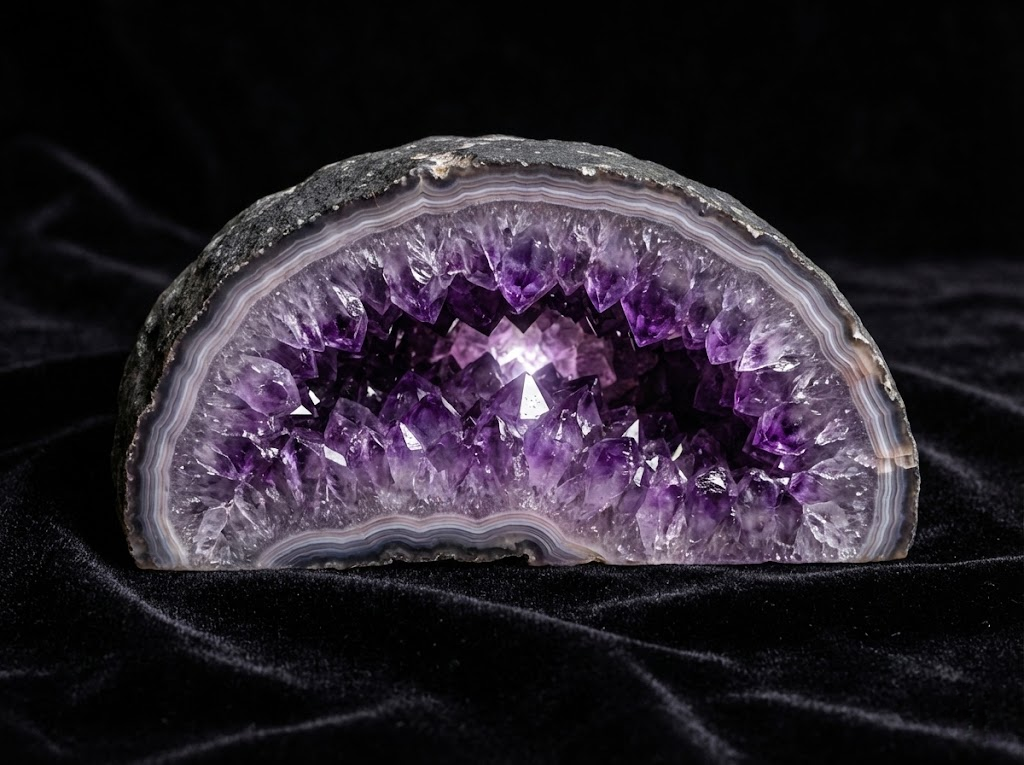
If you have ever wondered where are amethysts found, you are looking at a geological miracle. When you hold a crystal, you are holding a timestamp of Earth’s violent history, preserved in silicon dioxide.
For a crystal to form, a dozen chaotic variables must align. Where does amethyst come from? It is the result of extreme heat, specific pressure, and millions of years of cooling. At Zerevia, we believe amethyst origins are the key to its unique character.
Just as wine from Bordeaux tastes different than wine from Napa Valley, Uruguay amethyst carries a different energy than stones from the red soils of Brazil (learn about quality differences and unique shapes).
1. The Geology of Magic: How Is Amethyst Formed?
The recipe for Amethyst requires fire, water, time, and radiation. Here is the science behind the stone.
The Host Rock: Basalt & Volcanic Origins
The Volcanic Beginning: To understand how is amethyst formed, we must go back 130 million years. Massive lava flows covered South America, eventually hardening into a dark rock called Basalt.
Gas Pockets: The Womb
As thick lava flowed, gas bubbles (CO2 and water vapor) became trapped. Rapid cooling froze these bubbles in time, creating the hollow cavities where amethyst geodes would eventually grow.
Hydrothermal Solution
Over millions of years, mineral-rich groundwater seeped into these pockets. Saturated with dissolved silica, this hydrothermal solution crystallized layer by layer on the cavity walls.
Iron & Gamma Irradiation: The Purple Spark
For quartz to turn purple, trace amounts of Iron (Fe3+) are needed. However, iron alone only creates yellow or orange quartz. The secret to how is a amethyst formed with that deep violet hue is Gamma Irradiation.
2. The Source Titans: Brazilian Amethyst vs. Uruguay Amethyst
90% of the world’s supply comes from South America. But not all amethyst mining sources are created equal.
The Brazil-Uruguay Border (Los Catalanes District)
The massive basalt flow that created the world’s largest deposits straddles the border between Brazil and Uruguay. Slight variations in cooling speed and mineral content resulted in distinct differences between brazilian amethyst and uruguay amethyst.
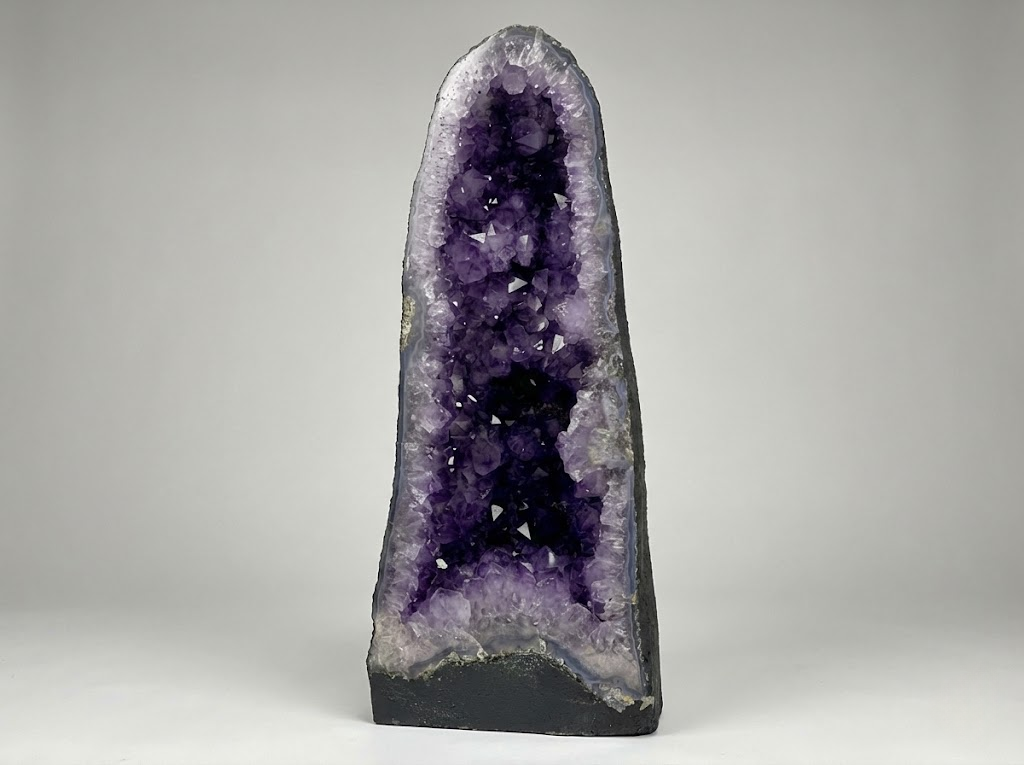
Brazilian Amethyst: The Land of Giants
Primary Source: Rio Grande do Sul.
The Reputation: Undisputed volume king. Brazilian amethyst is the primary source for massive, human-sized Cathedral Geodes.
- Size: Famous for tall, arch-shaped geodes up to 10 feet tall.
- Color: Typically lighter to medium purple with clear quartz roots.
- Value: Excellent value for large home decor statement pieces.
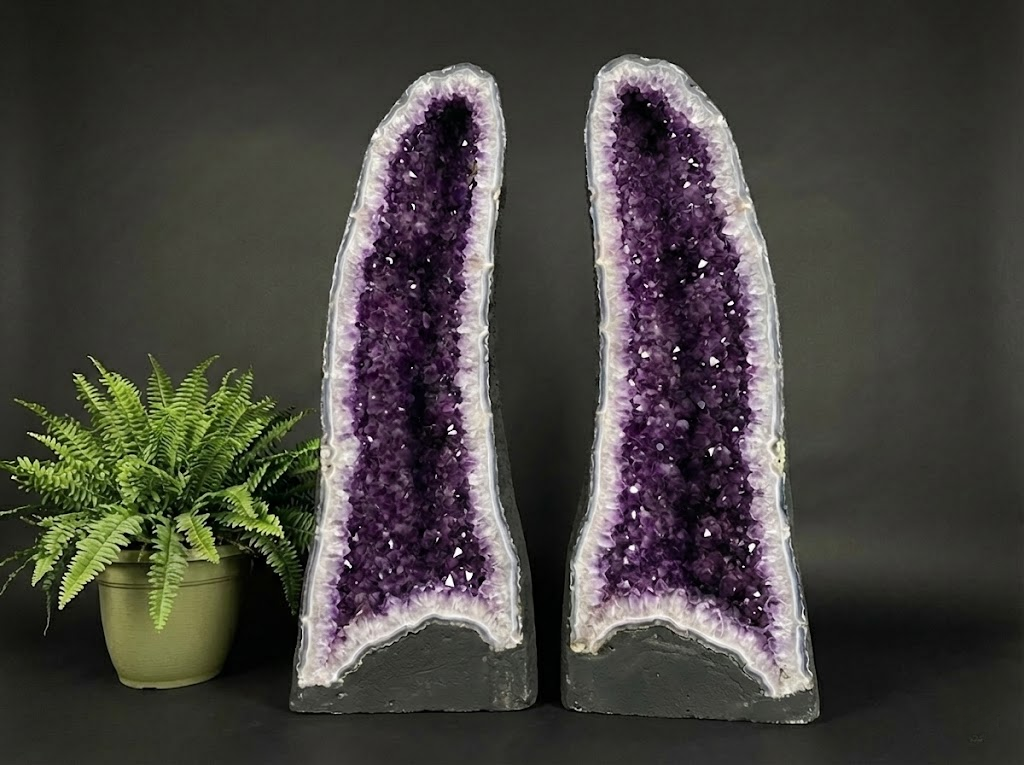
Uruguay Amethyst: The Quality Queen
Primary Source: Artigas.
The Reputation: Prized by collectors for its incredible saturation. Uruguay amethyst is the gold standard for color intensity.
- Color: Famous for “Grape Jelly” purple—a syrupy violet that flashes red.
- Crystal Size: Points are typically smaller but packed densely.
- Value: High extraction difficulty commands a premium price.
3. The Legends: Siberian Amethyst & Vera Cruz Points
Beyond the commercial giants lies a world of rare, collector-grade localities.
Siberian Amethyst (Russia)
The Historic Benchmark: Produce the finest crystals the world has ever seen. While mines are largely exhausted, the term siberian amethyst still describes any stone with deep royal purple and flashes of red fire.
Zambian Amethyst (Africa)
The Clarity King: Zambia amethyst rivals Uruguay for saturation but is found in veins. It produces extremely clear fragments highly sought after for fine jewelry.
Vera Cruz Amethyst (Mexico)
The Laser Wands: Vera Cruz amethyst is famous for long, slender, pale lavender crystals. They are prized for their high-frequency, focused energy and aesthetic beauty.
Four Peaks (Arizona, USA)
The only commercially significant mine in the US. It is rare and known for a unique reddish-purple color that rivals deep siberian amethyst.
Bolivia (Ametrine)
The world’s only natural commercial source of Ametrine. Precise conditions caused iron in some parts to oxidize (turning Citrine) while other parts remained Amethyst.
4. Mineralogy 101: Amethyst Crystal Structure & Hardness
Understanding the physical properties that make Amethyst a perfect stone for the home.
Mohs Hardness 7
On the Mohs Scale, Amethyst ranks at a 7. It is harder than steel and glass, making it a low-maintenance choice for open home decor.
Amethyst Crystal Structure
Like all quartz, the amethyst crystal structure is trigonal. It is also piezoelectric, meaning it generates a small electrical charge under mechanical stress—the scientific foundation for its energetic reputation.
5. Amethyst Mining, Authenticity & The Market
How to spot fakes, treatments, and ethical concerns in the crystal market.
Amethyst Mining & Ethics
Synthetic vs. Real
Heat-Treated Citrine
Much of the “Citrine” on the market is actually low-grade heat treated amethyst. We always label our stones transparently so you know exactly what you are buying.
Honor the Earth’s Masterpiece
Whether it is a brazilian amethyst geode or a vera cruz amethyst point, you are looking at a gemstone forged by volcanoes and colored by radiation. Geology is the biography of the stone.
How Origin Can Affect Color, Crystal Structure, and Value
Origin does not make one amethyst automatically better than another, but it can help you understand color, crystal habit, and display style. If you want a shorter origin overview, read where amethyst comes from before comparing specific pieces.
| Source | Common Visual Clues | Buying Notes |
|---|---|---|
| Brazil | Large geodes, lighter-to-medium violet zoning, open cavities | Good for statement raw amethyst geodes and larger decor pieces |
| Uruguay | Deep purple druzy surfaces and tighter cavities | Often chosen for caves, cathedrals, and compact high-color display pieces |
| Zambia | Strong color in smaller crystals and faceted material | Useful comparison point for jewelry color and clarity |
| Madagascar | Varied tones, clusters, and mixed mineral associations | Judge piece by piece because color and structure vary widely |
For purchase decisions, compare origin with size, condition, and display use in our raw amethyst geodes guide.
 Crystal Cluster
 Crystal Tower
 amethyst crystal ball
 Amethyst Caves for Sale
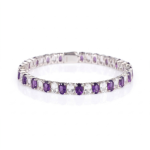 Amethyst Bracelets
 Amethyst Earrings
 Amethyst Necklaces
 Amethyst Rings
 amethyst crystal healing
 Amethyst Beauty & Wellness
 Crystal Home Decor
 Spiritual & Divination Tools