
The Science of Amethyst Crystal: Formation, Chemistry & Color
When you pick up an amethyst, you’re holding something that required a very specific set of conditions to exist—conditions that took millions of years to line up.
Its deep and mysterious purple color is the perfect encounter of silicon, iron, and natural radiation deep within the Earth’s crust under specific time and space conditions. Amethyst is not only a beautiful gemstone but also a crystallization of nature’s exquisite chemical and physical processes. Its unique formation mechanism and chemical properties hold the secrets of Earth’s evolution.
From a mineralogical perspective, amethyst is a purple variety of quartz. Quartz is one of the most common minerals on Earth, with the chemical formula SiO₂ and a Mohs hardness of 7.
However, not all quartz can display its purple allure. What makes amethyst unique is the microscopic drama invisible to the naked eye—a series of precise and stringent conditions must be met simultaneously to give it its distinctive purple hue.
The “Impossible Recipe”: How an Amethyst Crystal Forms
The formation of amethyst is a complex, multi-stage process that requires the precise coordination of four key elements, none of which can be omitted. It’s like an “impossible recipe” concocted by nature.
1. Silicon: The cornerstone of the crystal framework
It all begins with silicon. As the main component of quartz, silicon dioxide (SiO₂) is the foundation for the crystal structure of amethyst. Deep within the Earth, silica-rich magma or hydrothermal fluids serve as the primary environment for quartz crystals. Under specific pressure and temperature conditions, these solutions gradually precipitate silicon atoms, which then arrange themselves in a highly ordered manner around the crystal nucleus, forming a typical hexagonal crystal system.
2. Iron: A key “impurity” causing coloration.
Pure quartz is colorless and transparent (i.e., clear quartz). To make it turn purple, an “impurity” must be introduced—a trace amount of ferric ions ($Fe^{3+}$).
During crystal growth, these iron ions replace the original silicon atoms in the quartz lattice. However, the mere presence of iron is not enough to turn quartz purple; the crystal may instead appear pale yellow or yellowish-green. Iron ions are only a potential “dye”; an “activator” is also needed.
3. Radiation: The activator of purple and the birth of “color centers”
This is the most crucial and wondrous step in the coloring process of amethyst.
Deep underground, amethyst crystals are often encased in surrounding rocks containing radioactive elements, such as granite. These radioactive elements continuously release natural gamma rays. When these gamma rays bombard the quartz crystal containing iron impurities, they strip an electron from the $Fe^{3+}$ ions that have substituted silicon sites, thus oxidizing the $Fe^{3+}$ to unstable tetravalent iron ($Fe^{4+}$).
The stripped electron forms a “color center” in the crystal lattice. It is these color centers that can selectively absorb yellow-green light in the spectrum while reflecting or transmitting the violet light we see.
- Expert Notes: This “color center” mechanism explains why amethyst requires sun protection. Ultraviolet rays provide energy to send electrons back to their original positions, damaging the color centers and causing fading. Read our [Amethyst Care Guide] to learn more about sun protection.
4. Hydrothermal Environment: The nurturing environment for crystal formation.
The formation of amethyst requires a specific hydrothermal environment. This environment typically exists in bubbles or fissures formed after volcanic rocks (such as basalt) cool. Amethyst crystal growth requires a precise temperature range, usually between 50°C and 250°C. “The volcanic basalt formations of Brazil and Uruguay — the source of 90% of the world’s supply — are the perfect example of this process at work. To see how origin shapes color and quality, explore our amethyst geological sources guide.”
- Excessive temperature: If the temperature exceeds 250°C, the unstable color center structure will be destroyed, causing the amethyst to lose its color.
- Low temperature: If the temperature is below 50°C, the crystal growth rate will be extremely slow, and it may even be impossible to form large-sized crystals.
This unique low-temperature hydrothermal condition is the secret behind Uruguayan amethyst’s deep purple hue.
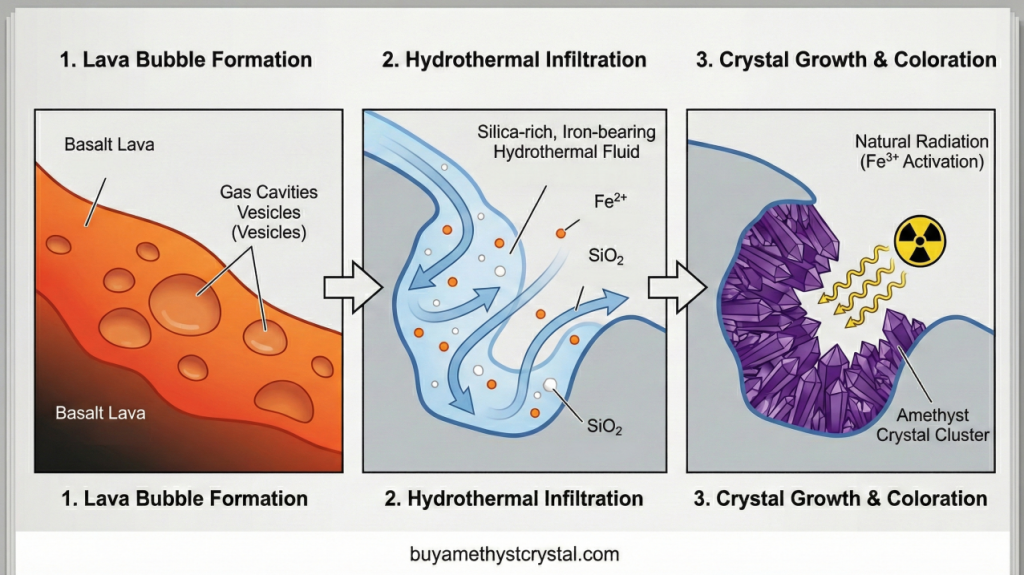
The Birth of Geodes: Nature’s Treasure Chest
One of the most common forms of amethyst is the geode. The formation of geodes is a long and fascinating geological process:
- Volcanic activity and bubble formation: In ancient volcanic eruptions, when lava flows cooled and solidified, they trapped a large amount of gas inside, forming hollow bubbles.
- Hydrothermal infiltration: Over time, hydrothermal fluids rich in silica and trace amounts of iron ions infiltrate into the interior of these bubbles through fissures and micropores in the rock.
- Crystal growth: As the hydrothermal fluid gradually cools inside the bubble, tiny quartz crystals grow from the inner wall of the bubble towards the center. This process can take millions of years, eventually forming spectacular amethyst geodes.
The Threat of “Heat”: Why Does Amethyst Change Color?
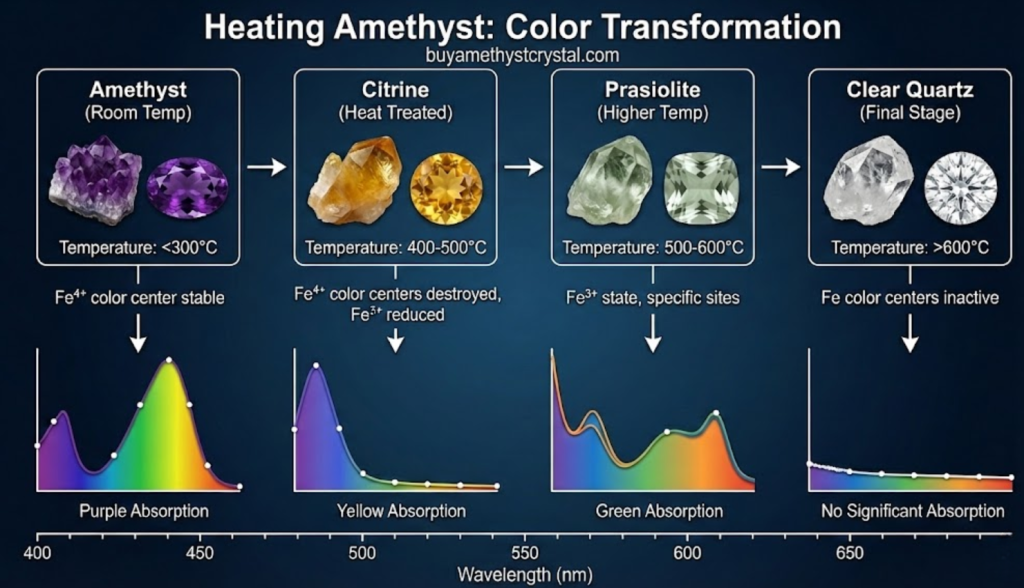
While amethyst’s purple color is beautiful, its color-causing mechanism is relatively fragile. The color centers mentioned earlier are composed of unstable $Fe^{4+}$ ions and electron-hole pairs. This means they are highly sensitive to heat.
Scientific principles
When amethyst is heated to 400-500°C, the electrons that were stripped away by gamma rays return to the positions of the $Fe^{4+}$ ions, reducing them to stable $Fe^{3+}$ ions. The color center structure then disintegrates, the purple absorption spectrum disappears, and the crystal loses its purple color, turning yellow, orange, or even green.
Industry Truth
This is why most “citrine” on the market is actually “heat-treated amethyst” (often nicknamed “baked amethyst”) that has undergone artificial heat treatment. By controlling the heating temperature and time, amethyst can exhibit different hues ranging from light yellow to deep orange.
Understanding this is crucial for collectors and investors. Our guide, [Real vs. Fake Amethyst], details how to distinguish between natural and heat-treated crystals.
Natural vs. Laboratory: A Geological Distinction
With the development of technology, scientists have been able to simulate the formation process of amethyst in the laboratory.
Hydrothermal Synthesis
Laboratory hydrothermal synthesis technology can perfectly replicate the formation conditions of amethyst in nature. In an autoclave, scientists can grow synthetic amethyst crystals of considerable size and uniform color in just a few weeks.
How to distinguish between natural and laboratory-synthetic amethyst?
Despite advanced synthetic techniques, subtle geological differences still exist between natural and laboratory-produced amethyst:
Natural Amethyst
- Imperfections: Often contain natural inclusions (such as gas-liquid inclusions and goethite), which are marks of their natural growth.
- Color Zoning: Uneven color distribution, often with bands or areas of varying shades, is caused by changes in environmental conditions during the growth process.
- Brazil Law Twinning: A common crystal defect that is characterized by “tiger stripes” visible under a polarizing microscope.
Lab-Grown Synthetic Amethyst
- Too perfect: Usually extremely clear with no obvious natural flaws.
- Uniform color: Lacks the color banding characteristic of natural amethyst.
- Growth lines: Under a microscope, regular synthetic growth lines can sometimes be seen.
A collector’s guide: For collectors who value authenticity, these “imperfections” in natural amethyst are precisely the source of its unique charm. They carry the geological stories of millions of years, rather than being products of human manipulation.
Conclusion: The Value of Geological Time
Every piece of natural amethyst crystal is a geological survivor.
It must precisely evade the high-temperature reshaping of the Earth’s crust to avoid overheating and destroying the color center, thus luckily preserving this touch of purple. From silicon-rich hydrothermal fluids to the incorporation of trace iron ions, to the activation by natural radiation, and finally to its slow growth and shaping at a suitable temperature—the birth of amethyst is a grand narrative of countless coincidences and inevitabilities deep within the earth.
This is not just a mineral but a work of art sculpted by time.
Do you want to own a raw amethyst crystal that has not been heat-treated and retains its original geological features?
Explore our [Raw Amethyst Collection], touch the memories of billions of years of Earth’s history, and feel the wonders of nature.
Frequently Asked Questions About Amethyst Science
How does an amethyst crystal get its purple color?
The purple color of an amethyst crystal comes from trace amounts of iron (impurities) within the quartz lattice that have been irradiated by natural radiation from surrounding rocks. This process creates “color centers” that absorb yellow-green light and reflect violet.
What happens if you heat an amethyst crystal?
Amethyst is sensitive to heat. If heated above 300-400°C, the unstable color centers break down, and the purple color fades or transforms into yellow/orange. This is how most commercial “Citrine” on the market is made—it is actually heat-treated amethyst crystal.
Is amethyst a type of quartz?
Yes. Amethyst is the purple variety of the mineral Quartz (Silicon Dioxide, SiO₂). It has the same hardness (7 on the Mohs scale) and crystal structure as Clear Quartz, but differs due to the presence of iron.
How long does it take for an amethyst geode to form?
The formation of a large amethyst crystal geode is a slow geological process that can take millions of years. It begins with gas bubbles trapped in cooling lava, which are later filled by mineral-rich hydrothermal fluids that slowly crystallize into quartz.

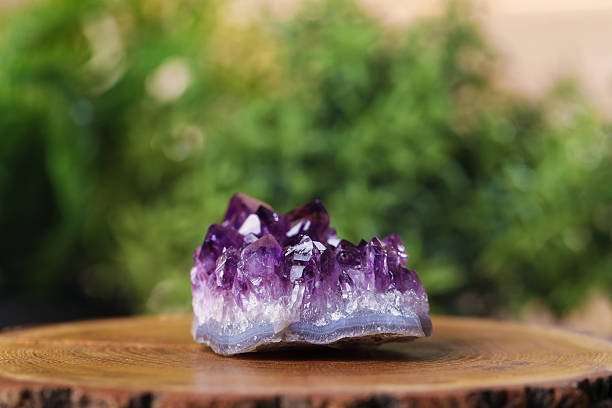

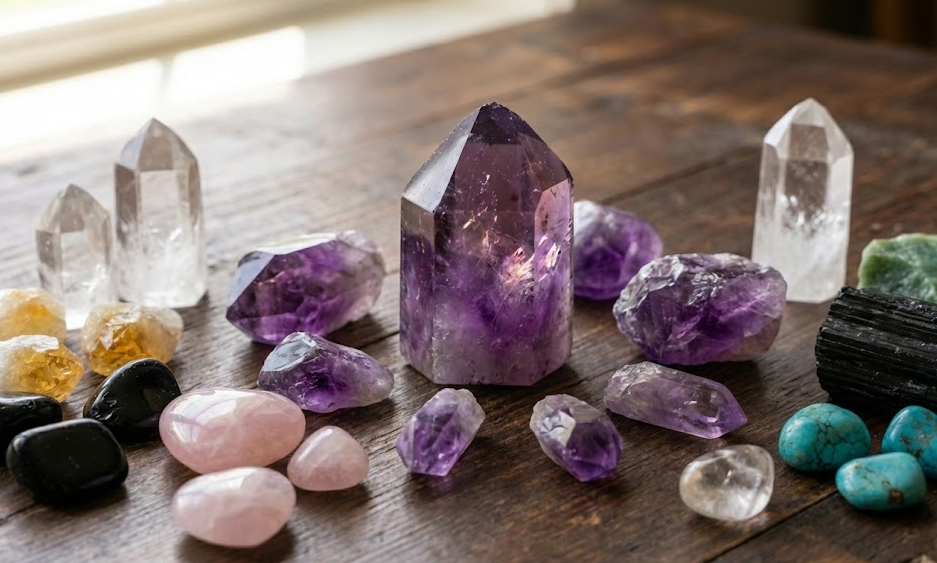
 Crystal Cluster
 Crystal Tower
 amethyst crystal ball
 Amethyst Caves for Sale
 Amethyst Bracelets
 Amethyst Earrings
 Amethyst Necklaces
 Amethyst Rings
 amethyst crystal healing
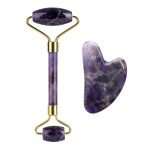 Amethyst Beauty & Wellness
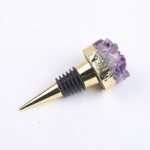 Crystal Home Decor
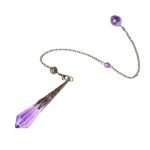 Spiritual & Divination Tools