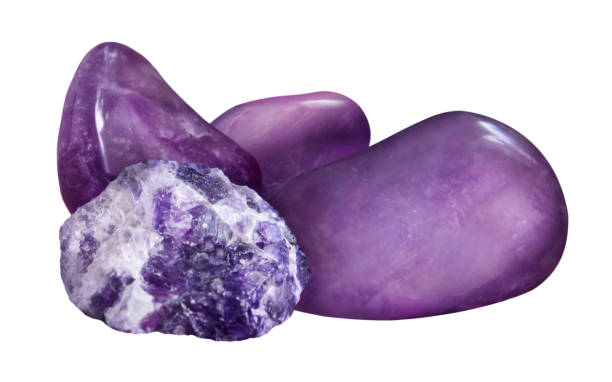
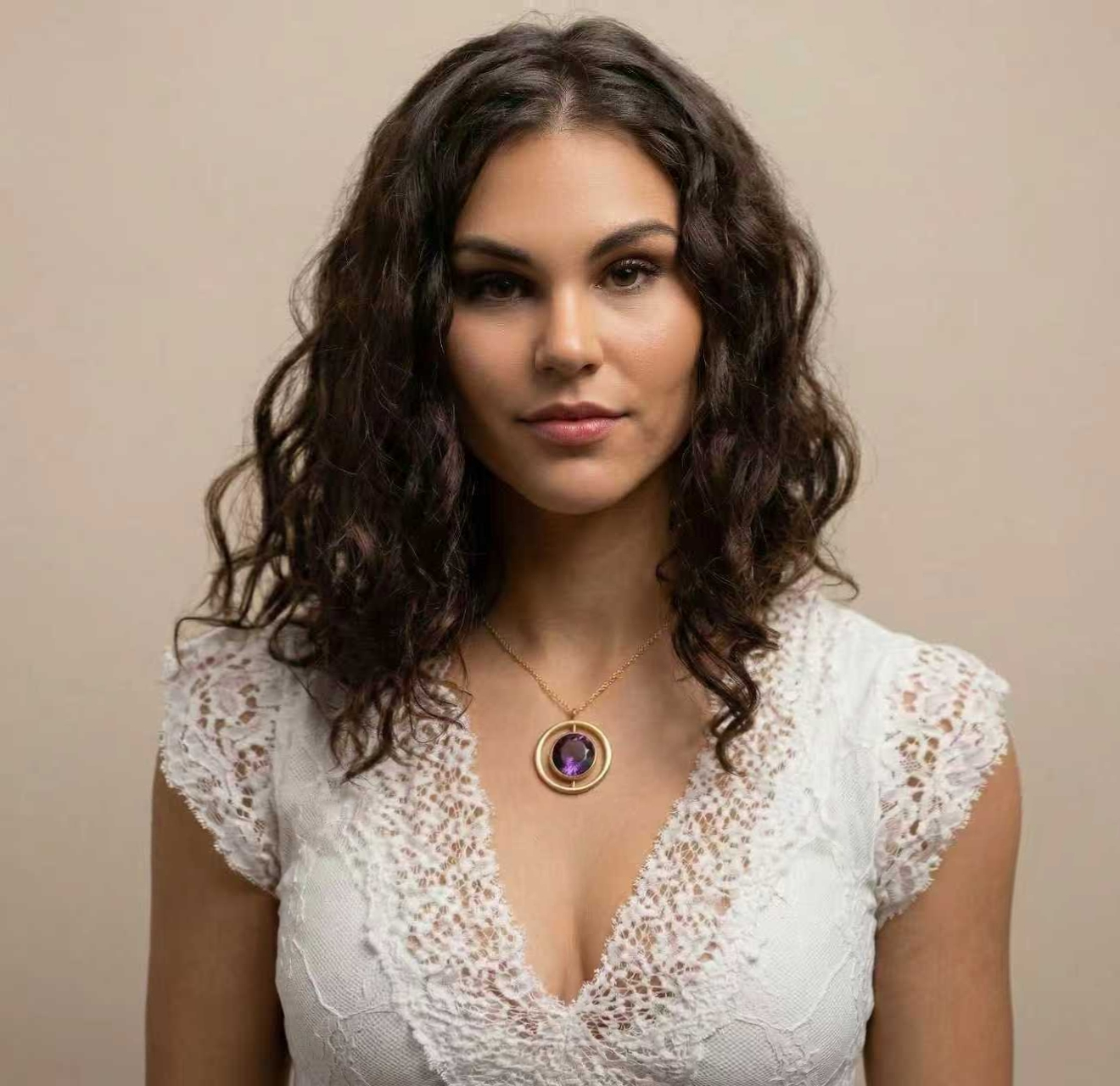
Pick up any two amethyst crystals from the same geode — crystals that grew within centimeters of each other, in the same fluid, at the same time — and they won’t match. Different height, different color depth, different internal structure. Sometimes dramatically different.
I find this genuinely interesting, and I’ve been looking at these stones long enough that I probably shouldn’t still find it surprising. But I do.
Here’s what’s actually happening inside the rock.
Today, we will delve into the microscopic world to explore what geological forces have shaped the unique destiny of each piece of amethyst crystal.
Family Positioning: A Unique Identity Found at the Macro Level
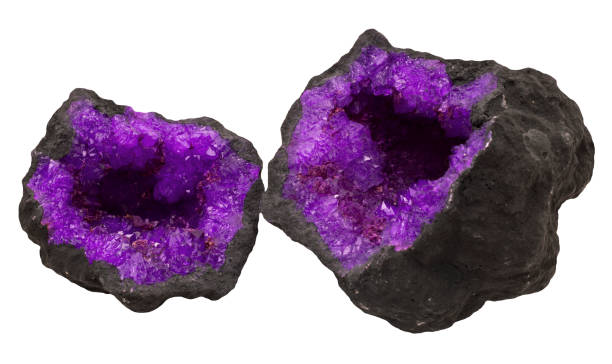
To understand why every piece of amethyst looks different, we must first clarify its mineralogical coordinates.
Amethyst crystal is essentially silicon dioxide (SiO₂). Within the vast family of quartz, there is an important dividing line: phanerocrystalline and cryptocrystalline.
Cryptocrystalline: such as agate or chalcedony, their crystals are extremely small and cannot be distinguished by the naked eye. They usually exhibit a layered or massive structure and appear relatively “uniform.”
Macrocrystalline: Amethyst belongs to this category. This means that its crystal structure is large enough to form visible, individual geometric shapes—usually beautiful hexagonal prisms.
Because it is macrocrystalline quartz, each crystal is an independently grown individual. Just as every tree in a forest has its own way of spreading its branches and leaves, each amethyst crystal forms its own unique shape in the process of competing for space and nutrients.
A breeding ground for chaos: the uncertainty of the growth environment
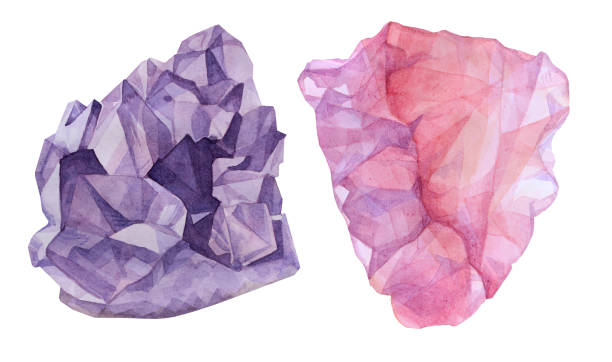
Textbook diagrams make crystal growth look orderly. It isn’t. Deep in the Earth’s crust, the conditions that produce amethyst are closer to controlled chaos — and that chaos is exactly why no two stones come out the same.
Amethyst crystals typically form in silica-rich hydrothermal fluids that fill bubbles or fissures in volcanic rock. Imagine it as a pressure cooker full of variables:
There is no thermostat: the temperature of the geothermal fluid is never constant. Even a slight fluctuation in temperature will change the crystallization rate. This fluctuating growth rate directly leads to differences in the appearance and shape of the crystals—some are as thin as needles, while others are as thick as pillars.
The battle for space: Within a confined geode, thousands of crystal buds begin to grow simultaneously. They engage in a fierce “fight” for living space. The winner possesses a complete six-sided tip, while the loser may be distorted in shape or grow together with other crystals.
Chemical Cocktail: The coloring agents of amethyst are iron impurities and natural gamma irradiation. The iron content in geological fluids is uneven, and the distance of the radiation source is also random.
The instability is the point. Each stone is essentially a record of the specific conditions it grew through — temperature shifts, competition for space, whatever iron happened to be present that week, geologically speaking.
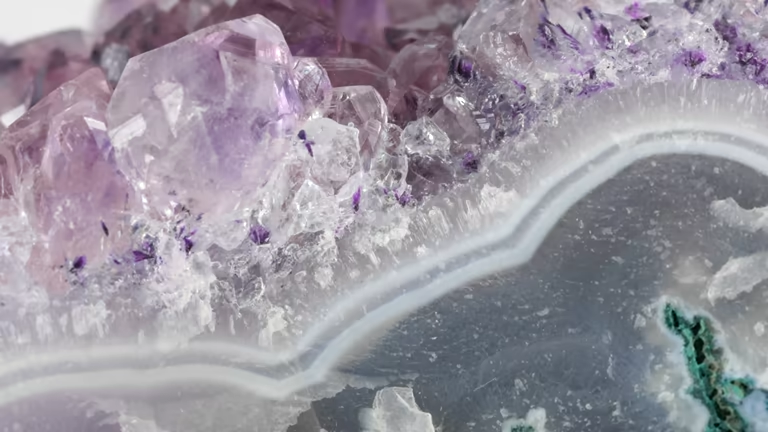
Internal fingerprints: color bands and inclusions
If the external shape is constrained by physical space, then the internal structure is the DNA of an amethyst crystal.
When you examine a crystal with a magnifying glass, you’ll find that the interior is often more fascinating than the surface. These so-called “flaws” are, in the eyes of geologists, key evidence for identifying the crystal.
1. Ghostly Color Zoning
As we mentioned earlier, the purple color of amethyst comes from the process of iron ions ($Fe^{3+}$) being converted into ($Fe^{4+}$) by radiation. Due to changes in hydrothermal concentration during growth, the amount of iron absorbed by the crystal varies at different stages. This results in color bands of varying shades, usually distributed parallel to the crystal facets.
Some amethyst crystals have clear, sharp color banding, while others spread out like an ink wash painting. This random distribution of chemical composition ensures that even two gemstones cut from the same rough stone will have distinctly different color distributions.
2. Frozen History (Inclusions)
During the long growth cycle, other minerals in the surrounding environment (such as goethite, hematite, or rutile) may accidentally fall onto the growing crystal face and then be encased by subsequent layers of silica.
These captured foreign objects form the unique internal landscape of each amethyst crystal. Some resemble stars, others hair. They are irreplaceable time capsules, preserving geological moments from hundreds of millions of years ago.
Experts point out that this internal unevenness is the biggest difference between natural minerals and synthetic crystals. Laboratory-grown crystals are usually grown under constant conditions and are often so clean that they “appear fake due to being too perfect.”
Why is this difference a value rather than a defect?
In traditional business thinking, people once blindly pursued “purity and flawlessness.” But in modern mineral aesthetics, gemstone individuality is the true luxury.
When you hold an amethyst crystal in your hand, you are holding a frozen, unrepeatable piece of time and space.
That cloud-like, cotton-like substance may be evidence of a change in the flow rate of groundwater at some point.
That tiny gap is likely a remnant of a minor tectonic tremor millions of years ago.
That uneven, deep purple hue is the result of a chance encounter between radiation and iron.
Because no two pieces are exactly alike, each natural amethyst is like an independent personality waiting to be interpreted. This is something I had to unlearn from years of looking at gemstone grading systems — the instinct to rank everything on a cleanliness scale. A crystal with unusual color zoning or an interesting inclusion isn’t a lesser stone. It’s a more specific one.
When I’m looking at a piece for the shop, the ones I keep coming back to aren’t usually the cleanest. They’re the ones where something is happening inside — a color shift, a veil, a needle inclusion catching the light at a particular angle. Those are the pieces that are hardest to put down.
If that’s what you’re looking for, the raw collection is where to start. Every piece is photographed as-is — inclusions, color variation, and all.
Conclusion
What makes amethyst interesting isn’t scarcity in the diamond sense, or status value. It’s that you genuinely cannot predict what you’re going to find inside one until you look.
Nature has no molds; it only has laws and probabilities. Each piece of amethyst is a survivor born from a series of almost impossible coincidences. Understanding this, the next time you see cracks or color variations inside a crystal, you’ll start reading them differently — not as flaws, but as the actual record of how the stone got here.
FAQ: Frequently Asked Questions about Amethyst Crystal
1. Since each piece of amethyst crystal is different, how can we determine its quality?
Uniqueness and quality aren’t the same thing, but they’re not opposites either. Color saturation matters — deeper, more saturated stones hold their value better, and the closer the color gets to what the trade calls ‘Siberian,’ the more it’s worth. But a stone with unusual internal structure, interesting inclusions, or a distinctive color pattern has its own kind of value that doesn’t show up on a grading scale. It depends on what you’re collecting for.
2. Why does my amethyst crystal look uneven in color?
This is one of the characteristics of natural amethyst crystal, known as “color zoning.” As the concentration of iron and temperature in the geological fluids change during crystal growth, the color deposits exhibit a layered distribution. This inhomogeneity is strong evidence of its natural formation, distinguishing it from the dull, uniform color of synthetic glass or imitations.
3. What is the relationship between heat-treated citrine and amethyst?
Heat-treated citrine is an amethyst crystal that has undergone a transformation. When amethyst is heated to above 450°C, the valence state of the iron ions within its crystal lattice changes, and its color changes from purple to orange-yellow. Although its chemical composition remains silicon dioxide, this artificial intervention alters its natural properties. Amethyst that retains its original purple color and natural internal texture better showcases the mineral’s original beauty.
 Crystal Cluster
 Crystal Tower
 amethyst crystal ball
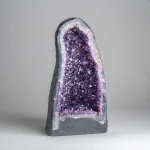 Amethyst Caves for Sale
 Amethyst Bracelets
 Amethyst Earrings
 Amethyst Necklaces
 Amethyst Rings
 amethyst crystal healing
 Amethyst Beauty & Wellness
 Crystal Home Decor
 Spiritual & Divination Tools