

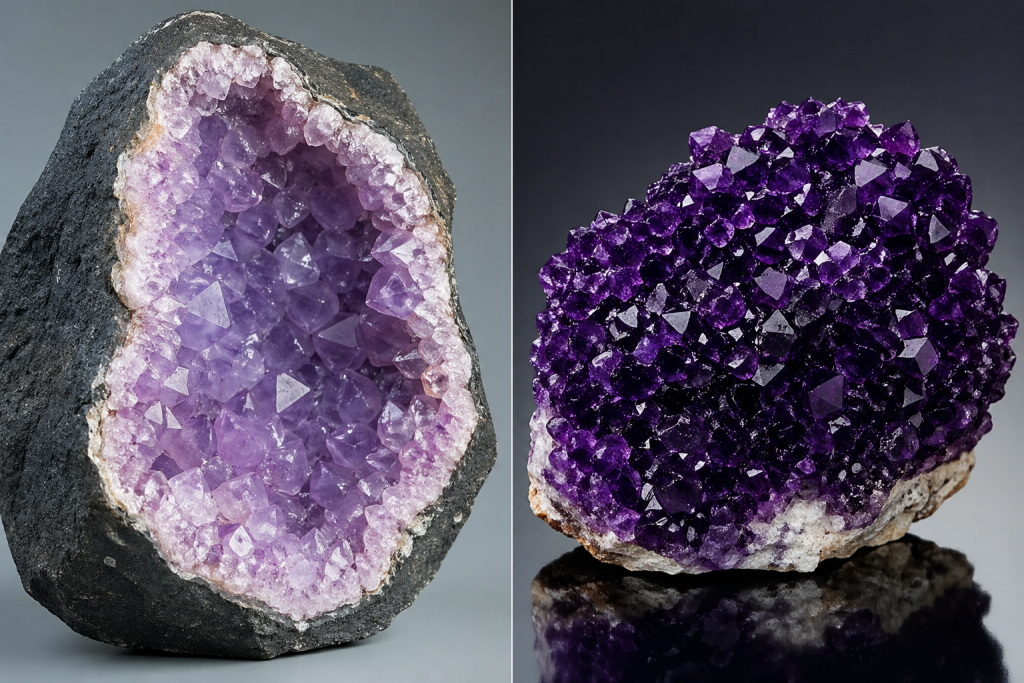
Amethyst comes from quartz-rich volcanic and hydrothermal environments around the world. Major commercial sources include Brazil, Uruguay, Zambia, and Madagascar, with Brazil and Uruguay especially known for geodes, caves, and crystal clusters. For a deeper comparison of amethyst origins, use the geological sources guide.
| Origin | Often Noted For | Buyer Takeaway |
|---|---|---|
| Brazil | Larger geodes and broad color zoning | Good for raw display pieces and larger decor |
| Uruguay | Deep purple druzy caves and compact geodes | Good for high-color caves and cathedrals |
| Zambia | Strong purple in smaller crystals | Useful for comparing jewelry-grade color |
After sourcing amethyst from suppliers across two continents, one thing becomes clear: most buyers ask where amethyst comes from out of curiosity. The more useful question is what that origin tells you about the stone you’re about to bring home.
This guide covers both.
How Amethyst Forms Inside Volcanic Rock
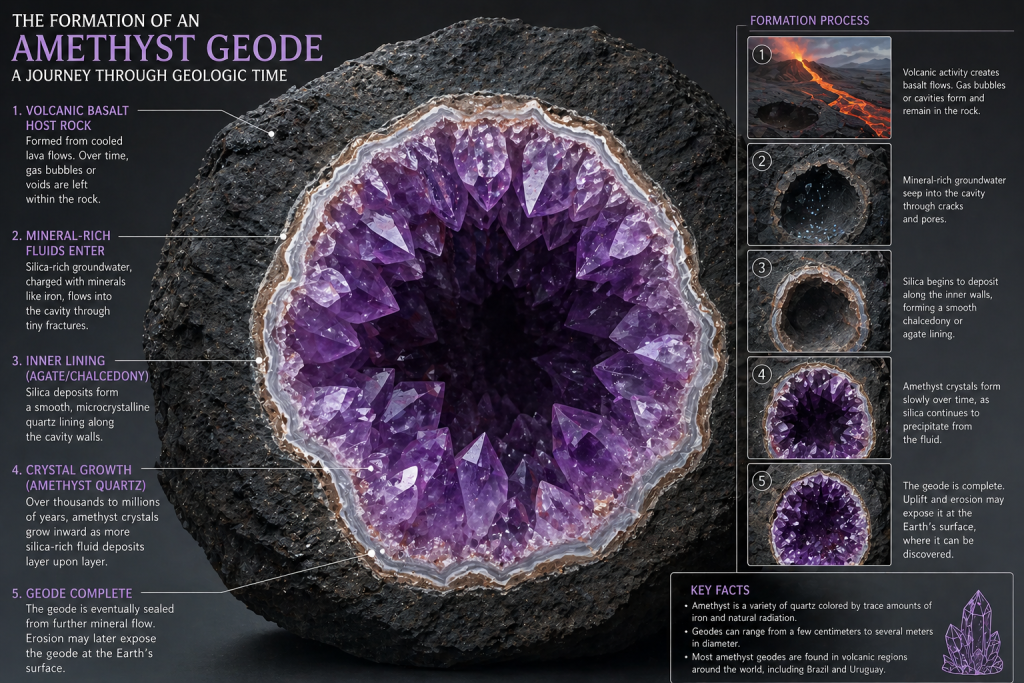
Amethyst doesn’t grow in the ground the way most people picture. It forms inside cavities — gas bubbles that were trapped in ancient lava flows millions of years ago. As the rock cooled, silica-rich water moved through those cavities and slowly crystallized into quartz. The purple color came from iron impurities (Fe³⁺) activated by natural radiation over geological time.
That’s why amethyst is so often found inside geodes: the hollow cavity is literally the space where a gas bubble used to be. The dramatic interior you see — walls covered in pointed crystals — is the result of the right minerals arriving at the right moment, in the right concentration, over an enormous span of time.
The color isn’t added. It grows in. (To understand what natural saturation looks like, read more on what color depth actually indicates.)
The World’s Major Amethyst Mining Regions
Amethyst occurs on every continent. But “occurs everywhere” and “commercially significant” are different things. The regions that matter for most buyers — especially those looking at geodes, clusters, and cut gemstones — are a short list.
Brazil supplies the majority of the world’s commercial amethyst. Uruguay produces far less, but at a consistently deeper color. Zambia is the third major player, known for smaller crystals with excellent clarity and saturation. Historical sources — Russia’s Ural Mountains, Sri Lanka, India — were once the benchmark for quality, but their commercial significance has largely faded.
For US buyers purchasing decorative geodes or 925 silver jewelry with natural amethyst, the conversation almost always comes back to Brazil and Uruguay.
Brazil: Where Most of the World’s Amethyst Comes From
The southern Brazilian state of Rio Grande do Sul — specifically the municipality of Ametista do Sul — is the closest thing to a ground zero for global amethyst supply. The region sits on ancient basalt flows from the Triassic and Jurassic periods, and those basalt layers are riddled with amethyst-bearing geode cavities.
Brazil produces amethyst across a wide color spectrum: from pale lavender to mid-purple, with occasional deeper specimens. The sheer volume of production makes Brazilian amethyst the most accessible in terms of price, and the most variable in terms of quality. A buyer can find anything from a $40 entry-level geode to a museum-quality specimen from the same general region. For buyers who want size — a statement piece for a bookshelf or living room — Brazil is where most of that inventory starts.
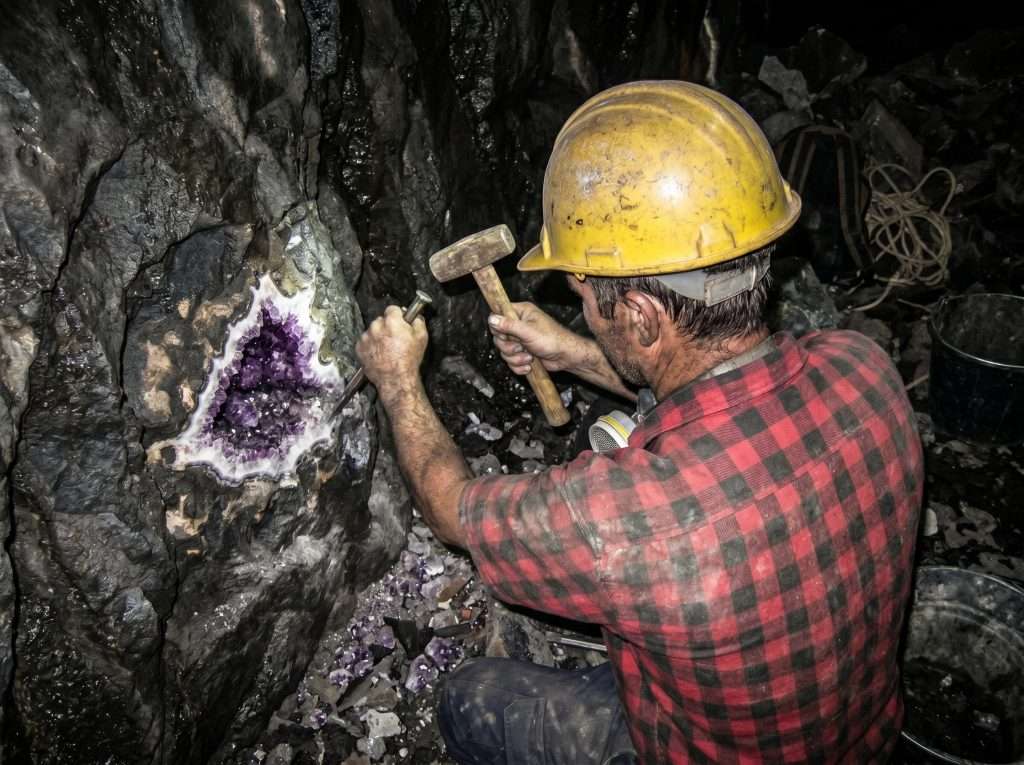
When my supplier in Ametista do Sul recently sent over a raw video straight from the mine, I ended up re-watching it three times. The footage was shaky and grainy, lit only by the headlamps inside the tunnel. You could see a worker carefully chipping away at a massive basalt wall, revealing a completely intact, cavernous geode cavity taller than he was. Suddenly, he shouted something in Portuguese—I couldn’t understand the words, but the sheer excitement in his voice was universal. That’s the reality of sourcing Brazilian amethyst geodes: the scale of these discoveries is genuinely staggering.
Uruguay: Smaller Supply, Deeper Color
Uruguay produces a fraction of what Brazil does. The tradeoff is color.
Uruguayan amethyst — primarily from deposits in the country’s western regions — tends toward what the trade calls “deep Siberian” saturation: a rich, almost blue-tinged purple that holds even under artificial light. The crystals themselves are finer and more densely packed than typical Brazilian specimens.
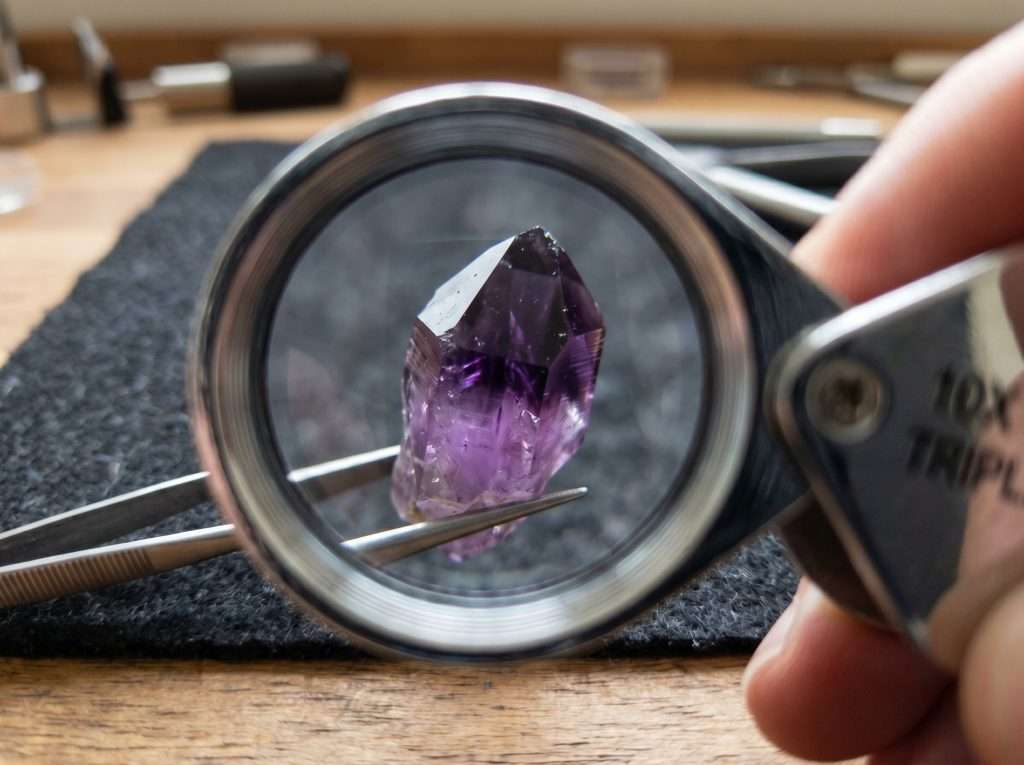
I remember placing two clusters side-by-side on my sorting table to show a client the difference. Under the exact same bright overhead lighting, the center of the Uruguayan piece held a dense, almost velvety deep purple, whereas the edges of the Brazilian piece had already started to look washed out and grayish. During my first major negotiation with a Uruguayan supplier, I brought out my 10x loupe and set strict baselines: the color depth could be no lighter than medium purple, even at the crystal bases.
The premium for Uruguayan amethyst — typically 30% to 80% above comparable Brazilian pieces — reflects this scarcity. It’s not marketing. It’s supply. (Learn more about why Uruguayan amethyst commands a premium.)
When I’m helping a buyer choose between the two, I usually start with one question: do you want a larger visual presence, or a deeper color in a smaller footprint? The answer almost always points clearly to one region over the other.

Zambia and Other Notable Sources
Zambia is the world’s third-largest amethyst producer, accounting for roughly 1,000 tons annually. Zambian stones are typically smaller than Brazilian or Uruguayan geode material, but the clarity and color saturation of Zambian faceted amethyst can rival anything in the market. The country is Zambia’s second-largest gemstone export after emerald.
For decorative geodes and raw clusters — the kind of amethyst Zerevia carries — Zambian material is less common in US retail. Where it appears most often is in cut gemstones: rings, pendants, earrings where the quality of the faceted stone matters more than the drama of an intact cavity.
Other regions worth knowing: Arizona’s Four Peaks mine produces small quantities of deep reddish-purple amethyst that commands significant premiums among collectors. Russia’s Ural Mountains — once the source of the finest amethyst in the world, prized by Russian royalty and referenced in trade names like “Siberian” and “Uralian” — now produce commercially negligible quantities. The name lives on as a quality descriptor; the source largely doesn’t.
Why Amethyst’s Origin Affects What You Receive
Origin isn’t just geography. It’s a shorthand for a set of characteristics that will affect the stone sitting on your shelf or around your wrist.
Brazilian amethyst, at its best, offers size and drama at an accessible price. At its worst, it’s pale, gray-tinted material dressed up in vague language. Uruguayan amethyst is more consistently deep in color — but “Uruguayan” on a label doesn’t automatically mean exceptional; it just means the starting point is better.
The honest version of origin disclosure looks like this: not just “Brazil” or “Uruguay,” but sourced from an established wholesale partner in a specific region, with enough of a relationship to ask questions and get real answers back.
In my own sourcing for Zerevia, ‘good enough’ isn’t a standard. During supplier negotiations, I outline specific acceptance criteria: color saturation cannot drop below a medium purple even under harsh LED lighting, there must be no tell-tale fractures indicating heavy heat treatment (which I verify under a loupe), and I require an individual photo and exact weight for every single piece. That level of scrutiny is what filters out the pale, commercially generic material before it ever reaches our inventory.
How to Know Where Your Amethyst Actually Came From
A legitimate seller should be able to answer a simple question: where is this from?
Not “South America.” Not “natural mining regions.” A real answer sounds like: Rio Grande do Sul, Brazil — or the western amethyst belt in Uruguay.
If a seller can’t or won’t get specific, that’s information. It doesn’t necessarily mean the stone is fake, but it does mean the supply chain isn’t transparent enough for the seller to know — or they’ve decided you don’t need to know.
A few questions worth asking before you buy:
- Is this Brazilian or Uruguayan? (For geodes, this matters most for color expectations.)
- Has it been heat-treated? (Natural amethyst can be heated to alter color; the result may look similar but will behave differently over time. Be sure to avoid direct sunlight to protect natural color.)
- Do you have an individual photo of this specific piece? (For raw stones, a stock photo tells you almost nothing about what you’ll receive.)
At Zerevia, every raw amethyst geode is sourced from established wholesale partners in Ametista do Sul, Brazil and Uruguay. Every piece is individually photographed before it ships. The origin is in the listing — not because it’s a marketing point, but because it’s the minimum information a buyer needs to make a real decision.
If you’re ready to see what’s currently available, our amethyst geode collection is the place to start.
Frequently Asked Questions About Amethyst Origins
Where is the highest quality amethyst found?
The highest quality amethyst for deep color saturation is generally found in Uruguay and Zambia. However, if “high quality” means large, structurally dramatic geode formations, Brazil (specifically Rio Grande do Sul) is considered the premier global source. The “best” origin depends entirely on whether you prioritize color depth or physical size.
Is African amethyst better than Brazilian amethyst?
Yes, in terms of average color saturation and clarity. African amethyst (primarily from Zambia) typically features a much deeper, richer purple than the average Brazilian stone. However, Brazilian amethyst is “better” if you are looking for large raw clusters and geodes, as African deposits rarely produce massive geode cavities.
Does an amethyst’s origin affect whether it will fade?
No, origin does not determine how fast amethyst fades. All natural amethyst—whether it comes from Brazil, Uruguay, or Zambia—gets its purple color from iron impurities interacting with natural radiation. All natural amethyst will eventually fade if left in direct, prolonged sunlight. This vulnerability is tied to the quartz mineral’s chemistry, not its geography.
Can you find amethyst in the United States?
Yes, you can find natural amethyst in the US. The most famous commercial deposit is the Four Peaks Mine in Arizona, known for deep reddish-purple stones. Rockhounds can also find amethyst in public digging sites across states like Colorado, North Carolina, and Georgia, though these are typically small, isolated crystals rather than large Brazilian-style geodes.
About this article Written by Serena Delaney, Founder of Zerevia · GIA Gemology Graduate. Content is based on hands-on specimen assessment, GIA gemology coursework, direct supplier sourcing, and questions collected from our customers. Where conclusions are based on personal observation rather than third-party testing, this is noted in the text. Last reviewed: April 2026
 Crystal Cluster
 Crystal Tower
 amethyst crystal ball
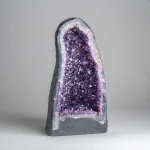 Amethyst Caves for Sale
 Amethyst Bracelets
 Amethyst Earrings
 Amethyst Necklaces
 Amethyst Rings
 amethyst crystal healing
 Amethyst Beauty & Wellness
 Crystal Home Decor
 Spiritual & Divination Tools