
Zerevia · Amethyst Origin Guide
Brazil vs Uruguay Amethyst: How to Choose by Color, Size, and Use Case
Two countries, one mineral, very different results. Here is a grounded comparison of Brazilian and Uruguayan amethyst — covering color depth, crystal size, price logic, and which origin actually fits what you need.
When someone asks me about Brazil vs Uruguay amethyst, I usually start with one question: do you want something big, or something deeply purple? That framing has saved more buyers confusion than any grading chart ever could. The answer is not about one origin being better than the other — it is about understanding what each deposit does well, and then matching that to your space, your budget, and the kind of stone that will actually hold your attention.
Where Each Amethyst Comes From — And Why That Matters
Brazil and Uruguay are not just marketing labels stuck on the same kind of stone. They are distinct geological deposits that produce physically different crystals, and understanding why goes a long way toward making a confident purchase.
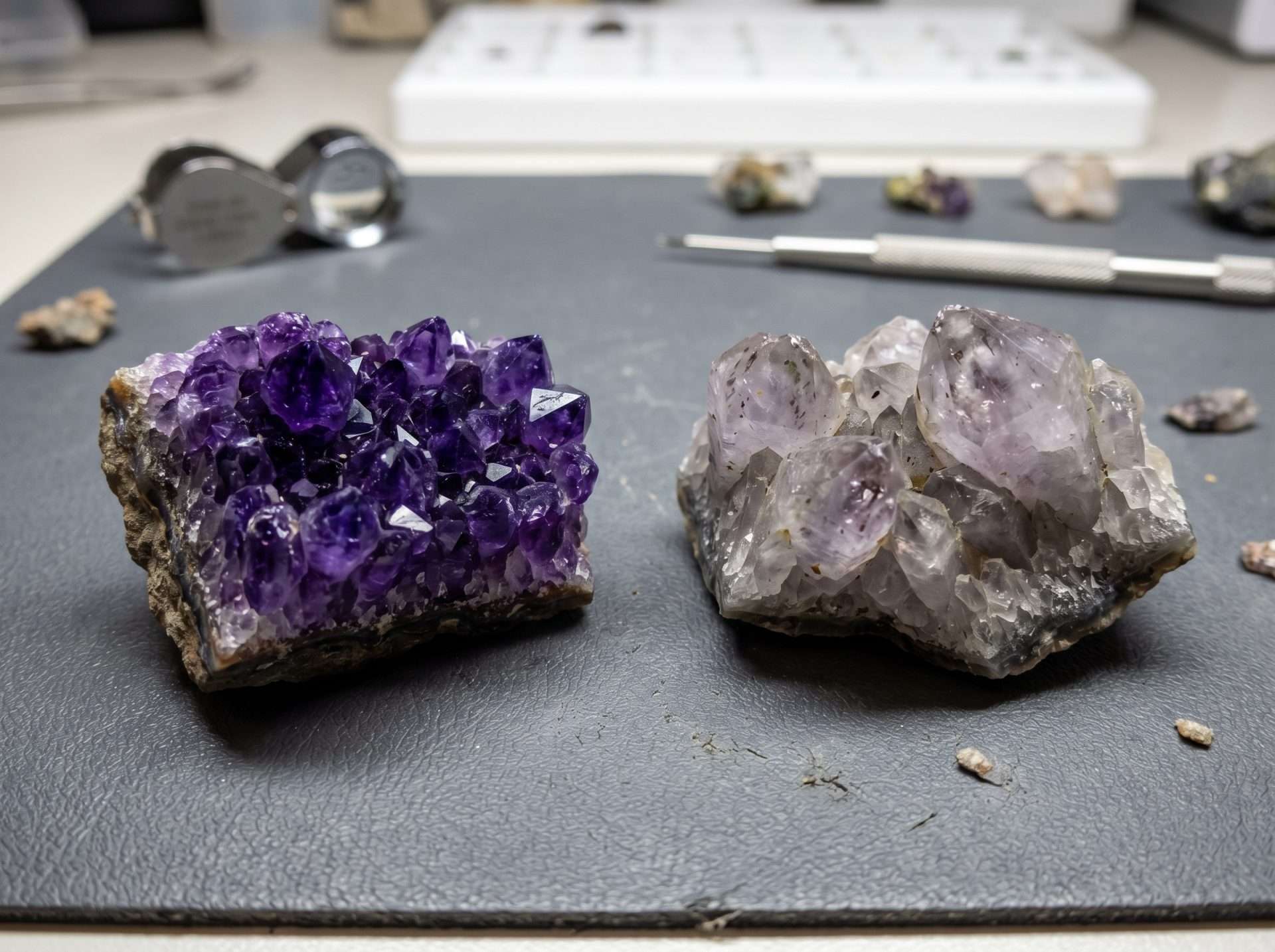
Brazil — especially the Ametista do Sul region in Rio Grande do Sul — is the world’s largest amethyst producer by volume. The geodes there form inside basalt cavities that can grow enormous, which is why most of the oversized cathedral geodes and room-sized statement pieces you see come from Brazilian mines. The basalt gives the crystals room to spread out, and the result is large individual points with visible terminations and a color range that runs from soft lilac all the way through to medium-deep purple.
Uruguay — specifically the Artigas department, which sits right near the Brazilian border — produces fewer geodes but with a different character entirely. The cavities are smaller, the growth conditions tighter, and the iron concentration higher. Crystals form slowly in compact spaces, packing together into dense, fine-grained formations. This is why Uruguayan amethyst tends toward that deep, saturated purple that collectors gravitate toward.
Both origins produce the same mineral: natural SiO₂ — silicon dioxide — with Fe³⁺ (triple-charged iron ions) sitting in the quartz crystal lattice. Natural background radiation activates those iron centers and produces the purple color. Same chemistry, different formation conditions. The geological context explains the tradeoff that defines each origin: size for Brazil, color density for Uruguay.
Color Depth: The Most Visible Difference
Color is usually the first thing buyers notice, and it is the dimension where Brazilian and Uruguayan amethyst diverge most clearly.
I learned this the first time I asked a vendor about it at a mineral show. I was pointing at a geode that ran from my shoulder to my elbow, asking if it was Brazilian or Uruguayan. The vendor — a man in his fifties with calloused hands and twenty years of selling — spent twenty minutes walking me through the differences. “You see this color depth?” he said, tapping a smaller geode next to the big one. “That’s Uruguayan. Put them side by side and you’ll see it in two seconds.” He was right. The Brazilian piece was impressive in scale, lavender to medium purple with white matrix visible at the base. The Uruguayan piece was half the size, but the purple went so deep it nearly turned black at the center, with crystal tips that caught the light like glass.
That contrast — size versus intensity — is the core of the Brazil amethyst vs Uruguay question.
A note on emperor purple: it is a color descriptor, not a certified grade. There is no international gemological standard that assigns an emperor purple designation the way diamond grading works. When a seller uses the term, they are describing a visual quality — deep, saturated, sometimes with a bluish undertone — that is most commonly associated with stones from Uruguay or historically from Siberia. It is useful as a shorthand, but it does not replace looking at the actual stone.
Color zoning — the uneven distribution of purple within a crystal — is natural in both origins. If every square centimeter of a stone is exactly the same shade of purple, that is worth questioning. Natural amethyst grows unevenly, and the variation is part of how you know it is real. For a fuller picture of how color relates to value, our amethyst quality and value guide covers grading language in detail.
Size, Shape, and Crystal Structure
The size difference between these two origins is not subtle. If you have ever stood in front of both at a mineral show, you know what I mean.
If you want a geode that anchors an entire room — the kind of piece that guests notice from across the living room — you are almost certainly looking at Brazilian amethyst. The basalt cavities in southern Brazil produce cathedral geodes that can reach museum-scale dimensions, and the mining infrastructure there supports extracting and shipping those large pieces.
If you want a piece that rewards close inspection — something you can hold in both hands and see every crystal point, every shade of purple — Uruguayan amethyst tends to deliver more in a smaller package. The crystal density means that even a 15 cm geode half can feel substantial and detailed.
Matching the form to your intended use matters as much as choosing the right origin. Our amethyst forms and shapes guide walks through geodes, clusters, towers, spheres, and tumbled stones with practical placement advice for each.
Price Expectations and Value Positioning
Price is where the Brazil vs Uruguay amethyst comparison gets practical — and where buyers sometimes get confused by labels that do not match what they actually see.
Brazilian amethyst is generally more affordable per gram. Higher mining volume, larger average crystal size, and a well-established export infrastructure all contribute to lower baseline prices. You can find a visually striking Brazilian geode for a fraction of what a comparable-size Uruguayan piece would cost.
Uruguayan amethyst commands higher prices for three reasons: smaller production volume, higher collector demand, and the relative rarity of that deep emperor purple color. A 15 cm Brazilian geode in medium purple will typically cost less than a 15 cm Uruguayan geode in deep, saturated purple — and the price gap reflects color intensity and sourcing scarcity, not a quality hierarchy.
Here is the framing I use: value is not the same as price. If you need visual impact across a large space, a Brazilian geode gives you more coverage per dollar. If you want something compact with color that stops you mid-step, a Uruguayan piece is where that experience lives.
When I started asking sellers “Brazilian or Uruguayan?” at mineral shows, half of them looked at me differently afterward. The question itself separates sellers who know their supply chain from those who just label everything “natural amethyst” and move on. A seller who can name the region their stone comes from is a seller worth talking to.
That experience — learning to ask about origin — is one I wrote about in my notes after my first few shows. The vendor who spent twenty minutes explaining crystal density to me did not have to do that. But he recognized that I was asking real questions, and that changed the conversation. The same principle applies when you are buying online: documented origin from a seller who can specify the region is more useful than the word “natural” alone.
Which Origin Fits Which Use Case
This is the section where the Brazil vs Uruguay amethyst comparison becomes a decision you can actually make. Use the list below as a starting point, then think about your specific space, budget, and what you want the stone to do in your home.
- Large room decor, entryway statement, or feng shui wealth corner placement: Brazilian geodes or cathedral pieces. The size creates the visual anchor that these spaces need.
- Desk, nightstand, meditation shelf, or small altar: Uruguayan geode halves or clusters. Compact form, deep color, enough visual density to hold your attention without dominating the surface.
- Collector shelf or display case where you want to see every crystal detail: Uruguayan specimens. Emperor purple, fine crystal structure, and the kind of density that rewards a loupe.
- Gifts where budget matters — birthdays, housewarmings, February birthstone occasions: Brazilian tumbled stones, small clusters, or compact geodes. Accessible pricing, natural variation, and enough size range to fit different gift budgets.
- Wall-mounted art or decorative slices: Both origins produce slices, but larger-format slices are more commonly Brazilian due to the production volume.
One thing worth remembering: the shape you choose matters as much as the origin. A geode behaves differently on a shelf than a tower or a sphere. If you are not sure which form fits your space, start with the use case and work backward to the shape, then to the origin.
Care Is the Same for Both Origins
There is a quiet assumption I hear sometimes: that deeper-colored stones must be more resistant to fading. They are not. The iron-related color centers inside quartz respond to UV light the same way whether the stone came from Ametista do Sul or Artigas. Deeper color may make fading less noticeable at first, but prolonged sunlight will damage either origin irreversibly.
I learned this the hard way — or rather, one of my early buyers did. She messaged me about a crystal point that had lost its color. When I asked about placement, it turned out she had set it on a south-facing windowsill with two hours of direct afternoon sun every day. The deep purple had shifted to a pale lavender. The stone was still real quartz, still natural, but that specific color was gone and it was not coming back.
After that, I added UV care warnings to every product page. It is a small thing, but it prevents the kind of disappointment that makes people think their stone was fake when it was simply in the wrong spot.
Safe care practices for both origins:
- Keep away from prolonged direct sunlight — a window with afternoon sun is the most common risk
- Safe cleansing methods: moonlight overnight, sound bath with a singing bowl, or gentle smoke — these do not affect the color
- Avoid salt water and prolonged sun-based “charging” — these can damage the surface or accelerate fading
- Store in a cool, shaded spot when not on display
Origin documentation helps with care, too. When you know where your stone was mined, you can make more realistic decisions about placement and handling. For the full rundown on cleansing rituals and daily care, see our amethyst care and cleansing guide.
Frequently Asked Questions
Choosing with Confidence
The Brazil vs Uruguay amethyst question does not have a single right answer. It has a framework: what color do you want, how big does it need to be, what is your budget, and where will it live in your home? Once you know those four things, the origin usually narrows itself.
Browse Zerevia’s documented-origin amethyst collection — each piece photographed individually, with origin, weight, dimensions, and care details included.
 Crystal Cluster
 Crystal Tower
 amethyst crystal ball
 Amethyst Caves for Sale
 Amethyst Bracelets
 Amethyst Earrings
 Amethyst Necklaces
 Amethyst Rings
 amethyst crystal healing
 Amethyst Beauty & Wellness
 Crystal Home Decor
 Spiritual & Divination Tools