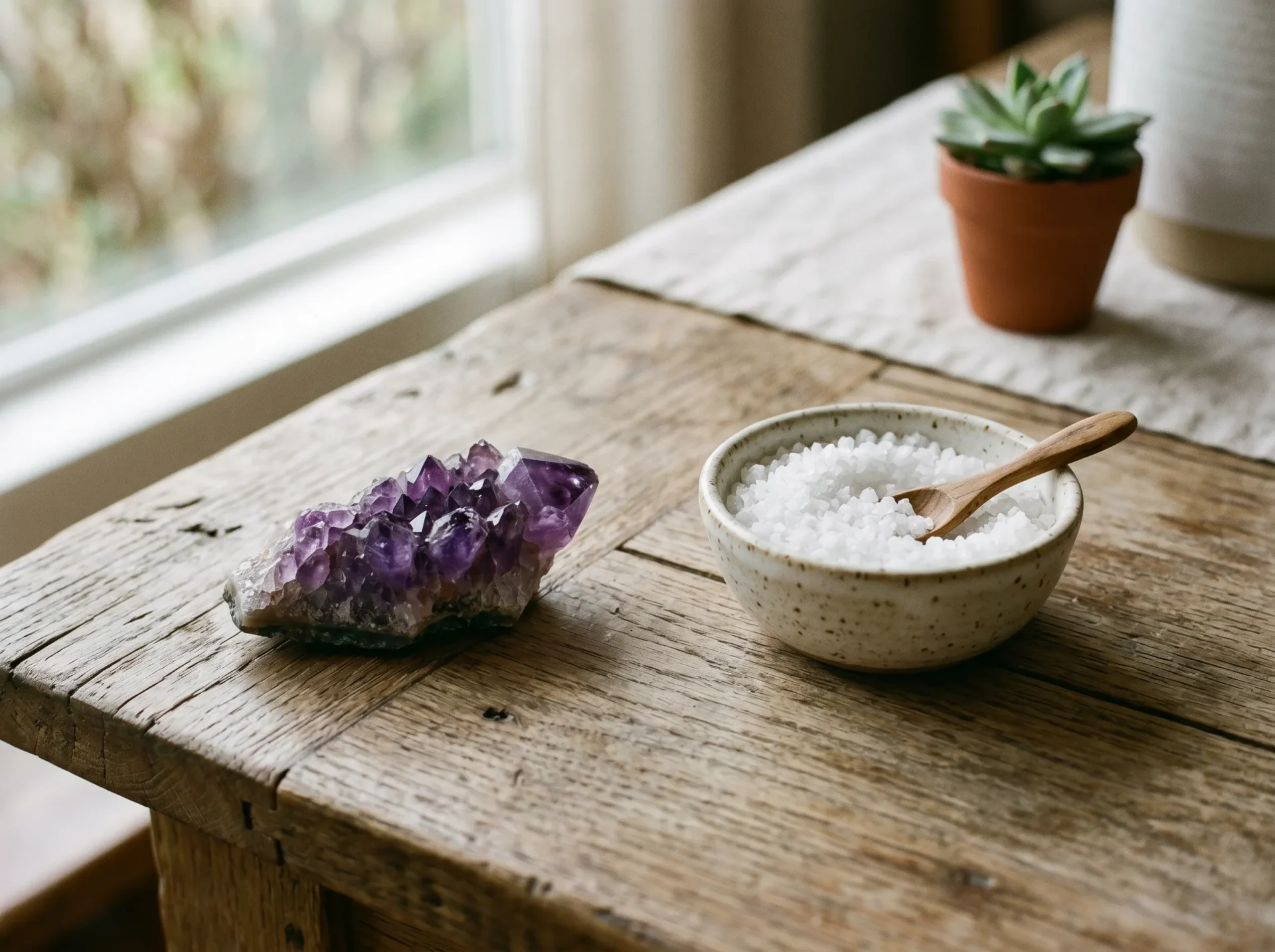

Crystal care guide
How to Charge Amethyst Crystals: 5 Simple Methods for Your Crystal Ritual
A step-by-step guide to charging amethyst with moonlight, sound, intention, and more — without damaging the stone or confusing it with cleansing.
If you’ve been searching for how to charge amethyst, you’re probably past the point of just wanting something purple on your shelf. You want to do right by the stone — whatever that means to you. That instinct is worth honoring, and it starts with understanding what charging actually is in crystal tradition, and how it differs from cleansing your amethyst.
Below, you’ll find five methods used in crystal practice, each with clear steps and honest notes on what works for which crystal forms. None of these are medical prescriptions. They’re rituals — personal practices that many people find meaningful.
Charging vs. Cleansing: Why the Difference Matters
These two terms get used interchangeably online, but in crystal tradition they describe different steps.
- Cleansing means clearing or removing accumulated residual energy from a crystal — think of it as washing the glass before pouring new water.
- Charging means restoring or setting a crystal’s intended focus after it has been cleansed — like filling that clean glass with exactly what you want in it.
Most practitioners who follow traditional crystal practice do both, in order: cleanse first, then charge. If you haven’t cleansed your amethyst yet, start with our full guide to amethyst cleansing and care before working through the methods below.
Method 1: Charging Amethyst with Moonlight
Charging amethyst by moonlight is the most widely recommended method in crystal tradition, and for good reason: it’s gentle, it’s accessible, and unlike sunlight, moonlight carries no UV fading risk. The purple color in amethyst comes from iron (Fe³⁺) in the quartz crystal structure, and sustained UV exposure can reduce that iron and permanently lighten the color. Moonlight doesn’t do that.
I learned this the hard way — not with my own stone, but with a buyer’s. She had placed a deep purple crystal point on her south-facing windowsill for what she called “charging.” Two hours of direct afternoon sun every day for a few weeks, and that emperor purple had turned to lavender. The crystal was still real, still amethyst, still beautiful in its own way. But that particular depth of color was gone, and no ritual could bring it back.
Moonlight avoids that entirely.
Steps for charging amethyst with moonlight
- Cleanse your amethyst first (smoke, sound, or a brief rinse — see our cleansing guide for options).
- Hold the stone and set your intention — even a simple thought like “I’d like this stone to support calm evenings” counts.
- Place the amethyst on a windowsill that receives moonlight, or outdoors in a safe spot if you prefer. A full moon is the most common timing in tradition, but any moonlit night works.
- Leave it overnight.
- Retrieve it in the morning before strong sunlight hits the spot.
Method 2: Charging Amethyst with Sound
Sound baths — using singing bowls, tuning forks, or bells — are a common approach in crystal practice for both cleansing and charging. The idea, in tradition, is that sound vibrations can reset and refocus the crystal’s energy. Whether or not you subscribe to the mechanism, there’s a practical advantage: you can charge several crystals at once this way.
If you have a collection that includes different amethyst forms and shapes — tumbled stones, a tower, a small cluster — sound charging lets you work with all of them in a single session.
Steps for charging amethyst with sound
- Cleanse your crystals first.
- Arrange them on a flat surface near your singing bowl, tuning fork, or bell. They don’t need to touch it — within a foot or so works.
- Play the bowl (or ring the bell) steadily for 5 to 10 minutes.
- As the sound plays, state your intention aloud or hold it clearly in your mind. Some people find that saying it out loud helps anchor the moment.
- Let the sound fade naturally. Your crystals are charged.
I find this method works well when you want the ritual to feel ceremonial without being complicated. No tools to bury, no moon to track — just a bowl, a mallet, and a few quiet minutes.
Method 3: Charging Amethyst with Intention Setting
Intention setting is the most accessible amethyst charging method because it requires nothing but your attention. No bowl, no moon schedule, no outdoor space. In crystal tradition, this is considered the core of every charging practice — moonlight and sound are supportive, but intention is the active ingredient, so to speak.
I had a conversation once with someone who asked me, point-blank: “Do you really think the stone does anything?” I told him the honest answer — that I didn’t know whether the stone had measurable energy, but that having a piece of documented-origin amethyst on my nightstand meant I spent one or two quiet minutes looking at it before bed instead of scrolling. He said, “Okay, I can accept that.” That’s the level of honesty I think this practice deserves.
Intention setting works the same way. It’s not about the stone performing magic. It’s about you being specific and deliberate.
Steps for charging amethyst with intention
- Cleanse your amethyst first.
- Hold the stone in both hands. Close your eyes.
- Take a few slow breaths. Let your mind settle.
- State your intention — silently or aloud. Be specific. “I want to feel grounded when I wear this” works better than a vague “good vibes.”
- Hold the stone for 3 to 5 minutes, keeping your focus on that intention.
- Open your eyes. Place the stone where you’ll use or wear it.
This method pairs naturally with any of the others. Many practitioners set an intention while placing their amethyst in moonlight or on a sound bath. It adds a personal layer to the physical method.
If you’re curious about the deeper traditions around what amethyst is believed to represent, our guide to amethyst meaning and uses covers the history without the hype.
Method 4: Charging Amethyst on a Selenite or Quartz Cluster
In crystal tradition, certain stones — particularly selenite and large quartz clusters — are used as charging stations. The idea is that these stones are believed to continuously radiate cleansing and energizing energy, so placing smaller crystals on or beside them passively charges them over time.
Practically, this is one of the most convenient methods. You set it and forget it.
Steps for charging on a selenite or quartz station
- Cleanse your amethyst first (selenite is often said to self-cleanse, but your amethyst still benefits from an initial clear).
- Place the amethyst on top of a selenite slab, or beside a large quartz cluster. Small tumbled stones, palm stones, crystal towers, and jewelry pieces all work well with this method.
- Leave for several hours or overnight.
- Retrieve and set your intention if you’d like an additional personal layer.
This method blends cleansing and charging in practice, which is why some practitioners rely on it as their primary routine. If you’re deciding which crystal forms to invest in for your setup, our amethyst forms and shapes guide walks through what works best for different uses.
Method 5: Charging Amethyst with Earth or Water
These are among the oldest methods in crystal tradition — returning the stone to the elements it came from.
Earth burial
The traditional practice is simple: wrap your amethyst in a natural cloth (cotton or linen), bury it shallowly in clean soil, and leave it for 24 to 48 hours. The belief is that returning the stone to earth restores its natural state and grounds any accumulated energy.
Steps for earth charging
- Cleanse the stone first.
- Wrap it loosely in a clean, natural-fiber cloth.
- Bury it a few inches deep in garden soil, a large planter, or any clean outdoor earth.
- After 24 to 48 hours, retrieve it. Rinse gently under cool water and pat dry.
- Set your intention as the final step.
A note on water
A brief rinse under cool running water is sometimes used as a charging step. Amethyst has a Mohs hardness of 7, which means it can handle brief contact with water without damage. However, not all amethyst forms are equal here. Geodes, cathedral specimens, and pieces with matrix rock (the base rock crystals grow from) can trap moisture in crevices and fractures. Water can weaken the matrix over time or cause mineral deposits.
If your amethyst is a smooth tumbled stone or a polished tower, a quick rinse is fine. If it’s a geode or cluster with rough base rock, stick with moonlight, sound, or earth burial instead.
You can learn more about how different origins affect the stone’s natural characteristics in our guide to amethyst geological origins.
How Often Should You Charge Amethyst?
There is no single correct answer. In crystal tradition, frequency depends on how you use the stone, where you keep it, and what feels right to you.
Some practical starting points:
- Jewelry worn daily: A monthly charge during the full moon is common practice. More frequent if the piece holds particular personal significance.
- Display pieces at home: Seasonal attention — once a quarter — is often enough for stones that aren’t handled regularly.
- Stones used in specific rituals or meditation: Before each use, or whenever you feel the practice has gone stale.
The honest answer is: trust your own sense of what the stone needs. No one else’s schedule applies to your practice.
Frequently Asked Questions
Ready to Start a Simple Charging Ritual?
Whether you choose moonlight, sound, intention, or a combination, the best charging method is the one you’ll actually use consistently. Browse our complete amethyst care and cleansing guide to pair your charging practice with the right cleansing approach, or explore our collection of documented-origin amethyst pieces that come with care instructions included.
 Crystal Cluster
 Crystal Tower
 amethyst crystal ball
 Amethyst Caves for Sale
 Amethyst Bracelets
 Amethyst Earrings
 Amethyst Necklaces
 Amethyst Rings
 amethyst crystal healing
 Amethyst Beauty & Wellness
 Crystal Home Decor
 Spiritual & Divination Tools