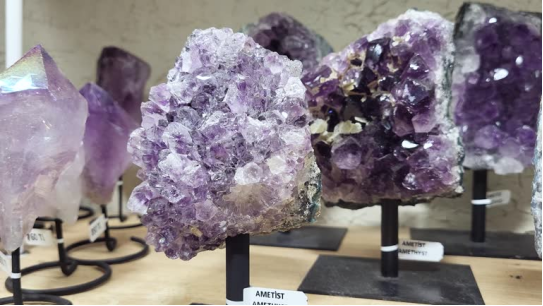
Amethyst Crystal Origin Guide: Brazil vs. Uruguay (Differences & Value)

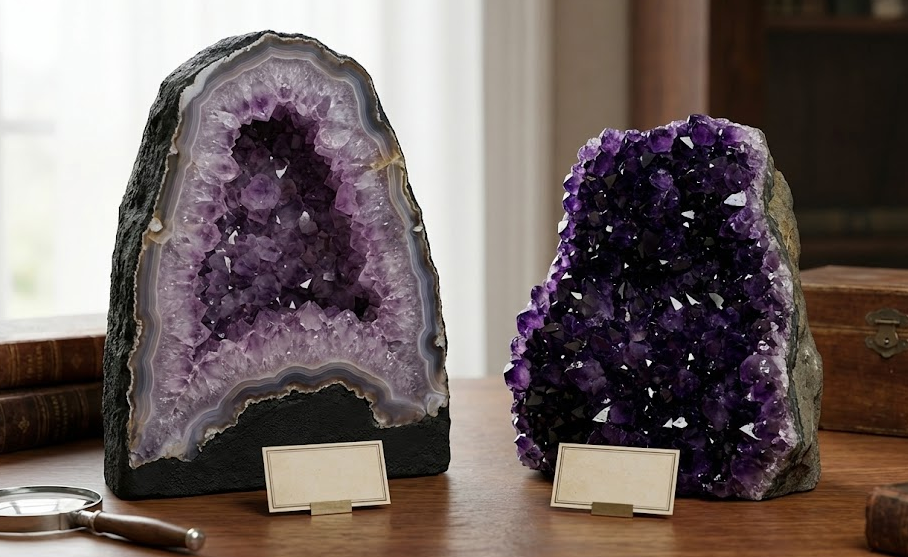
The question I get most often isn’t “which amethyst should I buy.” It’s “what’s the difference between Brazilian and Uruguayan — the two most famous geological sources of amethyst — and does it actually matter?”
The honest answer: it depends entirely on what you’re trying to do with it. One is about scale. The other is about depth. Neither is better. But they’re not the same stone.
The Purple Mystery: Amethyst Crystal Mineralogy
To truly understand the charm of amethyst, we must go beyond its appearance and explore its coloration mechanism at the molecular level and the macroscopic geological background.
The Color Code of Amethyst: Iron Ions, Radiation, and Color Centers
Pure quartz, the base of any amethyst crystal, is colorless. The reason amethyst appears purple is a precise chemical dance of trace elements, radiation, and lattice defects.
- Lattice Defects and Trivalent Iron Ions (Fe³⁺): During the long growth process of amethyst crystals, trace amounts of trivalent iron ions (Fe³⁺) will replace silicon ions (Si⁴⁺) in the silicon-oxygen tetrahedron at extremely low concentrations. At this time, the crystal usually appears yellow or pale green, rather than purple.
- Ionizing radiation and tetravalent iron ions (Fe⁴⁺) color centers: After crystal formation, it must undergo irradiation by high-energy gamma rays generated from the decay of radioactive isotopes (such as potassium-40) in surrounding rock formations (such as potassium-rich potassium feldspar). This ionizing radiation strips electrons from iron ions, oxidizing them to unstable tetravalent iron (Fe⁴⁺). It is this special electron-hole color center that strongly absorbs the yellow-green light region of the spectrum, causing the transmitted light to appear purple as we see it.
Thermal Sensitivity: Why Does High Temperature “Fade”?
Fe⁴⁺ color centers are extremely unstable at high temperatures. If the temperature of the geological environment exceeds 400-500°C, the color centers will be destroyed, and iron ions will be reduced to Fe³⁺, causing the color to revert to yellow (becoming citrine) or change to green (green quartz/Prasiolite). The reason why Uruguayan amethyst can retain such a deep purple color is directly related to its relatively low-temperature formation environment.
Brazil Law Twin: A Unique Imprint of Natural Identity
Natural amethyst has a decisive characteristic in crystallography – polysynthetic twinning, which refers to the twinned structure following the “Brazil Law”. This involves the microscopic intergrowth of left-handed quartz and right-handed quartz within the same crystal.
Under crossed polarizers, this twin structure exhibits a unique interference pattern, often described as “tiger stripe” or “fingerprint-like” ripples. This is one of the most reliable means to distinguish natural amethyst from hydrothermally synthesized amethyst—synthesized amethyst, in pursuit of perfection, is usually grown into a single-crystal structure without twins, thus losing this natural “proof of imperfection”.
Paraná-Etendeka Basalt Province: A Shared Cradle, Different Fates
The amethyst deposits in southern Brazil and northern Uruguay geologically belong to the same large igneous province – the Paraná – Etendeka Basalt Province. Despite sharing the same “parent rock”, there are subtle yet crucial differences in the specific geode formation mechanisms between the deposits of the two countries, and these differences directly determine the quality of the gemstones ultimately produced.
Brazilian Amethyst: Industrial Giant and Family Guardian
Brazil, especially the Ametista do Sul region in Rio Grande do Sul, is the world’s capital of amethyst. With its huge output and astonishing volume, amethyst has flown from the halls of the noble families of old into the homes of ordinary people.
Rio Grande do Sul: High-Temperature Hydrothermal and Giant Geodes
- Formation Mechanism: Gas Cavities and Thick Rind Structure. During the cooling process of large lava flows, volatile-rich bubbles were trapped inside. Subsequently, silica-rich hydrothermal fluids infiltrated these cavities at relatively high temperatures (often above 100°C), slowly crystallizing to form amethyst. A prominent feature of Brazilian geodes is their thick marginal structure, typically with a dark green penninite band over 1 cm thick, followed by a thick layer of agate.
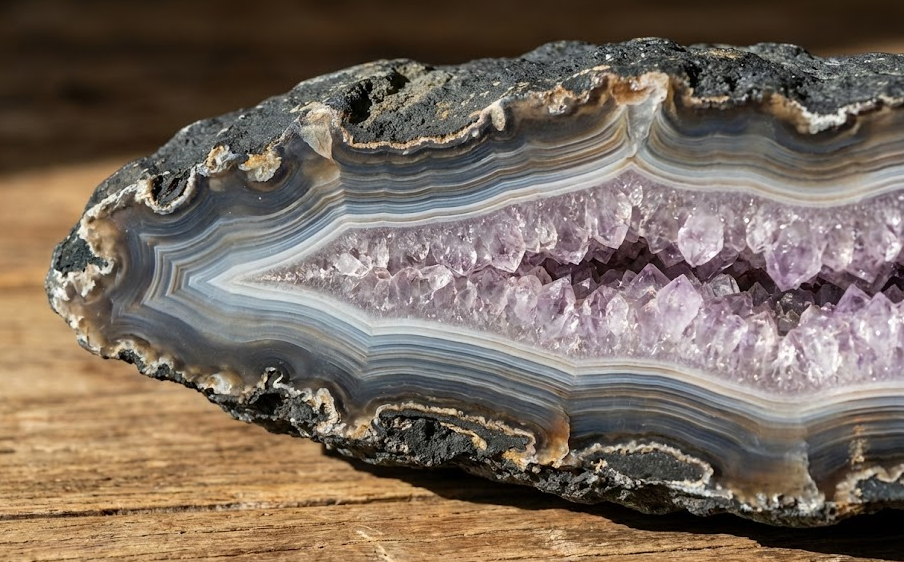
- Processing Technology: The Truth and Necessity of Cement Backing Boards. Due to the large size of Brazilian geode and the relatively brittle basalt shell, in order to ensure transportation safety and aesthetic display, the industry has developed a standardized processing procedure: applying a thick layer of cement or concrete to the back of the geode for reinforcement, and usually painting it black or dark gray.
This “artificial backplate” is one of the most intuitive features for identifying Brazilian commercial-grade geode. In most cases, it is not intended to cover up defects, but rather an industrial strategy to adapt to long-distance sea transportation. However, for collectors who aim for the highest level of naturalness, this factor needs to be taken into consideration.
Crystal Characteristics and Market Positioning
Brazilian amethyst typically has the following characteristics:
- Color and Clarity: Mostly lilac and medium purple, often with a pinkish tint. The crystal growth rate is relatively fast and the environment changes significantly, so it often exhibits distinct, straight angular color bands. When observed from the table, parallel stripes of alternating purple and colorless quartz can be seen.
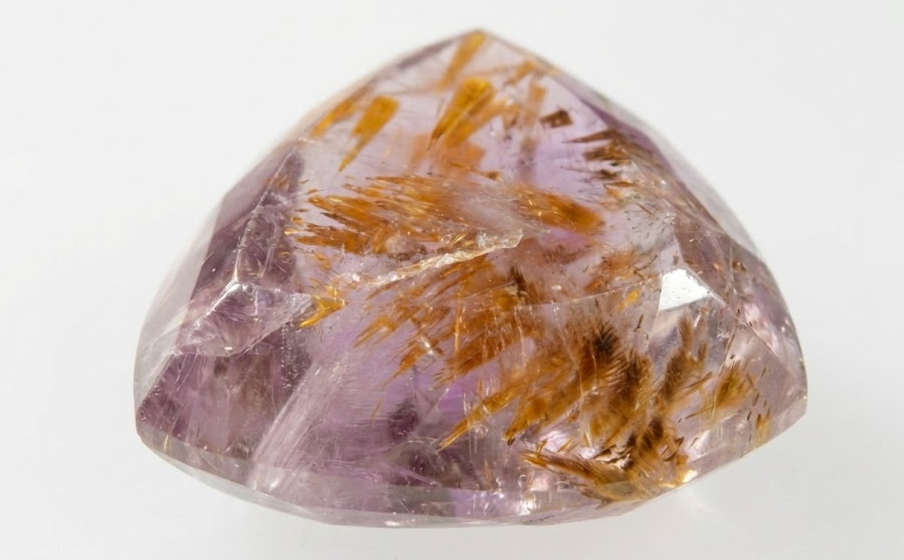
- Associated Minerals: The most typical inclusions in Brazilian amethyst are goethite (FeO(OH)). Under a microscope, they usually appear as yellowish-brown to golden-yellow needles, clustered in bundles, resembling brooms or radial furry balls.
- Market Role: Due to its significant production volume and size advantages, Brazilian amethyst is the top choice for entry-level collections and large-scale home decor items. If you want something that fills a wall, Brazilian amethyst is where you look. The size-to-price ratio doesn’t exist anywhere else.
The “Transformation” of Brazilian Amethyst: The Secret of Citrine. More than 95% of citrine on the market is actually made from Brazilian amethyst through high-temperature heat treatment at 400-550°C. Heat treatment permanently changes the color, and it is impossible to detect the trace of the change from “purple” to “yellow”, so it is widely accepted commercially. However, as a brand committed to transparency, we believe that transparency is crucial: natural citrine (such as that from Congo) usually has a clear lemon-yellow or smoky tone, while heat-treated citrine often has a faint reddish-brown tint.
Uruguayan Amethyst: The Pinnacle of Quality and a Collectible Treasure
If Brazil is the “supermarket” of amethyst, then Uruguay is the “boutique buyer’s store”. Although its production is far less than that of Brazil, the average value per carat in the Artigas region of Uruguay is much higher than the global average.
Artigas: Cryogenic Primary Geode and Extreme Colors
- Formation Mechanism: Groundwater Infiltration and Thin-Skin Characteristics. The formation temperature of amethysts from Artigas, Uruguay, is surprisingly low, mainly concentrated between 50°C and 120°C. Fluid isotope analysis indicates that these gemstones were formed by ancient rainwater infiltrating into the ground and groundwater slowly leaching basalt to extract minerals over long geological periods. This low-temperature, slow crystallization environment reduces crystal defects, allowing iron ions to enter the crystal lattice more uniformly, resulting in their iconic high clarity and deep color.
- “Jelly Purple” and “Midnight Blue”: Unparalleled Saturation. Top-grade Uruguayan amethyst exhibits an oily, jelly-like visual effect, where light seems to be “locked” and diffused within the gemstone. Many Uruguayan crystals are so intensely colored that they appear almost black under normal indoor lighting. Only under a strong flashlight or direct sunlight do they burst into deep violet or even blue-violet flashes.
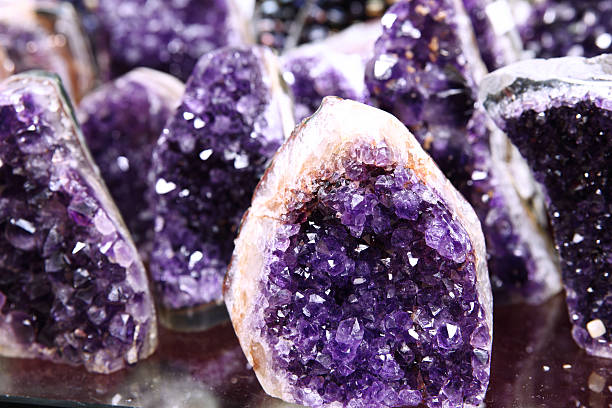
- Unique Structure: Symbiosis of “Stalactite” Specimens and Calcite. The Artigas mining area has a unique mineralogical wonder – the Stalactite Amethyst slices (sometimes locally called “Skunk” due to the striping). This is an epitaxial growth phenomenon where large calcite crystals first crystallize, and then amethyst microcrystals selectively attach and grow on specific edges or crystal faces of the calcite crystals. Eventually, a white or golden calcite core is formed, with its surface covered by deep purple amethyst bands.
Natural Backboard: A Symbol of Uruguay’s Geode Identity (Original Integrity)
Due to the lack of a thick green scale stone protective layer like that in Brazil, Uruguayan geodes are extremely difficult to maintain in their large, intact shape during mining. Therefore, large, intact Uruguayan geodes (over 50 kilograms) are very rare and expensive in the market. This also leads to a key differentiator and brand promise – Raw Integrity. High-quality Uruguayan geodes should retain their natural basalt crust and have it polished smooth to reveal the dark gray rock texture, rather than being coated with cement like Brazilian geodes. This “authentic” treatment method has become an important clue for identifying the origin and also reflects its high-end positioning.
At Zerevia, every Uruguay piece we carry — sourced from established wholesale partners in Artigas, Uruguay — ships with its natural basalt back intact and polished smooth. When you turn it over, you’re looking at the outside of a volcanic bubble. Not cement. The real thing.
Crystal Characteristics and Market Positioning
- Color and Clarity: The color is deep and uniform, with very few color bands visible to the naked eye. The crystal grains are extremely fine and closely arranged, presenting an ultimate color density.
- Associated Minerals: Internally, they are usually relatively clean. If there are inclusions, they are more likely to be fluid inclusions or extremely tiny black spots, and the prominent golden needles like those in Brazil are less likely to occur.
- Market Role: Uruguayan amethyst is the top choice for investment-grade collection and high-end customization. For collectors who aim for the highest color density, rarity, and wish to use gemstones as heirloom treasures, Uruguayan amethyst is the only option.
Global Vision: The Multiverse of Amethyst
Apart from Brazil and Uruguay, there are other producing regions worldwide that also produce amethyst, and as special chapters in geological archives, they each have their own unique features.
- Zambia: Red Flash Effect and Hematite Fingerprint. Top-grade Zambian amethyst possesses a unique charm. Under incandescent light, bright magenta or red flashes emerge from its deep purple body color. Its key distinguishing feature is the hematite (Fe₂O₃) inclusions, which typically appear as distinct, hexagonal or circular red/orange flakes, like red “confetti” or “gold dust” scattered on a purple background.
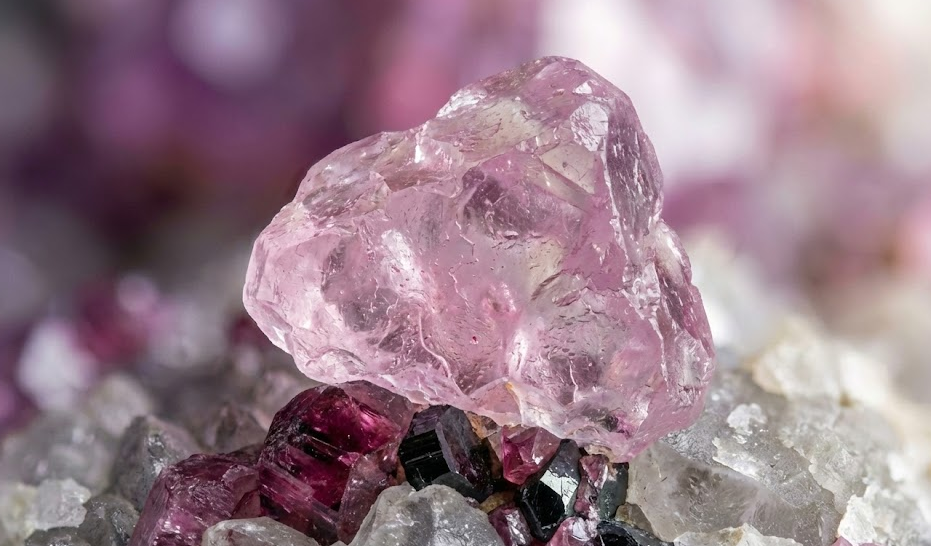
- Bolivia: The Only Source of Ametrine. Bolivia’s Anahí Mine is the world’s only commercial source of natural Ametrine. During the growth of quartz crystals here, due to periodic fluctuations in the microenvironment, the oxidation state of iron ions switches between Fe³⁺ (yellow) and Fe⁴⁺ (purple), forming distinct purple and yellow color zones.
- Siberia: A Color Grade, Not a Place of Origin. “Siberian Amethyst” is more of a color grading term in modern times, referring to top-grade deep purple amethyst with red flashes, rather than a place of origin. The real Siberian deposits have been completely depleted.
Guide to the Valuation and Identification of Amethyst
When I look at a piece before it goes into our inventory, I’m checking five things — and none of them is ‘does it look pretty in the photo.
- Origin and Geological Fingerprint: The origin determines the basic genetic makeup of the crystal. The low-temperature mineralization environment in Uruguay endows it with the unique “jelly purple,” making its scarcity and unit value far exceed the industrial output of Brazil.
- Color Intensity: The core value of amethyst lies in its saturation. The deeper the color, the closer it is to the “Siberian” or “Midnight” hues, the higher its value. However, beware of dyeing – if the color is deposited along the fissures, it is conclusive evidence of artificial dyeing. We adhere to presenting only the natural beauty of unaltered stones.
- Crystal Clarity & Integrity: Although natural crystals allow for slight inclusions, the overall transparency of the crystal directly affects its value. More importantly, integrity — especially for geode products.
- Reject resin injection: Many merchants perform resin injection to cover up cracks.
- Reject patchwork: Be wary of shapes that seem too perfect; they may be pieced together from fragments.
- We deeply understand that each piece of natural amethyst has its unique soul, so we reject “blind box-style” shipping and adhere to the principle of “one item, one picture, one video” to ensure that every detail you see is exactly what you will receive.
- Associated Minerals (Inclusions): Unique associated minerals (such as the calcite paragenesis in Uruguay and goethite in Brazil) can sometimes increase the collection value. The key lies in distinguishing whether this is a natural work of art (anomaly) or a flaw that affects the structure.
- Geode Form: For feng shui ornaments, whether the geode forms a perfect “treasure basin” shape and whether the natural basalt crust is retained on the back (instead of being patched with cement) are both important factors affecting its ornamental and collection value.
How People Use It: Traditional Placement and Care
The geology is one part of the story. The other part is what people actually do with these stones once they’re home.
- Traditional associations. For centuries, amethyst has been placed near the head — on a bedside table, under a pillow, at the forehead during rest. The traditional explanation involves the third eye and crown chakras: intuition, mental quiet, the ability to stop turning things over. We can’t tell you whether the framework is literally true. What we can say is that the ritual of placing something intentional somewhere you’ll actually see it tends to matter, regardless of what you believe about why.
- Feng Shui Applications: Protecting the Home, Gathering Wealth, and Assisting in Learning.
- Geode placement. The traditional feng shui recommendation is to place a geode in the wealth corner of a room — the far left from the entrance. Whether or not you follow that framework, a deep Uruguayan geode in a corner catches light in a way that a Brazilian piece in the same spot won’t. The color does something to a room. That part isn’t metaphysics.
- Crystal Column (Focus): Amethyst crystal columns or clusters, due to their sharp crystal structure, can concentrate energy in a specific direction. Placing them in the Wisdom Corner/Academic Area (study or office) is the best companion for enhancing deep work efficiency.
- Daily Care of Precious Crystals. Proper maintenance can keep your amethyst shining brightly for a long time.
- Fading Truth: Amethyst is strictly prohibited from long-term exposure to strong sunlight. As previously mentioned, ultraviolet rays can damage the Fe⁴⁺ color centers, leading to irreversible fading.
- Cleansing. If you use your stone regularly, people have long reset their pieces with sound — a singing bowl nearby, a few minutes of stillness. It’s a habit, not a science. We’re not going to tell you it does or doesn’t work.
- Warning: If your amethyst is associated with goethite or hematite (such as those from Brazil or Zambia), water washing is absolutely prohibited, as iron minerals will rust and permanently damage the beauty of the crystal.
Conclusion: Choose Your Geological Legend
Brazil and Uruguay start in the same volcanic province. They end up producing very different stones.
Brazilian pieces are bigger, lighter in color, better value if you want presence in a room without spending collector money. Uruguayan pieces are denser, darker — the kind of color that looks almost black until the light hits it right.
Neither one is the answer for everyone. It depends on what you’re putting it next to, how much light the space gets, and honestly, which one you keep coming back to look at. That part’s usually not complicated.”
Brand Proposition: Not just ore, but the soul of space
At Zerevia, we source from established wholesale partners in Ametista do Sul (Brazil) and Artigas (Uruguay). Every piece is photographed individually before it ships — not a stock image, not a representative sample. The photo is the piece.
We don’t inject resin. We don’t patch fragments. We label the processing on Brazilian pieces accurately, including any cement backing. Uruguay pieces ship with natural basalt backs. That’s the baseline. It shouldn’t be remarkable, but in this market it still is.
If you’ve read this far, you probably already know which one you’re looking for. Brazilian if you want scale. Uruguayan if you want depth.
👉 Click here to enter our online Crystal Museum
After comparing Brazil and Uruguay origins, view raw amethyst geodes for sale with size, weight, and display notes.
 Crystal Cluster
 Crystal Tower
 amethyst crystal ball
 Amethyst Caves for Sale
 Amethyst Bracelets
 Amethyst Earrings
 Amethyst Necklaces
 Amethyst Rings
 amethyst crystal healing
 Amethyst Beauty & Wellness
 Crystal Home Decor
 Spiritual & Divination Tools