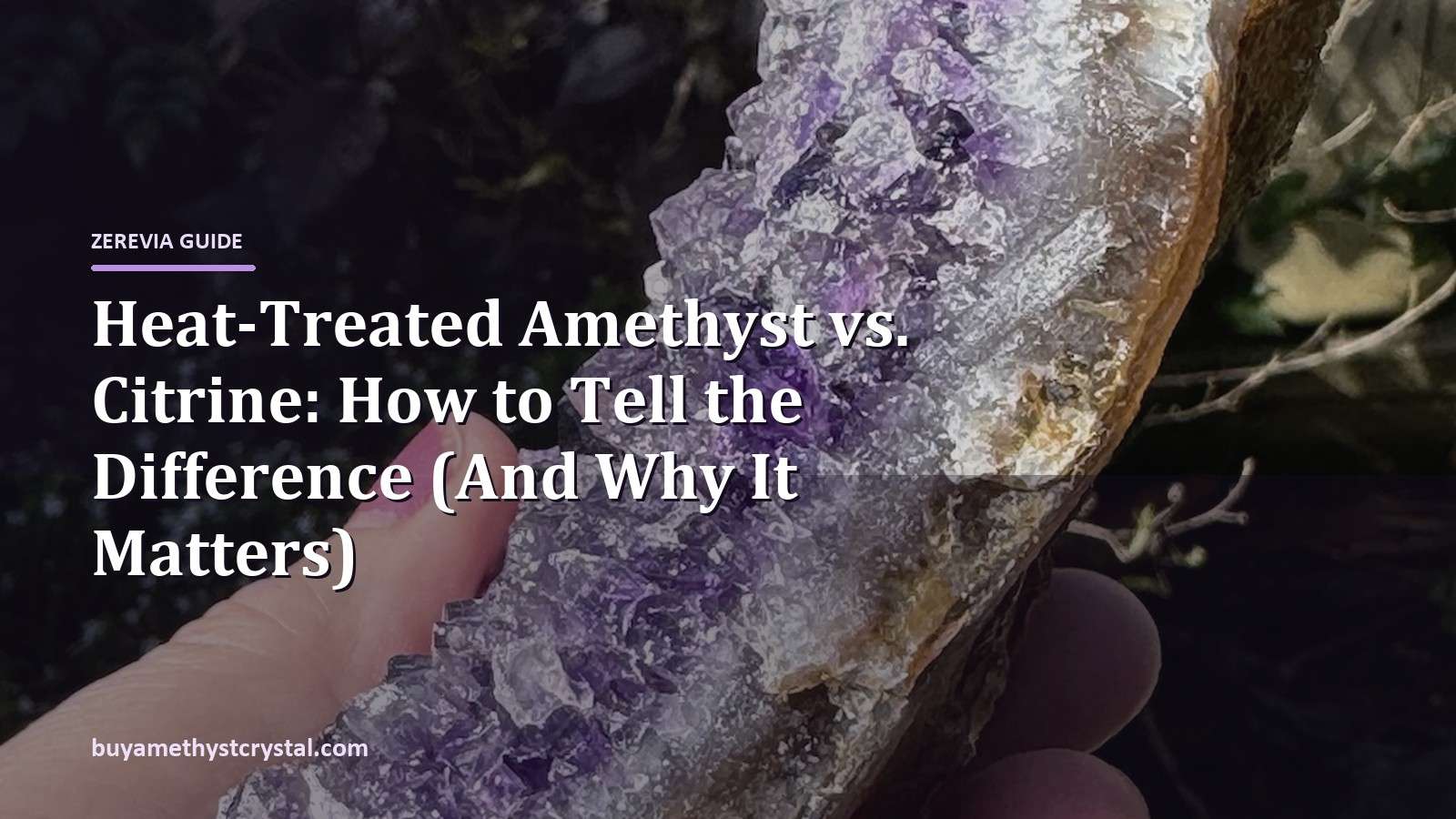

Heat-Treated Amethyst vs. Citrine: How to Tell the Difference (And Why It Matters)
If you’ve been shopping for yellow or orange crystals, you’ve almost certainly seen something sold as “citrine” that looks a little too bright, a little too orange, a little too cheap. That’s because the vast majority of commercial “citrine” on the market is not citrine at all — it’s heat-treated amethyst. The heat treated amethyst vs citrine question is one of the most common confusions in the crystal world, and it matters for reasons that go beyond labels. It affects color stability, what you’re actually paying for, and how the stone fits into your life. Whether you’re exploring amethyst healing properties and related stones, or simply trying to avoid paying natural-citrine prices for a treated piece, this guide will walk you through the real differences.
Why the Distinction Between Natural Citrine and Heat-Treated Amethyst Matters
Most commercial “citrine” — the kind you see in gift shops, on large retail sites, and in inexpensive geode displays — is amethyst that has been heated in a kiln until the purple shifts to yellow, orange, or brownish tones. This isn’t a secret among sellers, but it’s rarely explained to buyers.
The difference between citrine and heat treated amethyst is not just a matter of pedantic labeling. It affects three things you’ll actually notice:
- Color stability. Heat-treated stones can lose color over time with UV exposure, just like untreated amethyst. I learned this the hard way when a buyer sent me a photo of her crystal — a deep purple piece she’d placed on a south-facing windowsill. After months of afternoon sun, the color had shifted from rich purple to a pale lavender. That change was irreversible. The same mechanism applies to heat-treated amethyst: the color is permanent under normal conditions, but prolonged direct sunlight can cause fading.
- Value. Natural citrine is rare and commands a significantly higher price. Heat-treated amethyst is inexpensive to produce.
- Traditional associations. In crystal traditions, natural citrine and amethyst are associated with different qualities. If that matters to you, knowing what you actually own matters.
This guide gives you a clear, no-nonsense comparison — the kind of information I wish someone had laid out for me when I first started noticing that not all yellow quartz looked the same. For a deeper dive into understanding amethyst’s color and origins, we have a separate guide on that.
What Are They? Defining the Stones
Before we compare them side by side, let’s be clear about what each one actually is at a mineral level.
Natural Citrine
Natural citrine is a variety of quartz (SiO₂) that gets its yellow color from trace amounts of aluminum and iron impurities incorporated during crystal formation. The color is typically pale yellow to smoky gold — think champagne, not traffic cone. It forms in the earth over millions of years, often alongside smoky quartz, and it’s genuinely uncommon. Most “citrine” you encounter in shops is not this.
Mohs hardness: 7, same as amethyst. Same mineral family, different coloring story.
What Is Heat-Treated Amethyst?
Heat-treated amethyst is exactly what it sounds like: amethyst — purple quartz colored by Fe³⁺ (three-valent iron ions) in its crystal lattice — that has been heated in a kiln, typically between 800–1000°F (425–540°C). The heat causes a chemical reduction of the Fe³⁺ ions, which shifts the color from purple to yellow, orange, or brownish tones. The color change is permanent once cooled.
The process itself isn’t complicated. How heat treatment works is straightforward enough that it’s widely practiced in the gem trade, particularly with amethyst from Brazil and Uruguay — regions that produce large volumes of material. Some pieces are heated deliberately; others (especially paler stones) may be heat-treated because the resulting orange-yellow color is more commercially appealing than the original light purple.
For more on the quality factors that drive these decisions, see our amethyst quality guide.
Side-by-Side Comparison: Heat-Treated Amethyst vs. Citrine
This is where citrine vs heat treated amethyst becomes a practical question. Here’s the core comparison across the factors that actually matter when you’re deciding what to buy or what you already own:
| Factor | Natural Citrine | Heat-Treated Amethyst |
|---|---|---|
| Color | Pale yellow to smoky gold. Even, subtle distribution. Rarely intense. | Bright orange, burnt amber, or deep yellow. Often splotchy, with concentrated color at tips and a white, grey, or brownish base. |
| Color Origin | Geological — trace aluminum and iron impurities during natural formation. | Industrial — Fe³⁺ reduction via kiln heating. |
| Rarity | Genuinely uncommon. Limited natural deposits. | Abundant. Amethyst supply from Brazil and Uruguay makes large-scale treatment feasible. |
| Color Stability | Stable under normal conditions. Does not fade in sunlight. | Color is permanent under normal indoor conditions, but can fade with prolonged UV exposure. |
| Typical Price | Higher. Expect to pay meaningfully more for natural citrine of any decent size. | Lower. Often the least expensive option in any crystal display category. |
| Common Forms | Points, clusters, smaller specimens. Rarely large geodes. | Geodes, cathedrals, clusters, towers, tumbled stones. Widely available in large sizes. |
| Hardness | 7 Mohs | 7 Mohs (unchanged by heat treatment) |
| Traditional Associations | Prosperity, abundance, personal will. In some traditions, connected to the solar plexus. | Shared with amethyst origin in some traditions; others consider the color change relevant. Varies by practitioner. |
The practical takeaway: the color is your first clue. When I look at a piece and the orange is vivid, concentrated at the crystal tips, and fading to a white or grey base, I’m looking at treated material. Natural citrine doesn’t do that — its color is quieter, more evenly distributed, and tends toward warm gold rather than pumpkin.
How to Tell Real Citrine from Heat-Treated Amethyst: 4 Visual Clues
You don’t need a lab to figure out how to tell if citrine is heat treated amethyst. Here are the four things I check first:
Clue 1: Look at the Base
This is the most reliable visual indicator. Heat-treated amethyst geodes and clusters almost always show a white, grey, or brownish base — the original matrix rock that didn’t change color during heating. Natural citrine tends to have a more consistent color throughout, or a base that blends with the crystal color rather than contrasting sharply against it.
If the piece is a geode and the outer shell is whitish or grey while the crystals inside are vivid orange, that’s a strong signal of treatment.
Clue 2: Examine Color Distribution
In natural stones, color zoning is normal — but it follows geological logic. Citrine color tends to be relatively uniform or gently graded. Heat-treated amethyst often shows splotchy color concentration: darker at the tips, lighter or white toward the base, sometimes with abrupt transitions. That gradient pattern tells you the heat didn’t penetrate evenly.
Clue 3: Assess the Saturation
Natural citrine is rarely intensely orange. If you’re looking at a piece that’s the color of a ripe tangerine and it’s priced like an everyday purchase, pause. Real citrine tends toward champagne, honey, or pale gold. Deep, vivid orange-yellow is almost always treated.
I learned early on to stop relying on labels and start relying on my own observation. The checklist I use for evaluating any stone — pick it up, feel the weight, look at the color distribution, ask about the origin — applies here too. If the seller can’t tell you whether it’s natural citrine or heat-treated amethyst, that’s useful information in itself.
Clue 4: Price Check
This is the least glamorous clue but possibly the most reliable. Natural citrine is rare. If a large piece is labeled “citrine” and priced at $15 or $25, it’s almost certainly heat-treated amethyst. Real citrine of any meaningful size commands a higher market price. Price doesn’t lie, even when labels do.
For a more detailed walkthrough, see our guide on how to identify heat-treated amethyst.
Heat-Treated Amethyst Properties and Care
If you already own a piece of heat-treated amethyst — or you’re considering buying one for its color — here’s what to know about its properties and care.
Physical properties: Heat treatment does not change the crystal structure or hardness. It’s still quartz at 7 Mohs. The Fe³⁺ reduction alters color, not mineral identity. The stone is still real quartz — it’s just been altered.
Care: Because the color came from a process that modified the iron ions, heat-treated amethyst shares a vulnerability with its untreated parent: UV exposure. Avoid prolonged direct sunlight. A windowsill with afternoon sun for months will fade the color, and that fading is irreversible. This is not theoretical — it’s documented. Display away from direct sun, and you’ll preserve the color indefinitely.
Traditional use context: In some crystal traditions, heat-treated amethyst is considered to carry associations linked to its original amethyst identity. Others treat the color change as significant. This is a matter of personal practice and tradition, not mineral science. What’s not debatable is the care requirement: treat it like the amethyst it started as.
Which One Should You Choose?
The real citrine vs heat treated amethyst decision isn’t about “good” versus “bad.” It’s about what you value and how you plan to use the stone.
Choose natural citrine if:
- You value geological rarity and want a stone that formed its color over millions of years.
- Color stability matters to you — you want something that won’t fade in sunlight.
- You’re collecting, not decorating, and provenance is part of the appeal.
- Your budget allows for the higher price point that natural specimens require.
Choose heat-treated amethyst if:
- You love the warm orange-yellow color for home decor and don’t mind that it was achieved through treatment.
- A larger display piece is what you’re after — heat-treated geodes and cathedrals are available in sizes that natural citrine rarely reaches.
- Price is a practical consideration and you want the look without the natural-citrine markup.
- You’re comfortable with the care requirements (keep it out of prolonged direct sun) and you know exactly what you’re buying.
The problem has never been heat-treated amethyst itself. The problem is mislabeling — selling treated material as natural citrine without disclosure. When you know the difference, you can make a choice that actually fits what you want.
Ready to explore what’s out there? Browse our collection of crystal forms and shapes to find the right piece for your space.
Frequently Asked Questions
Does heat treatment ruin an amethyst?
Heat treatment permanently changes the color from purple to yellow, orange, or brownish tones. It doesn’t destroy the crystal — it’s still quartz with a hardness of 7 Mohs. But the original purple color is gone, and that change can’t be undone. The stone’s market value as “amethyst” is also permanently altered.
Can heat-treated amethyst turn back into purple amethyst?
No. The color change from heat treatment is irreversible. Once the Fe³⁺ ions have been reduced by heat, the purple doesn’t come back. This isn’t like a dye that might wash out — it’s a chemical change in the crystal lattice itself.
Is heat-treated amethyst bad?
Not inherently. It’s a real piece of quartz that’s been altered to change its color. The issue is transparency. Heat-treated amethyst should be sold as what it is. When it’s mislabeled as natural citrine — especially at natural citrine prices — that’s the problem. An informed purchase of treated material, at treated-material pricing, is a perfectly reasonable choice.
Which is more valuable, natural citrine or heat-treated amethyst?
Natural citrine is significantly more valuable. Its rarity, geological provenance, and color stability all contribute to a higher market price. Heat-treated amethyst is far less expensive to produce and source, which is reflected in its price. If you see a large “citrine” piece at a low price, the price itself is telling you what it likely is.
 Crystal Cluster
 Crystal Tower
 amethyst crystal ball
 Amethyst Caves for Sale
 Amethyst Bracelets
 Amethyst Earrings
 Amethyst Necklaces
 Amethyst Rings
 amethyst crystal healing
 Amethyst Beauty & Wellness
 Crystal Home Decor
 Spiritual & Divination Tools