
Cactus Amethyst Benefits: What This Spiky Formation Is Actually Used For
If you’ve been searching for cactus amethyst benefits, you’ve probably run into a wall of inconsistent naming and vague promises. Let me start with what you’re actually looking at — and what this unusual formation is genuinely used for in practice, tradition, and daily ritual.
What Is Cactus Amethyst?
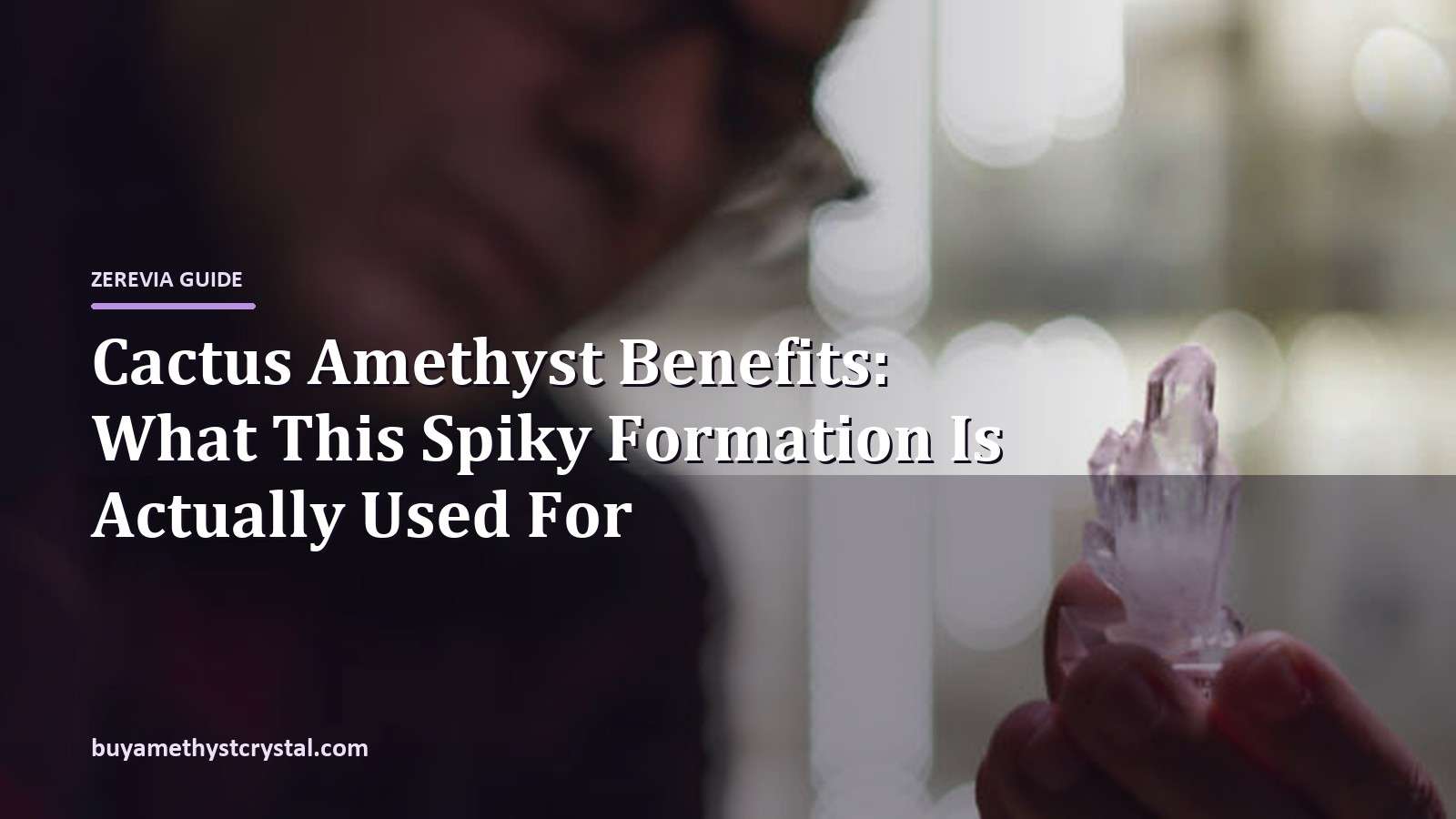
Cactus amethyst is a formation — not a separate mineral species — where tiny terminated quartz crystals grow outward from a larger central crystal, creating a shape that resembles a cactus or sea urchin. In some markets you’ll see it called spirit quartz or fairy quartz. Same structure, different seller preference. The amethyst healing properties people search for apply to all natural amethyst; cactus amethyst is simply a specific growth pattern within that family.
The primary source is South Africa’s Magaliesberg region, though some specimens come from Brazil. Colors range from pale lavender to deep violet, and most pieces have a druzy coating — that fine crystalline sparkle on the radiating tips that makes this formation look almost alive under room light. For a broader overview of how amethyst forms in nature, our amethyst forms and shapes guide covers the full range, and the amethyst geological origins page explains where different types come from.
Unlike standard amethyst points or clusters, cactus amethyst’s structure means you get hundreds of tiny crystal tips facing outward in every direction. That density matters — a palm-sized piece can weigh more than you’d expect, and the radiating surface creates a texture that catches light from multiple angles. At the first mineral show where I handled one, what surprised me was how the piece seemed to shift color depending on which way you turned it. The seller had labeled it “spirit quartz” and was asking about twice what a comparably sized point would cost. He was right to.
Why People Choose Cactus Amethyst for Ritual and Daily Practice
Now, the “benefits” part. Let me be specific about what amethyst quartz benefits actually are — verified and traditional — because the two categories get mixed up constantly online.
What’s verified: Amethyst is silicon dioxide (SiO2) with trace amounts of Fe3+ — tripositive iron ions — that produce the purple color through natural radiation activation over millions of years. This applies to all amethyst, cactus formation included. It’s Mohs hardness 7, which means it’s hard enough to scratch glass and resistant to most household wear. And it can fade under prolonged UV exposure — more on that in the care section.
I spent an evening going through the GIA color-mechanism chapter, and the thing that stayed with me was how specific the explanation is. The purple isn’t dye. It’s not coating. It’s millions of years of iron ions being rearranged by natural background radiation. I like that there’s a concrete, verifiable reason for the color rather than a vague claim about what the stone “wants” to be.
What’s traditional: People who practice crystal meditation and ritual choose cactus amethyst for specific reasons tied to its formation. The radiating crystal structure is traditionally associated with radiating calm outward — spreading steadiness rather than concentrating it in one direction. Amethyst meditation benefits, as people describe them, usually involve using the stone as:
- A focal point during seated practice — held in the hand or placed nearby as a tactile anchor
- A charging station for smaller stones — set tumbled stones on or near the radiating tips between uses
- An intention-setting companion during daily rituals
- A visual presence in a meditation space that signals a transition from activity to stillness
A friend once asked me if I really thought crystals did anything. I told him I didn’t know if stones had the kind of energy people describe online. But I knew that having a specific, real object from a documented place on my nightstand gave me a reason to pause for a minute or two before sleep instead of scrolling. That pause did something for me. Whether you call that a crystal benefit or a practice benefit is, I think, less important than whether it actually helps you slow down.
If you maintain a cleansing practice, the druzy surface on cactus amethyst does need gentle handling. Our amethyst care and cleansing guide covers safe methods for every formation type.
Amethyst in Islamic Tradition and Other Cultural Uses
Amethyst stone benefits in Islam is a specific search, and it deserves a careful, honest answer.
Amethyst and other violet stones have a documented historical presence in Islamic gemstone tradition. Classical Islamic lapidary texts — the written catalogs of stones and their attributed meanings — reference purple and violet gems. In some accounts, the Prophet Muhammad is described as favoring agate and related stones, and amethyst’s violet coloring places it within that broader tradition of valued gemstones in Islamic art and personal adornment.
This is historical and cultural context, not a religious requirement. People who practice within these traditions sometimes choose amethyst because of this documented history, in the same way someone might choose a specific gemstone because of its February birthstone association — it connects to something meaningful for them personally.
Similarly, amethyst stone benefits for money are primarily a feng shui tradition. In feng shui practice, amethyst geodes are placed in the wealth corner of a room — typically the southeast area — as a spatial ritual. The belief is that the stone’s natural formation supports the energy of abundance in that space. This is a practice tradition, not a financial guarantee. People who choose this placement are participating in a spatial ritual that’s meaningful to them; they’re not expecting the stone to generate income on its own.
Both of these uses share a common thread: the stone is chosen because of its place in a tradition, and the person using it brings their own intention and practice to the arrangement.
Cactus Amethyst vs Other Amethyst Types: How Benefits and Uses Compare
One of the more useful things I can do here is help you match formation to use case. Dark amethyst benefits, canela amethyst meaning and benefits, amethyst phantom benefits, and clear quartz and amethyst benefits are all different queries pointing at different buyer needs.
When people ask me about amethyst differences, I usually ask: do you want something big and visually dramatic, or something small with intense color depth? That question applies across formations.
| Formation | Appearance | Traditional Use-Case | Care Note | Best For |
|---|---|---|---|---|
| Cactus amethyst (spirit quartz) | Radiating crystals from central core; druzy sparkle; lavender to violet | Meditation focus, charging station, intention-setting ritual | UV care critical; gentle cleaning for druzy surface | Ritual practitioners, meditation spaces |
| Dark amethyst | Solid deep purple; often Uruguayan; Emperor Purple tones | Deeper introspection, stillness, contemplation | UV care critical — fading more visible on deep colors | Deep color lovers, display pieces |
| Phantom amethyst | Visible “ghost” growth layers inside the crystal | Growth, cycles, personal evolution; collector display | Standard amethyst care | Collectors, meaning-seekers |
| Canela amethyst | Cinnamon-toned; warm palette; from Mexico | Grounding, warmth; non-standard color | Standard amethyst care | Warm-toned decor, unusual specimens |
| Clear quartz + amethyst | Mixed mineral clusters or paired pieces | Amplification of calm paired with steadiness | Standard care for both minerals | Crystal grids, paired ritual use |
Dark amethyst — particularly the deep violet specimens from Uruguay — carries a price that reflects its color saturation. Brazilian amethyst tends toward larger formations with more varied color distribution, from lavender to medium purple. Uruguayan specimens are typically smaller but carry that near-indigo depth sometimes called Emperor Purple. Neither is better; it depends on whether you’re placing it in a living room where size matters or a meditation corner where color intensity matters more.
Phantom amethyst appeals to a different kind of buyer. If you’re drawn to stones that show their own formation history — those visible growth pauses that look like ghost crystals inside the main crystal — phantom amethyst is worth exploring for its visible geological narrative.
Canela amethyst is the outlier. The cinnamon color comes from specific iron oxidation states in specimens from Mexico, and it’s considerably less common. If you’ve been reading about canela amethyst meaning and benefits and you want something that doesn’t look like every other amethyst piece online, this is worth asking suppliers about directly.
Clear quartz and amethyst as a pairing comes from the traditional idea that clear quartz amplifies whatever it’s placed near. When paired with amethyst, the tradition suggests the combination supports both clarity and calm. Whether you put stock in that or simply like the visual contrast, the pairing is common in crystal grids and display arrangements.
For a fuller comparison of what determines quality across all amethyst types, our amethyst quality and value guide covers the specific markers.
Common Benefit Claims: What’s Tradition and What’s Verified
This is where I think the most honesty is needed, because the remaining queries — amethyst stone benefits for skin and amethyst oil benefits — describe real product categories that can easily slide into misleading claims.
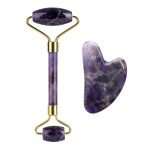
Amethyst stone benefits for skin: There are amethyst-tipped facial rollers and gua sha tools on the market. These are self-care tools, not medical devices. Here’s what’s real: natural amethyst is cool to the touch initially and warms slowly against skin. You can yourself by pressing any genuine amethyst piece against your cheek. That cool surface feels pleasant during a facial massage. But any benefit to your skin from using an amethyst roller comes from the massage practice itself — the pressure, the motion, the deliberate pause — not from mineral properties transferring through your skin.
One useful test before investing in any amethyst self-care tool: hold the piece. Real quartz feels heavier than glass or plastic of the same size, and it’s noticeably cool against skin for the first few seconds. Color distribution in natural amethyst is uneven — some areas deeper, some lighter, sometimes with white zones. Perfectly uniform purple across a large piece should make you ask questions.
Amethyst oil benefits describe a different product category: oils marketed as infused with amethyst or crystal energy. The aromatherapy practice itself — the scent, the ritual of application, the deliberate pause in your day — has its own value as a self-care tradition. But the “benefit” is in the ritual, not in mineral properties dissolved into the oil. Quartz is SiO2 with a Mohs hardness of 7; it doesn’t dissolve into carrier oils.
The distinction matters because it protects your expectations. Amethyst is a real, verifiable mineral. Its purple comes from iron ions activated by natural radiation. Its hardness is measurable. Its UV sensitivity is documented — color fades irreversibly under prolonged direct sunlight. But its effects on skin, mood, or finances are traditions and personal experiences, not clinical outcomes. Knowing your stone is genuine is the first step to any ritual use, which is why we include accurate photography and documented origin with every piece.
How to Choose and Care for Cactus Amethyst
A buyer once messaged me that her amethyst piece had faded. She’d placed it on a south-facing windowsill where it got direct afternoon sun for a couple ofhours each day. The deep violet had shifted to soft lavender. It was still real, still amethyst — but the color was never coming back. Fe3+ ions reduce under sustained UV exposure, and that process is irreversible. I added UV care warnings to every product description after that conversation. If your cactus amethyst benefits include daily display, direct sunlight is the one thing you need to avoid.
Here’s what to look for when choosing:
- Color coverage: Some cactus amethyst shows purple only on the outer tips while the central body is pale or white. Others have color throughout. The difference affects both visual impact and price — check the photos carefully.
- Weight and density: A genuine amethyst piece should feel heavier than its size suggests. Denser crystal coverage on the radiating surface means more value per gram.
- WYSIWYG photography: Since each piece is unique, look for sellers who photograph the exact specimen you’ll receive — not a stock photo of a “similar” one. What you see should be what you get.
- Matrix condition: The base rock (usually basalt) should be stable. Wobbly or cracked bases compromise display and long-term care.
Cleaning: Lukewarm water, soft brush for the druzy surface, no harsh chemicals. The radiating tips on some specimens are more fragile than they look — handle from the base when possible.
Placement: Meditation spaces, bedroom nightstands, and living room shelves are traditional spots. Avoid direct sunlight, high-humidity areas like bathrooms, and anywhere it might get knocked over. The radiating structure catches on things more easily than a smooth surface would.
If you’re ready to explore amethyst across different formations — documented origins, accurate photographs, care guidance included — you can browse our amethyst collection to compare what’s available. Choose by use case, size, color depth, placement, and care needs rather than by marketing language.
Frequently Asked Questions
What is cactus amethyst used for?
Cactus amethyst is traditionally used as a meditation focus, an intention-setting ritual companion, and a charging station for smaller stones placed on its radiating tips. It also works as a display piece. These are personal practice choices rooted in crystal tradition, not medically verified outcomes.
Is cactus amethyst the same as spirit quartz?
Yes. Cactus amethyst and spirit quartz are different market names for the same formation — tiny terminated crystals radiating outward from a central core. Spirit quartz is the more common trade name in some markets. Fairy quartz is another variant name you may encounter.
Can cactus amethyst help with meditation?
Many people use amethyst as a tactile or visual anchor during meditation practice. Holding a piece or placing it nearby during seated practice gives you a specific, physical object to return your attention to. This is a personal ritual choice — a practice aid, not a clinically proven benefit.
What is the difference between cactus amethyst and dark amethyst?
Cactus amethyst is a formation type — radiating multi-point crystals from a central core, usually from South Africa. Dark amethyst is a color descriptor for deeply saturated violet specimens, often from Uruguay. They serve different preferences: cactus amethyst appeals to those drawn to unique formations and ritual use; dark amethyst appeals to those who prioritize color intensity and visual weight.
Does amethyst have benefits for skin?
Amethyst-tipped facial rollers and gua sha tools exist as self-care products. The natural stone surface is cool to the touch — you can by pressing any genuine amethyst against your skin — and that coolness feels pleasant during facial massage. But any perceived benefit comes from the massage practice itself, the pressure and the intentional pause, not from mineral properties acting on skin. This is a traditional self-care use, not medical treatment.
 Crystal Cluster
 Crystal Tower
 amethyst crystal ball
 Amethyst Caves for Sale
 Amethyst Bracelets
 Amethyst Earrings
 Amethyst Necklaces
 Amethyst Rings
 amethyst crystal healing
 Amethyst Beauty & Wellness
 Crystal Home Decor
 Spiritual & Divination Tools