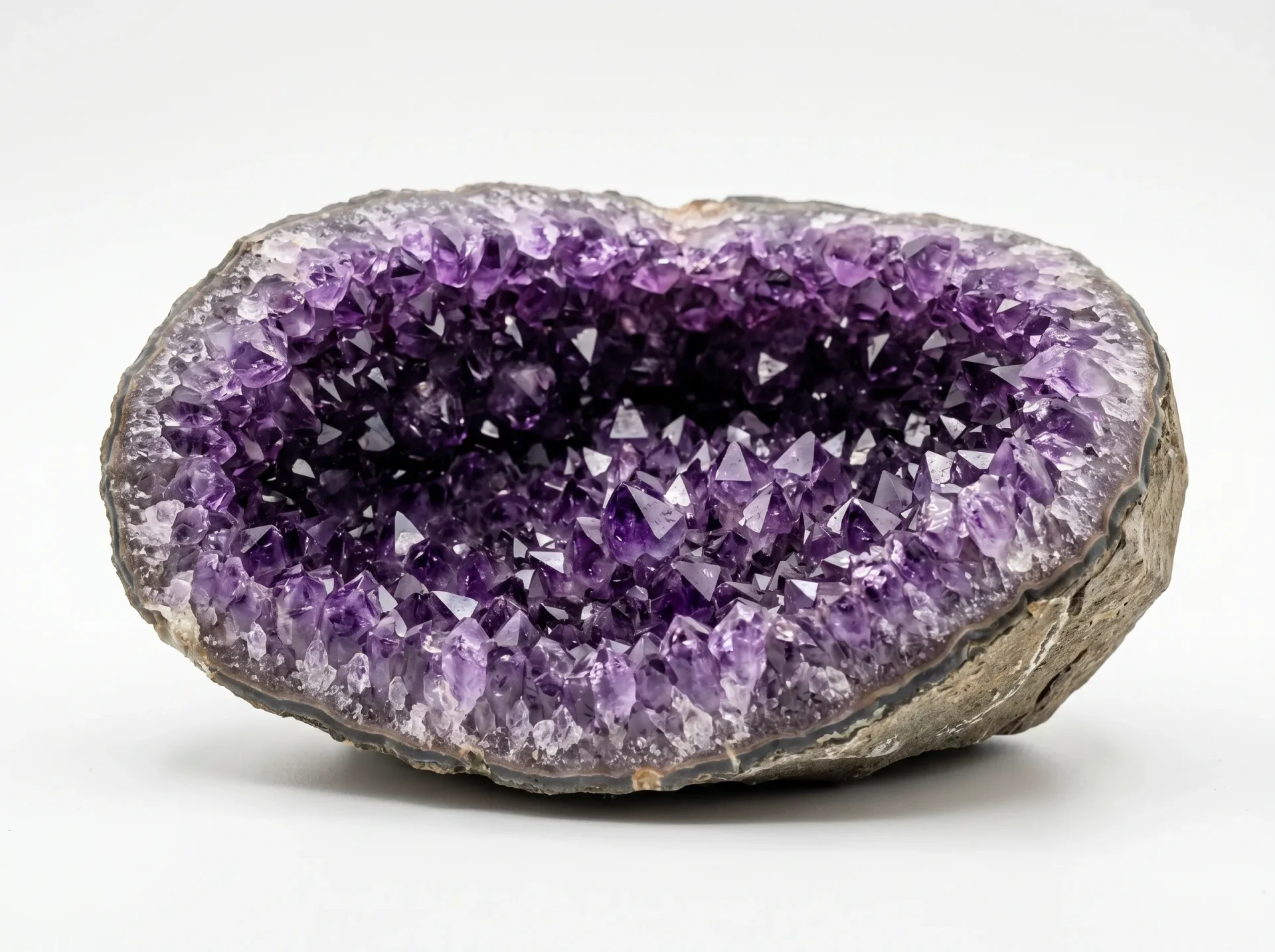
Amethyst Geode Buying Guide: What to Look For Before You Buy

Most people buying an amethyst geode for the first time are working with incomplete information. They know they want one. They’ve seen the photos. What they haven’t found yet is a clear answer to the questions that actually matter: what makes one geode worth $200 and another worth $1,500, why two pieces labeled “Brazilian amethyst” can look nothing alike, and what an honest seller will tell you that a vague one won’t.
After completing GIA gemology coursework and sourcing amethyst geodes from established wholesale partners in Brazil and Uruguay for several years, I’ve had the chance to look closely at a lot of specimens. This guide covers what I actually look at — and what I’d want to know if I were buying for the first time.
What Is an Amethyst Geode, Exactly?
A geode starts as an empty cavity inside volcanic rock — a bubble, essentially, left behind by gas escaping from cooling lava. Over millions of years, mineral-rich water seeps in, and silica slowly crystallizes along the inner walls. When those crystals contain trace amounts of Fe³⁺ — ferric iron ions activated by natural radiation — the result is amethyst: the purple variety of quartz.
What you’re buying when you buy an amethyst geode is that cavity, now lined with crystals, split open or cut to reveal the interior. The outer shell is typically basalt — dark, rough, unremarkable-looking. The interior is where everything happens.
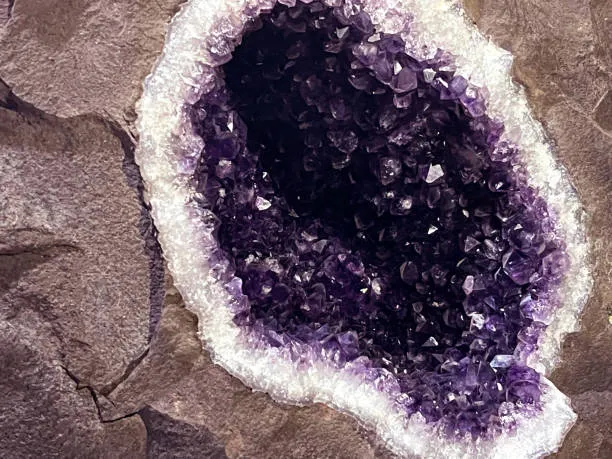
A few form distinctions worth knowing before you start shopping:
- Geode / Amethyst Cave: The general category. A hollow rock with crystal-lined interior, ranging from grapefruit-sized to taller than a person.
- Cathedral Geode: A tall, freestanding geode — shaped roughly like an arch or doorway — that can stand upright on its own. These are the statement pieces you see in hotel lobbies and high-end interiors. Museum-quality examples can reach several feet in height.
- Cluster: Not hollow — a flat or irregular base with multiple crystal points growing upward from it. Visually similar energy, different form. Often less expensive than a comparable geode for the same surface area of crystal.
For a full breakdown of amethyst forms and what each is best suited for, the amethyst crystal forms guide covers the complete range.
The Four Things That Actually Determine Quality
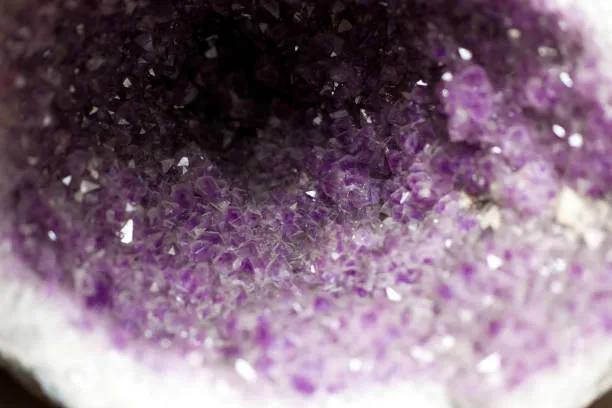
Color, crystal density, matrix quality, and origin transparency. In that order.
1. Color depth The purple in amethyst comes from Fe³⁺ — ferric iron — that was activated by natural radiation during the crystal’s formation. The concentration and distribution of those iron ions determines how deep the color runs. The range goes from pale lavender (light, washed-out, common) through medium violet to what the industry calls “emperor purple” or “royal purple” — a deep, saturated tone with visible depth when you look into the crystal. The deepest colors are predominantly found in Uruguayan specimens.
One thing to understand: natural color zoning — the uneven distribution of color within the crystal, where some areas are deeper and some lighter — is a marker of authenticity, not a flaw. Perfectly uniform, flawlessly even purple across an entire geode is worth a second look. Natural formation doesn’t produce that kind of consistency.
2. Crystal density and formation Tightly packed, well-formed crystal points with clear terminations generally indicate better quality than loose, poorly formed, or broken crystals. Look at the density of the coverage: are the crystals evenly distributed across the inner surface, or are there large bare patches of matrix?
3. Matrix (base rock) quality The basalt shell that forms the exterior of the geode is not a flaw to be hidden — it’s evidence of the geological process that created the amethyst. A solid, intact matrix without excessive cracking or flaking means the piece will remain stable as a display object for years. Heavy repairs or reconstruction of damaged matrix are worth noting if a seller is willing to disclose them.
4. Origin transparency A seller who can tell you which country, and ideally which region, the geode came from has more accountability than one who can’t. This matters not just for provenance but because origin is directly linked to color character. We’ll get into that in the next section.
For a deeper look at how quality is assessed across the full spectrum, the amethyst quality grading guide covers the terminology in detail.
Brazil vs. Uruguay: Which Origin Should You Choose?
This is the question I get asked most often, and it has a logical answer — once you know what you’re optimizing for.
Brazilian amethyst (primarily from Ametista do Sul, in Rio Grande do Sul state — the world’s largest amethyst mining region) tends to produce larger cavities with a wider color range. You’ll find everything from soft lavender to solid medium violet. The crystals are often larger and more dramatic in scale. For someone who wants maximum visual presence at a reasonable price, Brazil is usually the answer.
Uruguayan amethyst produces smaller, more densely packed crystals with significantly deeper color. The emperor purple that defines the top of the market — that dark, almost blue-tinged violet — comes almost exclusively from Uruguay. The tradeoff is price: comparable specimens from Uruguay typically run 30–80% higher than Brazilian equivalents of the same size.
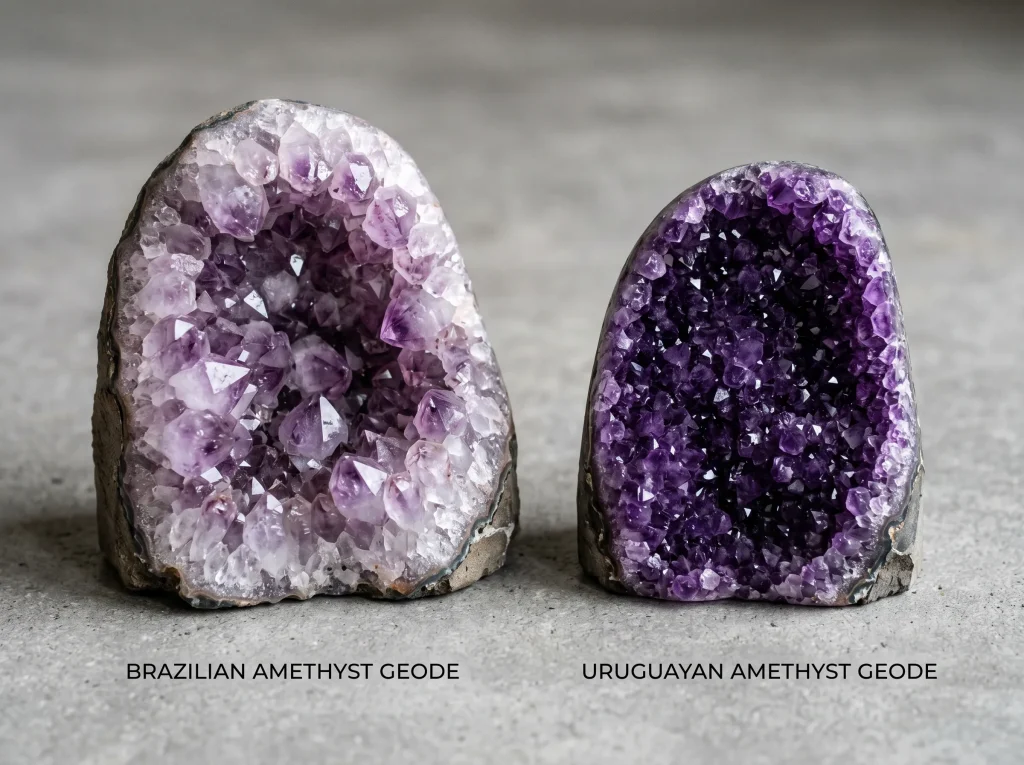
The question I usually ask someone trying to decide: do you want something large and visually commanding, or do you want the deepest color possible? Those two things rarely come at the same price point in the same piece. If you want both, you’re looking at the upper end of the market.
Our geodes are sourced from established wholesale partners in Ametista do Sul, Brazil and Uruguay. The origin of each piece is noted in the product listing.
How to Read a Geode Listing — And What Red Flags to Watch For
The difference between a trustworthy geode listing and a vague one usually comes down to a few specific signals.
What to look for:
- Individual photos of the actual piece. Not stock photography, not a representative example — the specific geode you’re buying, photographed from multiple angles under consistent lighting.
- Weight and dimensions noted precisely.
- Origin disclosed by country, ideally by region.
What to be cautious about:
- The label “AAAA grade.” There is no internationally recognized grading standard for amethyst geodes — no GIA equivalent, no independent certification body. The A/AA/AAA/AAAA system was self-assigned by sellers and means something different at every shop that uses it. A seller who grades everything AAAA has told you nothing about quality. We don’t use that label. We describe what we can actually measure: origin, color depth, crystal density, weight, and dimensions.
- Suspiciously low prices on large Uruguayan pieces. A genuine Uruguayan geode with deep emperor purple and tight crystal formation has a floor price that reflects its rarity. If you’re seeing a large, deep-purple Uruguayan piece at a price that seems implausible, it’s worth asking questions before buying.
- Listings where the photo is clearly generic — the same image used for multiple listings, or a stock photo that doesn’t show any identifying characteristics of the actual piece.
I remember my first time at a major mineral show. When I asked a vendor specifically which region in Uruguay a piece came from, his entire demeanor changed; he dropped the standard sales pitch and spent twenty minutes discussing the actual geology of the mines. A seller’s reaction to a direct question about origin tells you everything you need to know about their supply chain.
What Size Amethyst Geode Do You Actually Need?
Bigger is not always better. The right size depends on where you’re putting it and what you want it to do in the space. I write the weight of every geode in our listings — precise to the gram — because weight is the most reliable proxy for scale when you can’t hold something in your hands. A photo doesn’t tell you how large a piece is. 340 grams tells you it’s something you can comfortably pick up and move. 4.2 kilograms tells you it needs a dedicated surface and is probably not moving often.
Here’s a practical framework by placement:
- Nightstand / desk surface: Up to 1–2 kg. You want something with presence but not something that crowds the surface or feels precarious. A small to medium geode or a compact cluster works well here.
- Bookshelf / mantelpiece: 1–4 kg, depending on shelf depth and load capacity. This is the range where you start getting genuinely dramatic color and crystal coverage. Measure your shelf depth first — a geode that overhangs more than a couple of inches is a stability issue.
- Coffee table / console table centerpiece: 3–8 kg. At this size, you’re working with a piece that anchors a surface rather than sitting on it. These are the geodes that visitors actually comment on.
- Floor placement / living room statement piece: 8 kg and up. Large cathedral geodes in this range are room-defining objects. They need a stable, level surface and should be placed away from high-traffic areas where they could be knocked.
The largest geodes — the kind that stand at hip height with interior walls so densely packed the crystal points catch light from across a room — occupy a different category entirely. I stood in front of one at a mineral show for about fifteen minutes once. The price was $4,200. I didn’t buy it; I didn’t have the space. But the color was a deep violet that shifted toward black at the base and went clear at the tips of each point. That’s the top of what this material can do.
What Should an Amethyst Geode Cost? An Honest Price Guide
Here is what the market actually looks like, without the marketing.
- $50–$150: Small geodes, typically Brazilian, in the lavender to medium violet range. Crystals may be less densely packed. Good entry point for someone who wants to understand the material before committing more. At this price, expect a piece that fits comfortably in one hand.
- $150–$400: The main market for quality Brazilian geodes and smaller Uruguayan pieces. This is where you start finding meaningful color depth and solid crystal formation. A well-chosen piece in this range can be genuinely impressive on a shelf or nightstand.
- $400–$1,500: Larger Brazilian cathedral forms and mid-to-high quality Uruguayan geodes. Color depth becomes more consistent in this range, and you’re looking at pieces that make a real statement in a room. This is also where WYSIWYG (what you see is what you get) photography becomes essential — individual variation is significant at this price.
- $1,500 and above: Museum-quality pieces, large-format cathedral geodes, and Uruguayan specimens with exceptional emperor purple coloration. These are not impulse purchases. If you’re buying in this range from an online seller, insist on video footage in natural light and ask directly about the return policy for large pieces.
One honest note: if you’re seeing deep-purple Uruguayan geodes at dramatically below-market prices, something in the chain is worth questioning — origin, treatment history, or the quality of what’s actually shown versus what ships.
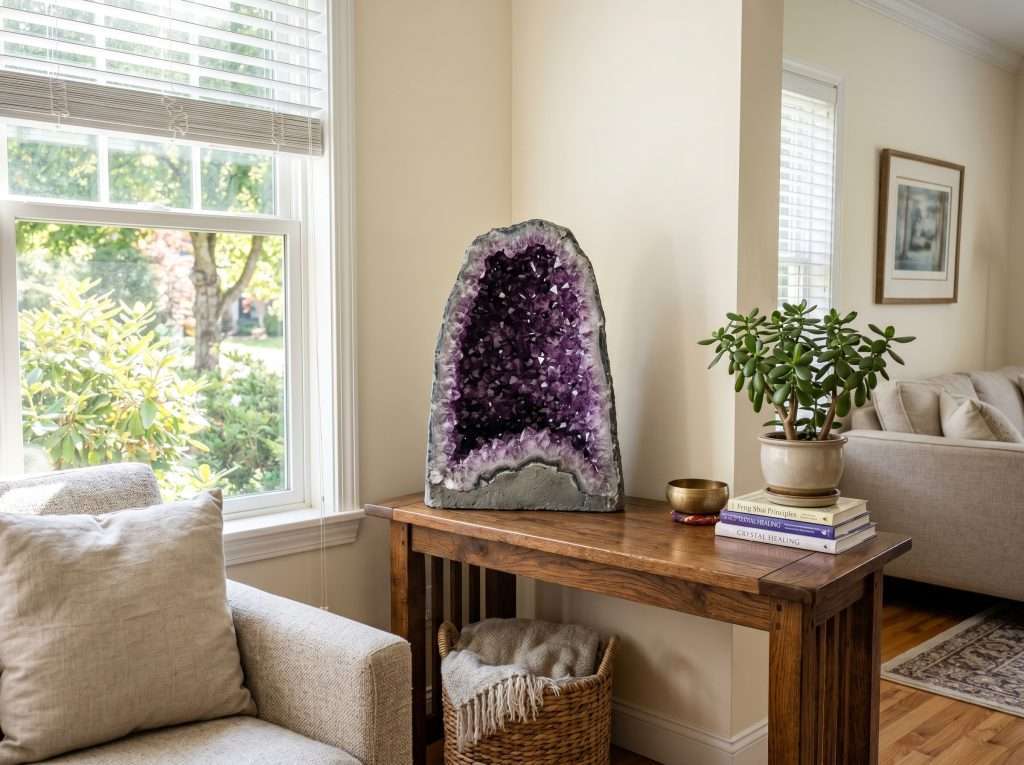
Where to Place Your Amethyst Geode at Home
Traditional feng shui places the amethyst geode in the southeast wealth corner of a room or home — the area associated with abundance and prosperity. This is one of the most common reasons people purchase large geodes, and it’s a placement that has a practical logic beyond the metaphysical: the southeast corner often catches good afternoon light, which makes the crystals visible without risking UV damage from direct sun.
Other placements worth considering:
- Living room: A floor-standing or large tabletop geode as a room anchor. Keep it away from south-facing windows with direct afternoon sun — sustained UV exposure causes irreversible color fading.
- Bedroom: A medium geode on a low shelf or dresser adds both visual calm and the traditional association with amethyst and sleep. Keep it off the windowsill for the same UV reason.
- Home office / study: Northeast placement in feng shui tradition is associated with knowledge and clarity. A cluster or medium geode on the desk keeps the visual presence without taking up the working surface.
- Entryway: A geode near the entry of a home is a traditional placement for protection and welcoming energy. Practically, it’s also the first thing visitors see.
Whatever placement you choose, the one consistent rule is indirect light. Ambient light, lamp light, and morning window light are all fine. Direct midday or afternoon sun is not — the purple will fade, and it will not come back.
What to Ask Before You Buy — And What the Answers Tell You
Three questions worth asking any seller before you commit to a geode, especially at higher price points:
- “Where is this piece from?” A specific answer — Ametista do Sul, Brazil; or a named Uruguayan mining region — indicates the seller knows their supply chain. “South America” or “natural amethyst” is not an answer.
- “Is this the actual piece I’ll receive?” The answer should be yes, and the listing photos should show it. If a seller is using representative photography — one photo for a category of similar pieces — you have no visibility into what ships.
- “What’s the return policy if it arrives damaged?” For large, heavy pieces, a seller who makes you ship a 10-kilogram geode back at your expense is a seller whose packaging you should scrutinize carefully before you order. Damage-on-arrival policies tell you how much confidence a seller has in their own shipping.
At Zerevia, every geode in our collection is photographed individually — the piece in the listing photo is the piece that ships. Origin is disclosed in every listing. And if something arrives damaged, we don’t ask you to return it at your expense.
You can browse our current selection of amethyst caves and geodes — each one individually photographed and origin-documented — here. For the full range of amethyst crystals including clusters, towers, and raw pieces, the complete collection is here.
About this article Written by Serena Delaney, Founder of Zerevia · GIA Gemology Graduate. Content is based on hands-on specimen assessment, GIA gemology coursework, direct supplier sourcing, and questions collected from our customers. Where conclusions are based on personal observation rather than third-party testing, this is noted in the text. Last reviewed: April 2026
 Crystal Cluster
 Crystal Tower
 amethyst crystal ball
 Amethyst Caves for Sale
 Amethyst Bracelets
 Amethyst Earrings
 Amethyst Necklaces
 Amethyst Rings
 amethyst crystal healing
 Amethyst Beauty & Wellness
 Crystal Home Decor
 Spiritual & Divination Tools