
Amethyst for Sleep: How to Use It for Better Rest Tonight

Most guides on amethyst and sleep will tell you it “promotes restful energy” and leave it there. This one won’t.
After completing GIA gemology coursework and sourcing amethyst from the same regions for years, I’ve had enough conversations with buyers — and enough sleepless nights of my own — to know that the question isn’t really whether to use amethyst for sleep. It’s how, specifically, in a way that actually fits into a real bedroom and a real routine.
Here’s what I’ve learned.
Why People Have Used Amethyst in the Bedroom for Centuries
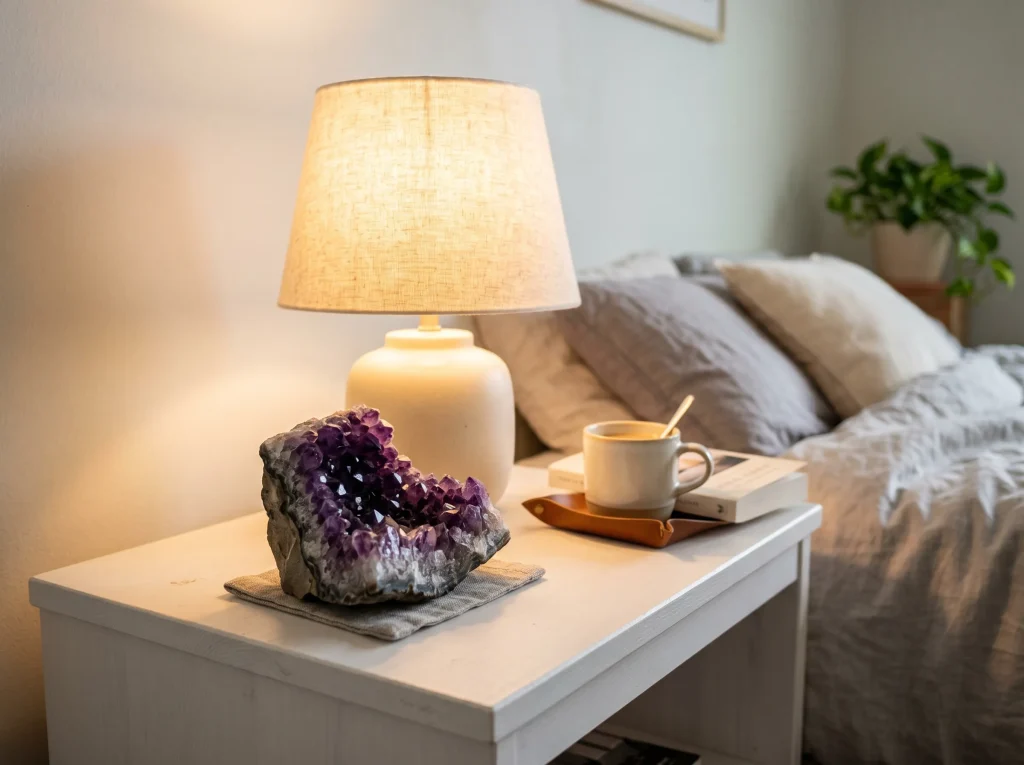
The Greek name for amethyst — amethystos — means “not intoxicated.” Ancient Greeks believed the stone kept the mind clear and calm under pressure. For centuries across cultures, people have placed amethyst near their beds not because of abstract energy claims, but because having an intentional object in the space where you’re trying to rest does something concrete: it gives your mind something to land on.
There’s also a simpler reason amethyst has stayed in bedrooms across centuries: it’s a genuinely pleasant thing to reach for in the dark. Real amethyst — the kind sourced from the volcanic formations of Ametista do Sul in Brazil or the deep-purple deposits of Artigas, Uruguay — feels cool and slightly heavy in your hand. That tactile quality isn’t mystical. It’s geology: natural quartz holds ambient temperature longer than glass or synthetic alternatives, which is part of why it registers as calming to the touch.
One buyer recently mentioned to me that placing a cluster on her nightstand finally gave her racing thoughts a physical endpoint. We can’t promise amethyst will fix your sleep. What we can tell you is that people have been reaching for it at bedtime for a very long time, and the reasons aren’t entirely hard to understand.
Where to Place Amethyst for Sleep — And Where Not To
This is where most guides are unhelpfully vague. So let’s be specific.
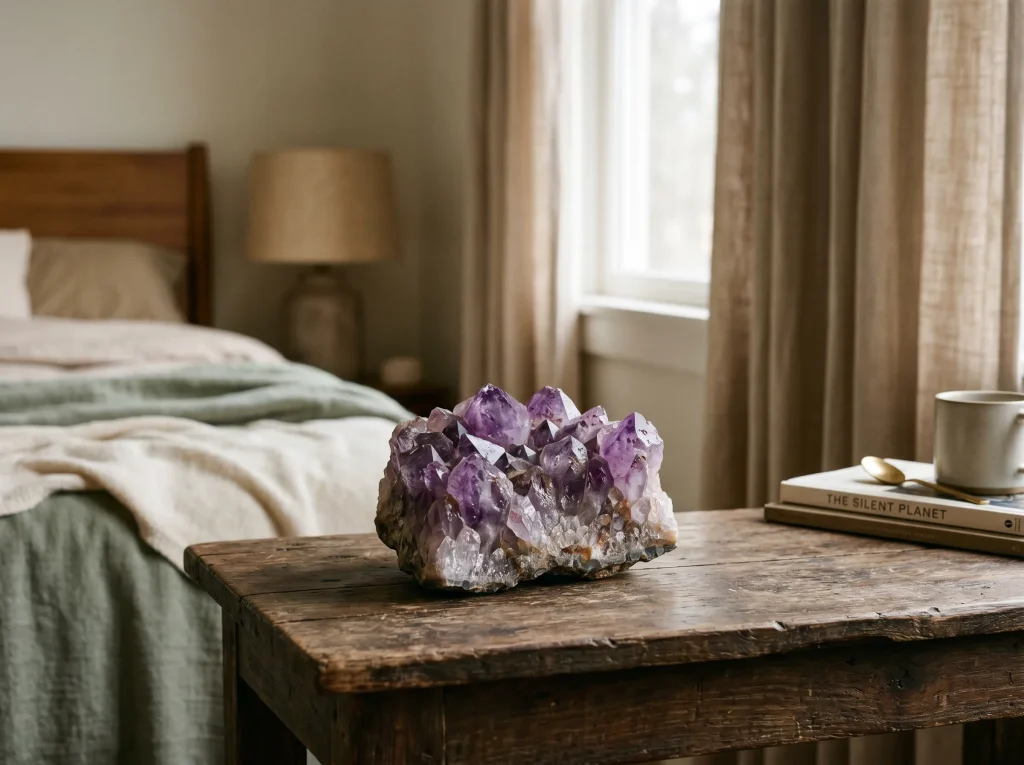
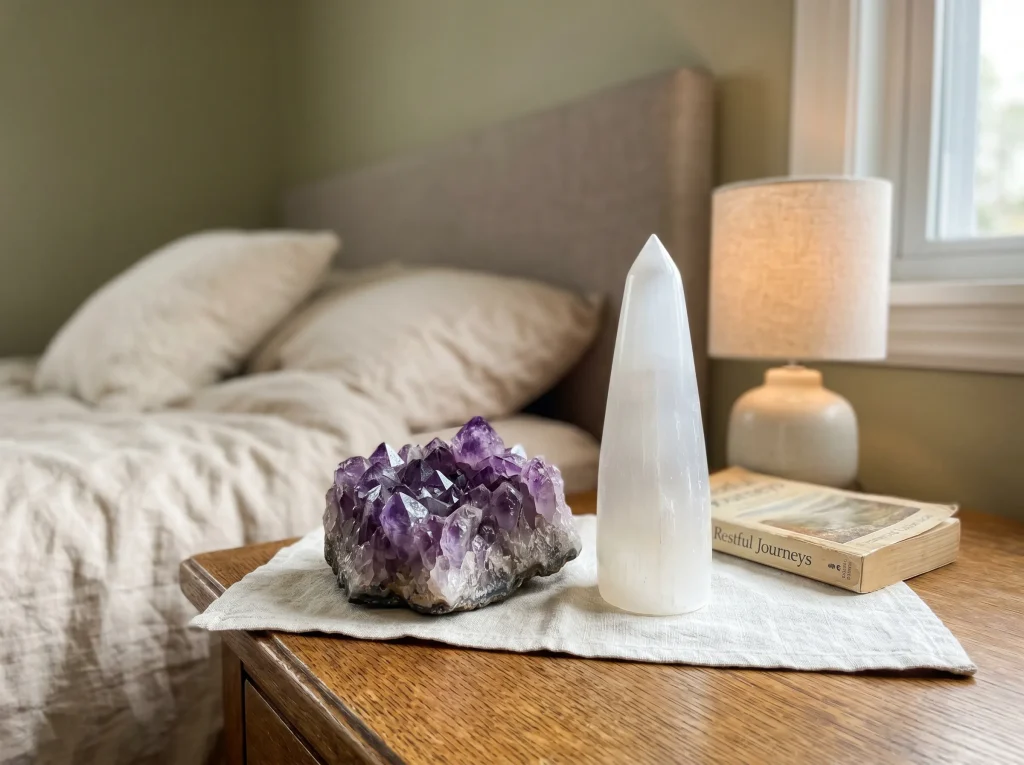
The bed area that works best: Your nightstand is the most practical starting point — within arm’s reach, visible when you open your eyes, easy to incorporate into a before-sleep routine. Either side works; this is a personal preference, not a directional rule. If you’ve heard that amethyst towers should point toward your head, that’s a traditional feng shui convention, not a fixed requirement. Place it where it won’t get knocked over.
Other effective placements: The shelf closest to the bed, a window ledge on the non-south-facing side of the room, or on the floor beside the bed if you’re working with a larger geode that won’t fit anywhere else comfortably.
Where not to place it: Any windowsill that receives direct afternoon sun.
This matters more than most sellers will tell you. The purple color in amethyst comes from Fe³⁺ — ferric iron ions — that were activated over millions of years by natural radiation inside the crystal. Sustained UV exposure reverses that process permanently. The purple fades to gray or pale lavender, and it does not recover.
A message I received a while back: a buyer had placed her amethyst tower on a south-facing sill where afternoon light came through for about two hours each day. By the time she reached out, the deep violet had shifted to a dull lavender at the base — that reversal is permanent. I added a UV warning to every product description that week.
The bedroom placement rule is simple: ambient light, indirect light, bedside light — all fine. Direct sustained sunlight — not fine, ever.
Should You Put Amethyst Under Your Pillow?
Yes — with conditions.
What works under a pillow: Tumbled stones and palm stones are the right form for this. They’re smooth, lightweight, and won’t press uncomfortably into your neck or wake you when you shift positions. Many people keep a small tumbled amethyst in their pillowcase rather than directly under the pillow, which gives the same proximity without the lump.
What doesn’t work under a pillow: Clusters, points, towers, and geodes. The reasons are practical: raw crystal points have edges. Clusters have multiple fragile terminations that can break under pressure. A small geode weighs enough to be actively uncomfortable. These forms are better suited to the nightstand or shelf.
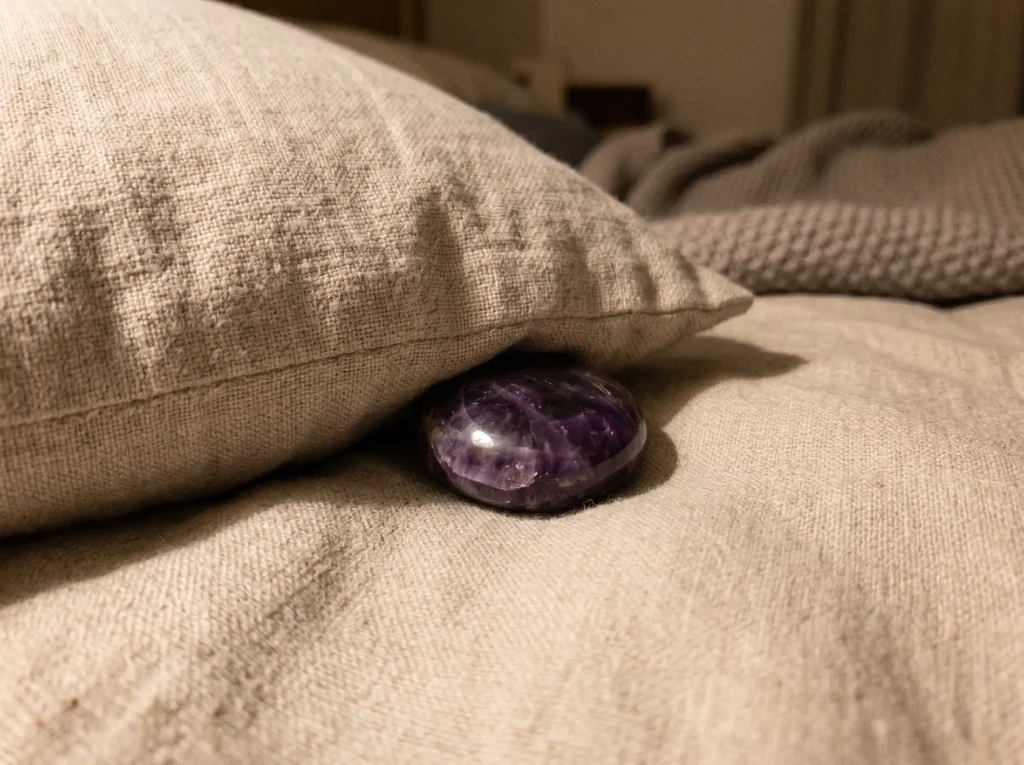
If you’re sensitive to the idea of anything under your pillow at all, placing a tumbled stone inside your pillowcase for a trial week is a low-stakes way to find out whether you notice anything. You’re out nothing if it doesn’t work for you.
How to Build a Sleep Ritual Around Your Amethyst
The most honest thing I can say about using amethyst for sleep is this: the stone itself is one part of it. The ritual around it is the other part — and the ritual may be doing more work than people admit.
Here’s a simple version that takes about three minutes:
- Step 1 — Clear the surface. Whatever is on your nightstand that doesn’t belong there, move it. The amethyst should have a clear spot.
- Step 2 — Hold it briefly before you put it down. Not for any mystical reason — because holding it for ten seconds pulls your attention away from your phone and toward something physical and quiet.
- Step 3 — Write down anything that’s still unresolved from the day. Not to solve it — just to give it a place to live outside your head. A notepad works. A sticky note works. The goal is to tell your brain: this is being held somewhere. You don’t have to keep running it.
I’ve done a version of this for years — a sticky note on the nightstand, no more than five things on it. Not a to-do list exactly. More like a parking lot. The items that are still there in the morning are usually the ones that needed a full night to sort themselves out anyway.
- Step 4 — Set the amethyst down, lights off. That’s it.
This kind of pre-sleep sequence works because it creates a consistent cue for your nervous system: these steps mean sleep is coming. The amethyst is part of that cue — a sensory anchor you can reach for in the dark if you wake up at 2am and your thoughts start running again.
Which Amethyst Form Works Best for Sleep?
Different forms suit different uses and different spaces. Here’s an honest breakdown:
- Tumbled stones and palm stones are the most versatile sleep companions. Affordable, safe to handle in the dark, and genuinely pleasant to hold. Best if you want something on your person or very close to hand.
- Amethyst clusters work well on the nightstand or shelf — the branching crystal structure is visually calming and they double as a charging station for other small stones. Not for under the pillow.
- Crystal towers and points are a good nightstand choice if you want a focused visual anchor. The pointed form is traditional for directional energy work, though from a practical standpoint, their main advantage is that they don’t roll off the shelf.
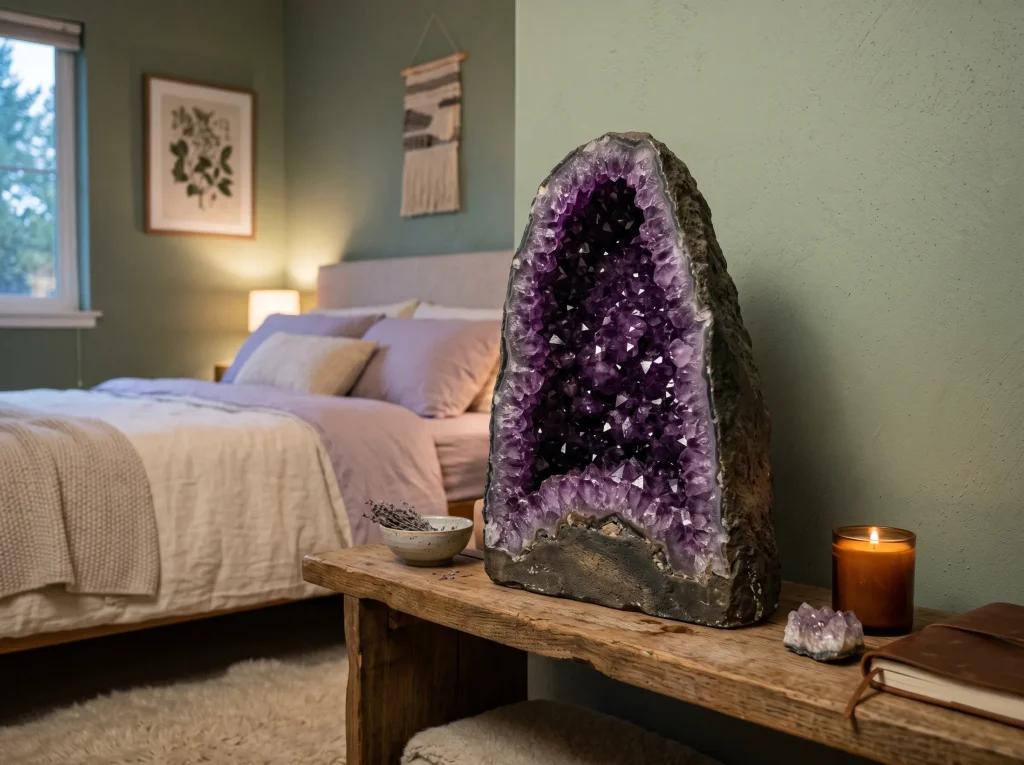
- Amethyst geodes and caves are the highest-investment sleep option — and arguably the most effective as a room-presence piece. A mid-sized geode on a dresser or low shelf changes the quality of the space in a way that a small tumbled stone simply doesn’t. If you’re dealing with genuinely disruptive sleep and want to give this a real try, a geode is worth considering.
All of our geodes are sourced from established wholesale partners in Ametista do Sul (Brazil) and Artigas (Uruguay), and each piece is photographed individually — what you see in the listing is the exact piece that ships to you. You can browse available amethyst caves and geodes here.
What to Pair with Amethyst for Better Sleep
A few combinations worth knowing:
- Amethyst + Selenite: A low-maintenance pairing. Selenite is traditionally considered self-cleansing and won’t need the same maintenance routine as other crystals. Placing selenite alongside amethyst on the nightstand is one of the quieter, less fussy setups.
- Amethyst + Rose Quartz: The calm-plus-comfort combination. Rose quartz is associated with emotional ease; the two together are a common recommendation for anxious sleepers specifically.
- Amethyst + Black Tourmaline: For people who sleep lightly and wake at sounds or disturbances. Black tourmaline is traditionally associated with protective and grounding energy — often placed near the door or at the foot of the bed rather than at the head.
One practical note: avoid pairing amethyst with stones that are typically charged in direct sunlight — citrine and carnelian being the most common examples. If your sleep setup includes amethyst, you’re keeping it away from UV. Make sure your other stones can share that same placement condition.
How Often Should You Cleanse Your Sleep Amethyst?
Once a month is a reasonable baseline. If you’re using it every night — holding it, placing it deliberately, building a routine around it — some practitioners suggest every two weeks.
- The safest method: Moonlight. Leave it on a windowsill overnight during a full or new moon. The indirect ambient light that comes through glass is fine; what you’re avoiding is sustained direct midday sun, not moonlight or morning light.
- Second option: Sound. A singing bowl held near the crystal for a minute or two is effective and has no risk to the stone whatsoever.
- What to avoid: Extended salt water soaking. Salt can gradually erode the iron-based matrix and inclusions that are, ironically, some of the clearest evidence of authenticity. A brief rinse with plain water is fine for physical cleaning; don’t leave it sitting in a salt solution overnight.
For more on caring for your amethyst long-term, the complete amethyst care guide is here.
A Note on What Amethyst Can and Can’t Do
Amethyst is not a sleep medication. It doesn’t interact with your neurochemistry, and there are no clinical studies demonstrating that crystals directly affect sleep quality. If you’re dealing with a diagnosed sleep disorder or serious anxiety, please talk to a healthcare provider — that’s not a disclaimer I’m adding to cover myself, it’s genuinely what I’d say to a friend.
If you are curious about amethyst’s broader healing properties, it is important to remember the context is always traditional belief. What amethyst can do, in our experience: it gives people a concrete object to build a pre-sleep intention around. The ritual of placing it, holding it, associating it with the transition from awake to asleep — that’s real. Whether you want to call that energy, habit formation, or mindfulness practice, the mechanism is the same.
For centuries, people have placed amethyst near their beds to quiet a busy mind. We can’t promise it’ll work for you. But we can tell you the stone is real, the origin is documented, and the ritual is worth trying.
If you’re ready to find the right piece for your bedroom, browse our full collection of amethyst crystals and geodes here.
About this article Written by Serena Delaney, Founder of Zerevia · GIA Gemology Graduate. Content is based on hands-on specimen assessment, GIA gemology coursework, direct supplier sourcing, and questions collected from our customers. Where conclusions are based on personal observation or traditional belief rather than third-party testing, this is noted in the text. Last reviewed: April 2026
 Crystal Cluster
 Crystal Tower
 amethyst crystal ball
 Amethyst Caves for Sale
 Amethyst Bracelets
 Amethyst Earrings
 Amethyst Necklaces
 Amethyst Rings
 amethyst crystal healing
 Amethyst Beauty & Wellness
 Crystal Home Decor
 Spiritual & Divination Tools