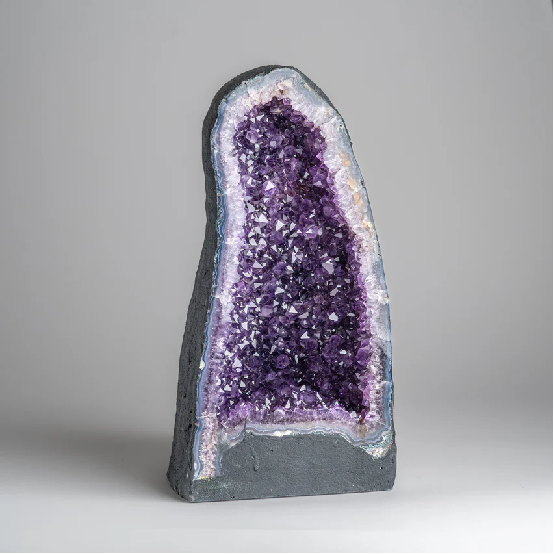
Uruguayan Amethyst Cave: How a Piece of “Purple Gold” Conquered the Collecting World

“In my time handling these stones, Uruguayan geodes are consistently the ones I find hardest to put back down. Not because of what they’re supposed to mean — because of what they actually look like. Under a direct light, a deep Artigas piece goes almost black, then opens into blue-violet when you shift the angle. That color took about 130 million years and a very specific set of geological conditions to happen. I find that worth knowing.” — Serena
Why can a piece of uncut, raw stone command tens of thousands of dollars at auction houses like Christie’s?
In the global mineral-collecting world, the Uruguayan Amethyst Geode (or Cave) stands as a mysterious and captivating treasure. With its intensely deep purple hue, pristine crystal points, and rare geological origin, it has earned the nickname “Purple Gold” among collectors — not a marketing term, just what people in the trade started calling it. Today these geodes turn up in high-end interiors, meditation spaces, and serious mineral collections alike.
But what exactly makes the Uruguayan Amethyst Cave so fiercely sought after? Is its beauty merely a visual impact, or does it carry deeper energetic and collectible value? Let’s dive into the geological wonders, the investment logic, and the metaphysical power of this extraordinary natural artifact.
1. The Geological Alchemy: Born in Volcanic Basalt
Unlike typical tumbled quartz, a true Uruguayan amethyst geode is a perfectly preserved ecosystem of time. Millions of years ago, violent volcanic activity left massive gas cavities within cooling basalt lava. Over eons, silica-rich hydrothermal fluids seeped into these cavities.
In the famous Artigas region of Uruguay, the geological cocktail is exceptionally rich in specific trace elements—namely, trivalent iron ($Fe^{3+}$). Combined with natural earth radiation, this unique mineral environment birthed the signature Uruguayan traits:
- The Deepest Purple on Earth: Often referred to by gemologists as “grape jelly” or “deep Siberian” purple, possessing a dense, royal saturation.
- Pristine Crystal Points: Short, highly reflective, and flawlessly terminated quartz points that sparkle with a glass-like luster.
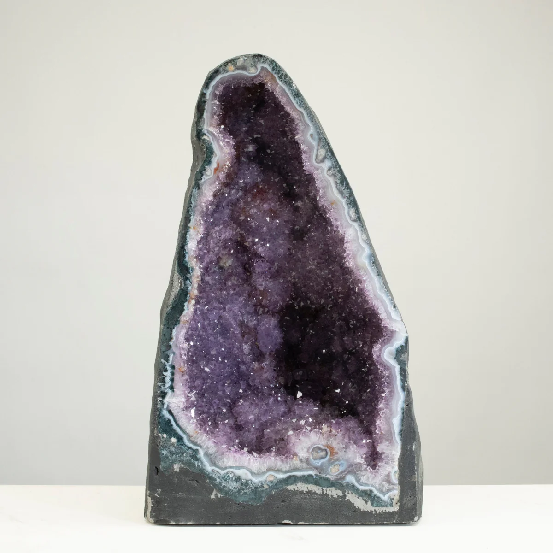
- The Natural Matrix: A stark, beautiful contrast between the dark, rough volcanic basalt shell and the brilliant purple interior.
(Want to dive deeper into how volcanic fire created these stones? Read our Amethyst Geological Sources Guide.
2. Behind the Name “Purple Gold”: The Logic of Collection & Investment
Why do interior designers and high-end collectors prefer Uruguayan geodes over any other variety? In the luxury mineral market, a top-tier Uruguayan geode is recognized as “hard currency.”
1. Rarity and Value-Preserving Power
While Amethyst is generally accessible, massive, intact caves with flawless, deep purple saturation are incredibly rare. High-quality Uruguayan geodes have repeatedly fetched staggering prices at Sotheby’s and Christie’s, with large, museum-grade caves often exceeding $30,000. For collectors, size equals presence, and a premium geode is viewed as an investment-grade art piece.
2. The Ultimate “Statement Piece”
High-end interior designers use these large geodes to anchor a room. Whether it’s in a corner office, a home study, or a bedroom — a large geode with deep color changes the feel of a room in a way that’s hard to explain until you’ve seen it. The contrast between the rough basalt shell and the violet interior does something that polished decorative objects don’t.
3. More Than Just Beauty: A Sanctuary for the Mind
In traditional metaphysical practice, amethyst has long been associated with the third eye and crown — intuition, mental quiet, the ability to stop turning things over at 2am. Whether you approach this literally or as a framework for intention, people have placed these stones in their living spaces for exactly this purpose for a very long time.
For Feng Shui placement, the traditional recommendation is the Southeast corner of a room — the ‘wealth corner’ in classical Bagua mapping. A deep, concave geode is considered ideal because the opening faces inward, gathering rather than dispersing. We can’t promise the financial outcomes. The placement logic is at least internally consistent.
4. Care & Placement: Honoring Your Geode
Owning a piece of purple gold requires basic but crucial care to preserve its beauty and energy. Because natural quartz has a Mohs hardness of 7, it is resilient, but it has one major weakness.
- Strategic Placement: Place it in a living room as a conversation starter, or in a study to promote mental clarity and focus.
- Beware the Sun (Crucial!): Natural amethyst is highly photosensitive. Never place your geode in direct UV sunlight. Prolonged exposure will permanently alter the iron ions, fading your deep Uruguayan purple into a dull gray.
- Energetic Cleansing: If you use the stone as part of a regular practice, a lot of people reset it monthly — moonlight overnight is the most common method, and it won’t damage the stone. Whether that does anything energetically, we genuinely can’t say. It doesn’t hurt, and it gives you a reason to actually look at the piece once a month.
Conclusion: Own a Piece of Earth’s Legacy
Whether you are seeking a collector’s item, a structural piece for a room, or an unforgettable gift, a high-quality Uruguayan amethyst cave offers a profound connection to geological history.
The Large Uruguayan Cave Series ranges from 10 to 65 pounds, priced from $479 to $3,150. Every piece is sourced from established wholesale partners in Artigas, individually photographed, and numbered. What you see in the listing is what ships.
If you’ve been looking for one, they’re here. [Browse the collection →]
Frequently Asked Questions (FAQ)
What is the exact difference between a Uruguayan and a Brazilian amethyst geode?
It primarily comes down to color, crystal size, and overall shape. Brazilian geodes are famous for their towering, massive sizes (often called “Cathedral Geodes”) and usually feature a lighter, lilac or lavender purple with larger crystal points. Uruguayan geodes, mined from the Artigas region, are typically smaller and rounder but are globally prized for their incredibly dark, rich “Deep Siberian” purple and highly reflective, tightly packed crystal points.
Why are these large Uruguayan caves so expensive?
Price is dictated by extraction difficulty and rarity. Mining intact, large volcanic gas cavities from hard basalt rock without shattering the delicate crystals inside is an engineering marvel. When you combine massive size with the rare, unheated “Deep Siberian” color grade, you are looking at a geological anomaly that took 130 million years to create.
How do I know my Uruguayan geode is real and not dyed glass?
A genuine Uruguayan geode will always have a natural matrix — the rough basalt and agate shell that formed around the crystals. Avoid anything sold without origin documentation, or with suspiciously uniform color and no visible inclusions. Our pieces come with individual photos and sourcing documentation from our wholesale partners in Artigas. If you have questions about a specific piece, ask before you buy — we’ll tell you what we know about it.
 Crystal Cluster
 Crystal Tower
 amethyst crystal ball
 Amethyst Caves for Sale
 Amethyst Bracelets
 Amethyst Earrings
 Amethyst Necklaces
 Amethyst Rings
 amethyst crystal healing
 Amethyst Beauty & Wellness
 Crystal Home Decor
 Spiritual & Divination Tools