Amethyst for Anxiety: Does It Really Work? What You Need to Know

If you’ve been staring at the ceiling at 2am more often than you’d like to admit — this is the part most crystal guides don’t tell you.
When you search for information on using an amethyst crystal for anxiety, the internet is quick to offer absolute certainty. Most articles will confidently state that it “definitely works,” listing it alongside drinking water and getting eight hours of sleep as a guaranteed cure-all for a stressed mind. But almost no one pauses to explain why it might work, or has the courage to admit what they simply do not know.
If you are dealing with genuine anxiety, the last thing you need is another empty promise. Here is our stance at Zerevia: we do not know if a purple stone will work for your specific situation. We cannot guarantee it will turn off a racing mind. But we can tell you three very real, documented things: the two-thousand-year history of its use, the grounded psychological mechanisms that explain why so many people find it helpful, and how to actually test it out for yourself without falling for industry hype.
First, the Honest Answer
To have a real conversation about using an amethyst crystal for anxiety, we first have to draw a hard line between medical claims and personal human experience.
There is no clinical research proving that holding a piece of quartz cures an anxiety disorder. It is not a medication, and it should never be treated as a replacement for professional therapy or medical care. However, the absence of a double-blind clinical trial does not mean the object has no value. It simply means we need to look at how humans interact with the physical world to understand its impact.
A few months ago, a buyer sent me an email with a very direct question: “Do you actually believe these stones have energy, or are you just selling them?” When she asked me that, I didn’t give her a mystical sales pitch. I told her the same thing I tell anyone who asks. I told her that I believe in the 200-million-year-old physical reality of the object, and I believe in the immense complexity of the human mind. When you take a tangible, ancient piece of the earth and combine it with a deliberate human intention, something shifts. I don’t sell medical treatments. I sell documented, authentic pieces of geology that people have used for centuries to help build a quieter place to land.
What History and Tradition Actually Tell Us
The idea of using this specific purple stone to steady the mind is not a trend invented by the modern internet. It is a continuation of one of the longest continuous traditions in recorded mineralogy.
The name itself gives us the first clue. It derives from the ancient Greek word amethystos, which translates literally to “not drunk” or “not intoxicated.” In classical antiquity, Greek and Roman citizens frequently wore the stone as an amulet or carved it into drinking vessels. While the literal interpretation was about preventing physical drunkenness, the broader cultural meaning was about maintaining clarity of mind—the state of not being overwhelmed, clouded, or intoxicated by chaotic passions.
For over two thousand years, people have traditionally associated this stone with maintaining a clear, grounded perspective. When you think about it, the modern experience of anxiety—the racing thoughts, the inability to focus, the feeling of being overwhelmed by external stimuli—is the exact opposite of that clear, sober perspective the ancients sought.
The traditional belief framework surrounding this stone has always been about purification of thought. It is about creating a boundary between the noise of the outside world and the quiet of the inner mind. For a deeper look at how these historical roots evolved across different cultures, you can explore the amethyst spiritual meaning.
The Psychology Behind Why It Might Help
If we step away from unverified claims and focus on observable human behavior, how does amethyst anxiety relief actually function in practice? This is the core question that most sellers ignore. Research in psychology and behavioral science points to several very real mechanisms that explain why interacting with physical objects can provide measurable comfort.
1. The Power of Intention Setting Research on intention-setting suggests that placing a physical object in your environment with a specific goal acts as a continuous cognitive cue. When you place a purple crystal on your nightstand with the specific thought, “This is my space for resting,” you are not casting a spell. You are creating a psychological anchor. Every time you look at that stone, it sends a deliberate, repeating signal to your brain, reminding you of your intention to wind down. In an anxious state, where the brain is constantly looking for threats, providing a visual cue of safety is a highly effective intervention.
2. Somatic Grounding (Tactile Feedback) This is perhaps the most immediate and physical intervention. When an anxiety spike or a panic attack begins, the brain often dissociates, losing its connection to the physical body and spiraling into “what-if” scenarios. Somatic grounding is a real psychological technique used to break this loop by forcing the brain to process intense, immediate physical sensations.
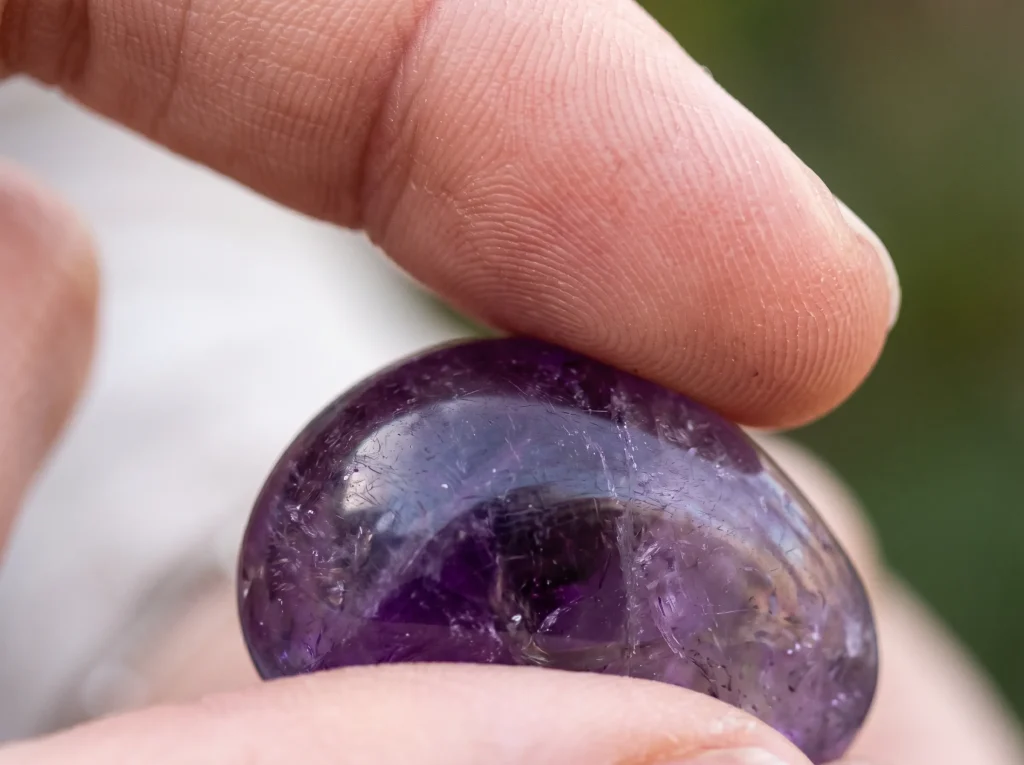
Many people find that holding a cold, heavy object forces this sensory redirect perfectly. A 340-gram natural mineral specimen feels distinctly dense. It is cold to the touch. The surface might be smooth in some places and jagged in others. Holding it tightly in your palm interrupts the physical feedback loop of stress by demanding the brain’s attention in the present moment.
3. Visual Attention Shift In color psychology, deep violet and purple hues are frequently associated with low-arousal states. When your eyes are exhausted from the harsh, high-arousal blue light of screens, spreadsheets, and endless scrolling, looking at a natural, non-emitting object provides a necessary visual reset. It is a deliberate shift of attention from the digital chaos to a quiet, natural geometry.
What We Can’t Tell You
If you are searching for what does amethyst do spiritually, you will eventually encounter thousands of web pages talking about specific frequencies, vibrational fields, and cellular realignment.
Here is the truth: we cannot verify those statements, and we will not pretend to know exactly how the unseen world operates. There are no clinical studies that measure the “frequency” of an anxiety attack against the “frequency” of a quartz crystal.
A while back, I was talking to someone at a local market who was highly skeptical of the whole concept. He picked up a cluster, weighed it in his hand, and asked me, “Do you really think rocks work for this stuff?” I told him, “I think real things have value.” We won’t make promises about magical energy fields. But we do know that having a tangible, authentic piece of the earth in your hands provides a specific kind of physical and psychological comfort that a plastic fidget spinner or another app on your phone simply cannot replicate.
What Actually Happens When You Use Amethyst for Anxiety — Real Scenarios
So, moving past the theory, how do people actually use amethyst for anxiety and stress in their daily, ordinary lives? It rarely involves elaborate ceremonies. It is usually much quieter.
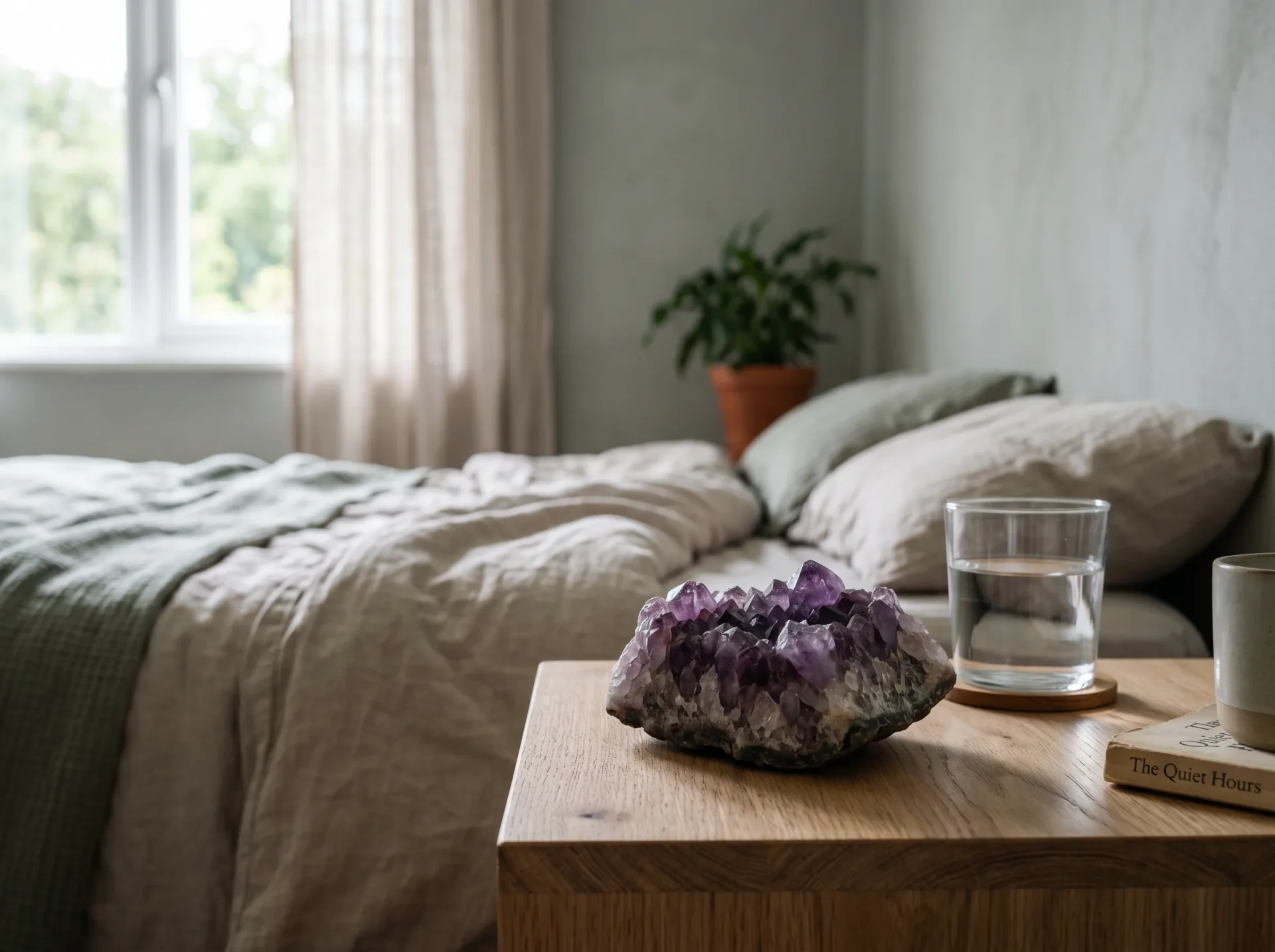
The Bedtime Ritual Using the stone at night isn’t about expecting it to emit a sleep-inducing aura while you lie there passively. It is about building a transition routine. You place the cluster on the nightstand. You touch the cool points of the stone. You turn off the lamp. You are signaling to your nervous system that the active portion of the day is over. It becomes the final physical touchpoint before sleep.
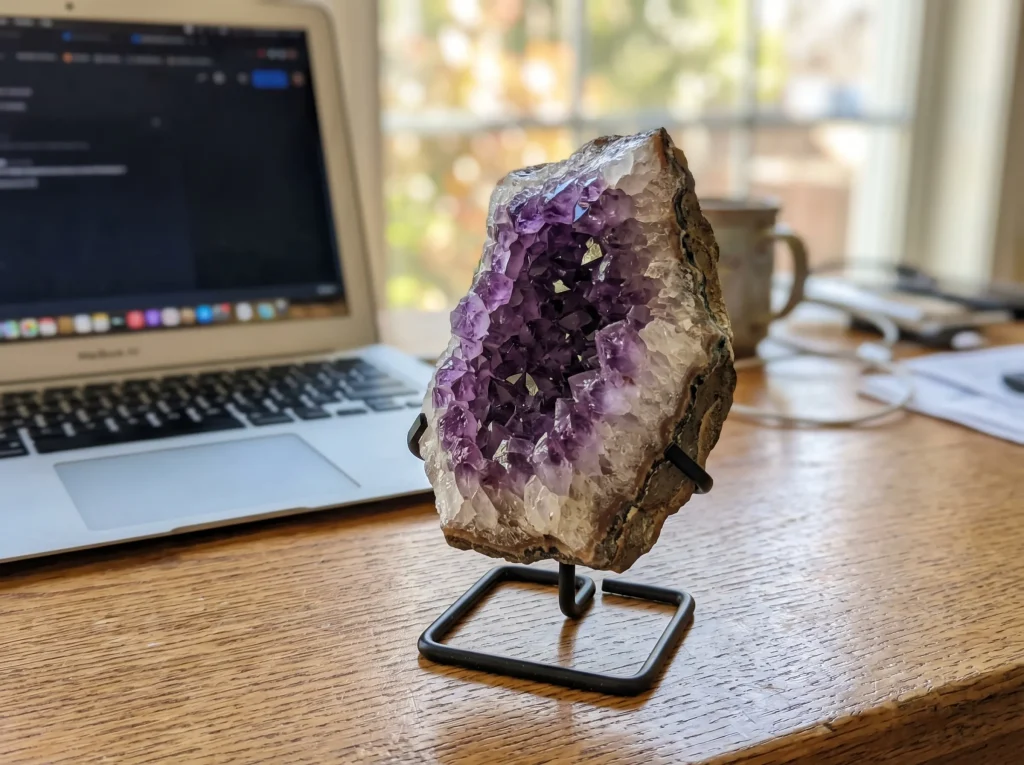
The Desk Reset On my own workspace, I always keep two or three raw stones. They aren’t there for decoration. When I hit a wall, when my inbox gets overwhelming, or when I feel my chest tightening from screen fatigue, they serve as physical anchors. I reach out, touch the cold surface, take a deep breath, and reset my focus before continuing. It is a micro-break that pulls me out of the digital world and back into the physical room.
The Pocket Anchor Carrying a small, smooth stone in a pocket gives you a private, tactile grounding tool that goes wherever you go. When a stressful conversation happens, or when you feel the familiar rise of social anxiety in a crowded room, tracing the smooth surface of the stone with your thumb is a discreet, silent way to manage physical tension.
How to Choose Amethyst Specifically for Anxiety — Practical Guidance
If you want to try this approach for yourself, the specific form you choose should match how you plan to use it.
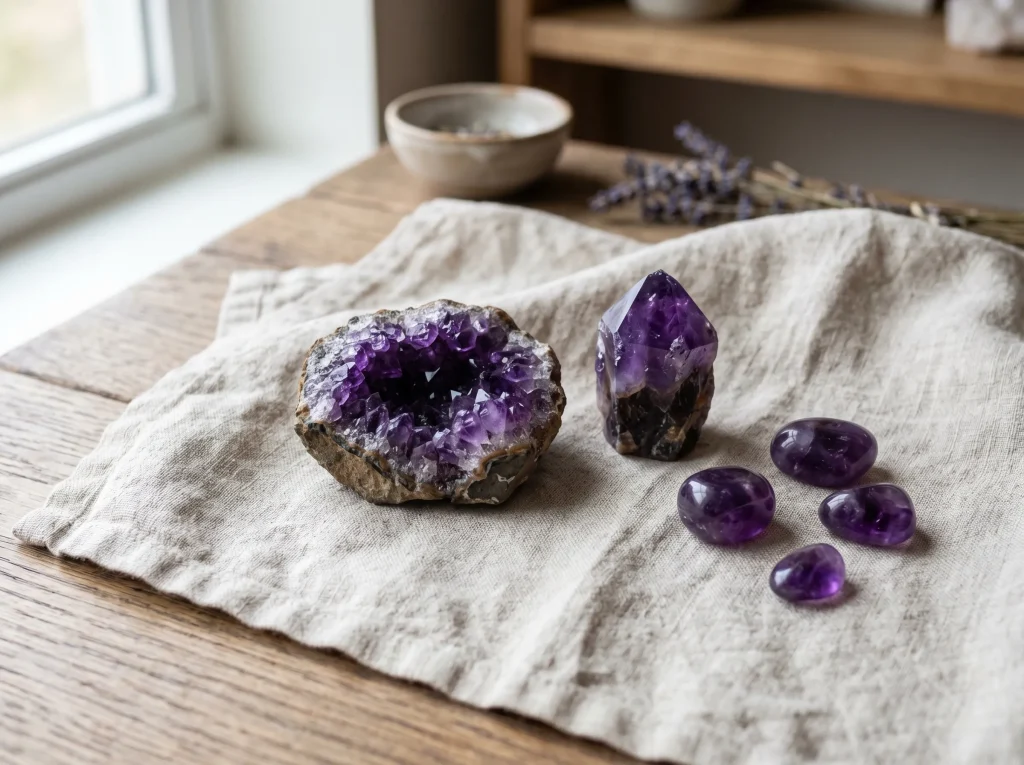
- Tumbled and Polished Stones: Best for carrying in a pocket or a purse. Because the sharp termination points have been smoothed away, they are the perfect tactile grounding tool for your thumb to trace during anxious moments.
- Geodes and Raw Clusters: Best for a bedroom or living space. Their complex, light-catching structures make them excellent visual anchors to break up a sterile room and provide a focal point during breathing exercises.
- Jewelry: Ideal for keeping the physical weight and temperature of the stone against your skin all day, acting as a constant, subtle reminder of your intention.
When selecting a piece specifically for anxiety management, the most critical factor is authenticity. The somatic grounding effect relies entirely on the specific gravity (the heavy weight) and thermal conductivity (the slow-to-warm coolness) of natural quartz. A dyed piece of glass will not feel the same in your hand—it warms up too fast to your body heat and feels noticeably too light.
For these applications, the exact geographic origin or the specific darkness of the purple matters far less than the geological reality of the stone. You need something real.
To ensure this, all of our raw pieces are sourced from documented wholesale partners in Ametista do Sul, Brazil and Uruguay. Our wearable pieces are crafted exclusively with 100% natural amethyst, 925 sterling silver. You can learn more about how to care for these authentic pieces in our guide to amethyst healing properties, or view our wearable options designed for daily wear in our amethyst jewelry collection.
Finding a quieter place to land doesn’t usually happen by accident. It takes intention, and sometimes, it takes a physical tool to help anchor that intention. If you are ready to introduce a natural grounding element into your daily routine, you can explore our curated amethyst crystal healing collection. Or, if you simply want a substantial, untouched piece of the earth for your home, view our natural amethyst crystals. Take your time, and choose the piece that feels right for your space.
About this article Written by Serena Delaney, Founder of Zerevia · GIA Gemology Graduate. Content is based on hands-on specimen assessment, GIA gemology coursework, direct supplier sourcing, and questions collected from our customers. Where conclusions are based on personal observation or traditional belief rather than third-party testing, this is noted in the text. Last reviewed: April 2026
 Crystal Cluster
 Crystal Tower
 amethyst crystal ball
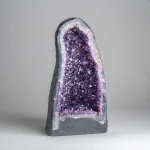 Amethyst Caves for Sale
 Amethyst Bracelets
 Amethyst Earrings
 Amethyst Necklaces
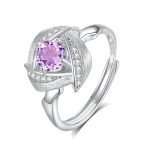 Amethyst Rings
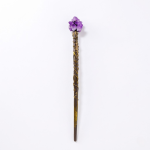 amethyst crystal healing
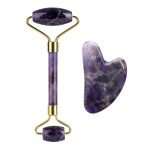 Amethyst Beauty & Wellness
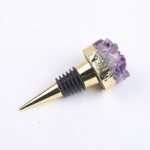 Crystal Home Decor
 Spiritual & Divination Tools