What Is the February Birthstone? The Complete Amethyst Guide
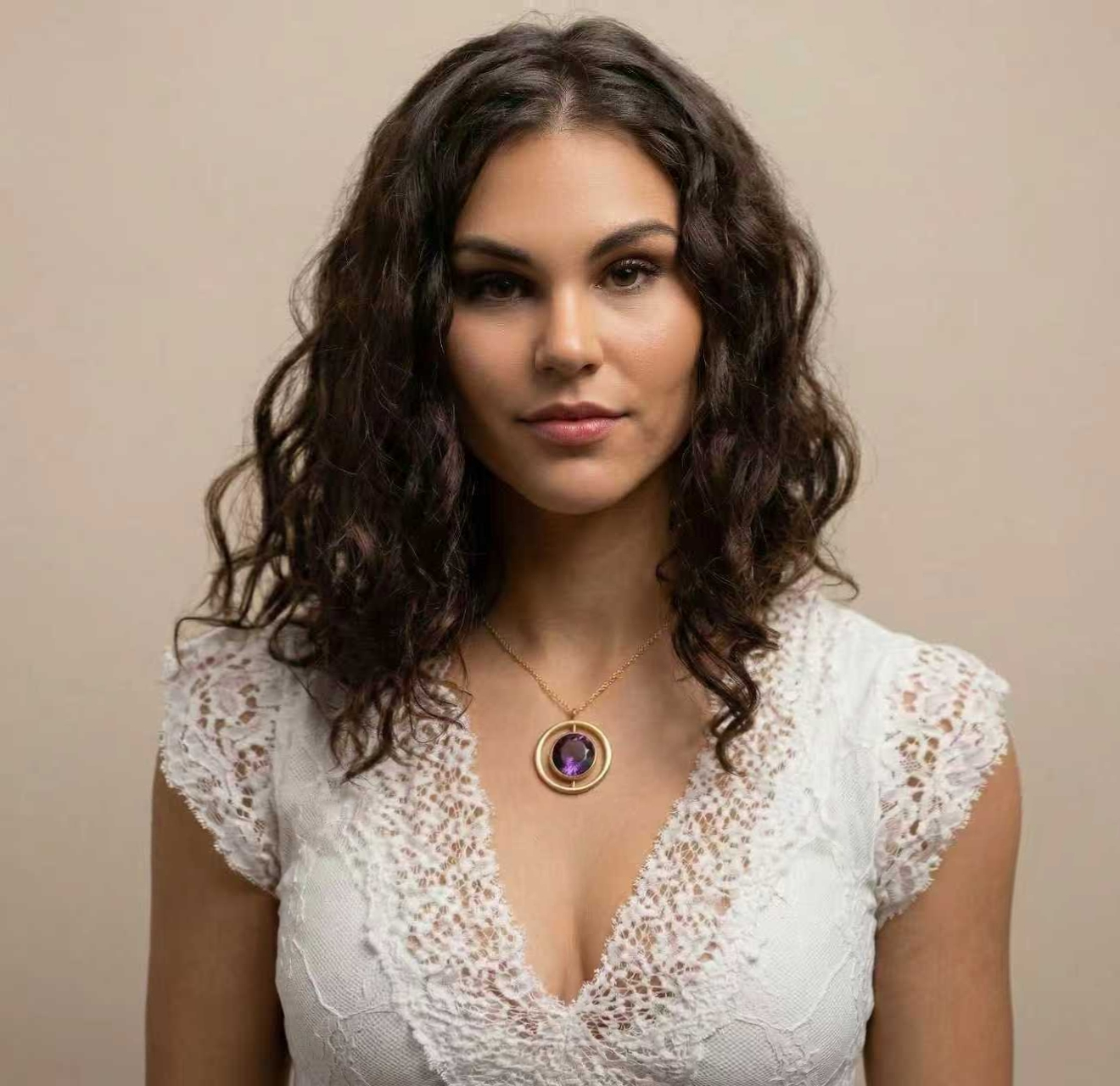
Table of Contents
After reviewing thousands of mineral specimens and fielding hundreds of buyer questions, one thing becomes clear: most people who search for the February birthstone already know it’s amethyst. What they actually want to know is whether the piece they’re looking at is real—and whether it is genuinely worth the investment.
When you buy a birthstone, whether for yourself or as a gift, you aren’t just buying a purple rock. You are buying the geological history, the traditional meaning, and the physical object that will sit on a nightstand or be worn daily. This guide bypasses the generic marketing scripts. We are going to look closely at the geology of the February birthstone, how to spot the synthetics and dyed glass flooding the market, and the exact criteria you should use to choose a piece that will last a lifetime.
The Short Answer: February Birthstone Is Amethyst
If you are looking for the definitive answer: the official February birthstone is amethyst.
This is universally recognized by the American Gem Society, the Gemological Institute of America (GIA), and the National Association of Jewelers. Unlike other months that often have secondary or alternative stones (like October’s opal and tourmaline), there is no debate regarding February. Amethyst owns this month completely.
A macrocrystalline variety of quartz, amethyst presents in a spectrum of colors ranging from pale, translucent lavender to a deeply saturated royal purple. We will explore exactly how to evaluate those colors—and what they mean for the stone’s authenticity—below.
What Color Is the February Birthstone?
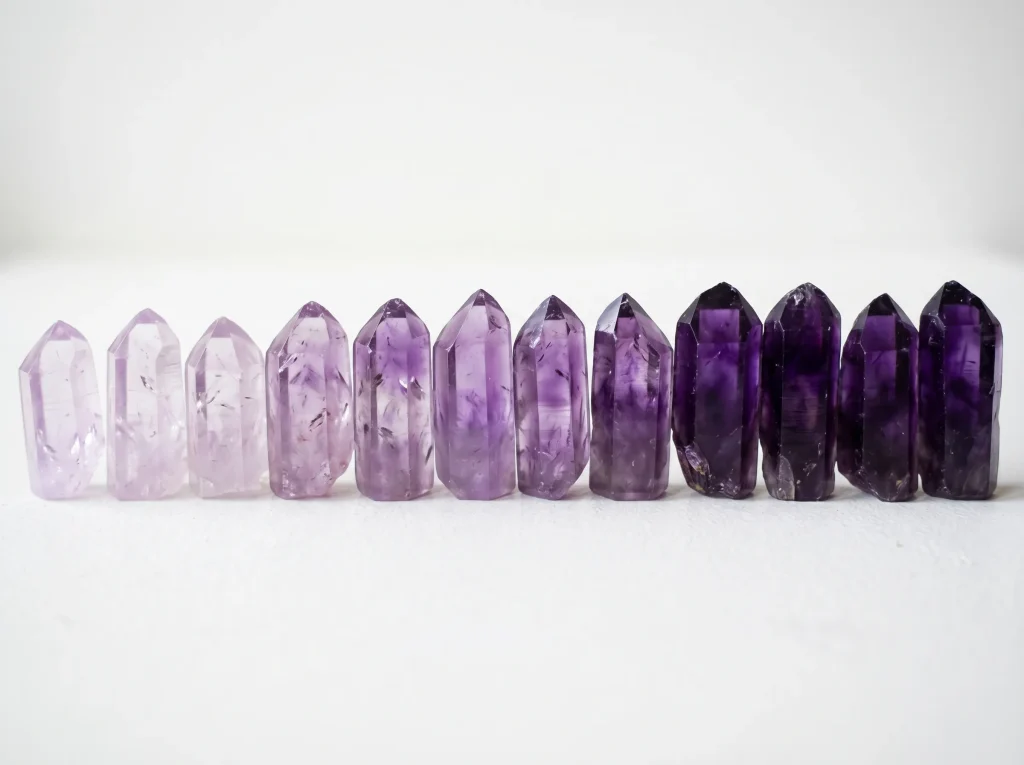
The defining characteristic of the February birthstone is its purple hue, but that color exists on a surprisingly wide spectrum. Amethyst ranges from a very light, almost pinkish-lavender (often marketed as “Rose de France”) through a medium-toned violet, all the way to a saturated, highly concentrated dark purple, historically referred to as “Siberian” purple.
The science behind this color is well-established. The purple hue is created when trace amounts of iron (Fe³⁺) are incorporated into the silicon dioxide crystal lattice during the stone’s formation, which is then exposed to natural gamma irradiation over millions of years within the host rock.
Not all amethyst looks the same, and the location it was mined directly influences its final color:
- Brazilian Amethyst: Typically found in large geode cavities, especially in the Ametista do Sul region. Brazilian stones often showcase a softer, warmer range of lavender to medium violet.
- Uruguayan Amethyst: Known for forming in smaller, denser clusters. Uruguayan amethyst is highly sought after for its intense, deep royal purple saturation, particularly concentrated at the very tips of the crystal points. Because of this depth of color, Uruguayan pieces often carry a 30% to 80% market premium.
A supplier recently sent me a video from Ametista do Sul. In it, a miner pries open a section of basalt to reveal a dense cavity of purple quartz crystals. The miner shouted something in Portuguese—I don’t speak the language, but the joy in his voice translated perfectly. I watched that video three times. It is a reminder of how extraordinary it is that the earth simply grows these structures in the dark.
When shopping, look closely at the color distribution. Authentic amethyst frequently displays natural color zoning—areas of darker purple fading into lighter lavender or clear quartz near the base. A stone that is perfectly and uniformly purple throughout is often a signal of synthetic origin or dyed glass. For more context on how this structural formation relates to its historical use, you can explore the amethyst crystal meaning.
A Brief History of the February Birthstone
The history of the February birthstone stretches back over two millennia. Its modern associations are not recent inventions; they are continuations of ancient traditions.
The name itself derives from the ancient Greek word amethystos, which translates to “not drunk” or “not intoxicated.” In Greek and Roman antiquity, amethyst was highly valued and frequently carved into drinking vessels or worn as amulets, based on the traditional belief that the stone would keep the wearer’s mind clear and sharp.
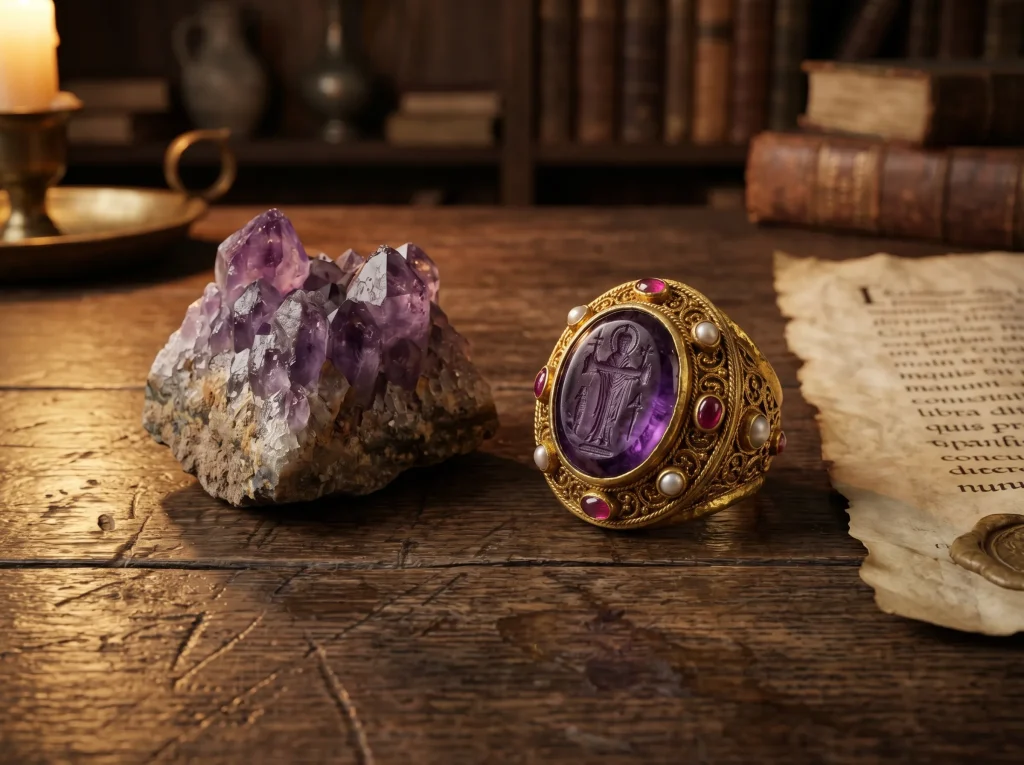
Moving into the Middle Ages, purple was the color of royalty and religious authority, largely due to the extreme expense of Tyrian purple dye. Amethyst, matching this coveted color, became a symbol of status. It was set into the rings of medieval bishops and incorporated into British crown jewels.
There is also a direct historical tie to February’s most famous holiday. According to historical legend, Saint Valentine wore an amethyst ring carved with the image of Cupid. This established a deep historical triangle between the month of February, the concept of love, and the amethyst crystal.
For centuries, amethyst was considered a “cardinal gem,” sharing the same value and rarity tier as diamonds, rubies, and emeralds. This changed in the 19th century when massive deposits were discovered in Brazil and Uruguay. This discovery democratized the stone, making the February birthstone accessible to the broader public without diminishing its visual appeal. In 1912, the American National Retail Jeweler’s Association formalized the modern birthstone list, cementing amethyst as the sole stone for February.
What Does the February Birthstone Mean?
When people ask about the meaning of the February birthstone, they are usually looking for the traditional and psychological associations tied to the gem.
Historically, the core meaning revolves around the concept of sobriety. In a modern context, this translates to mental clarity. Rather than physical intoxication, modern practitioners view amethyst as a tool to clear the “intoxication” of overthinking, stress, and the constant hum of digital distractions.
Across various cultures, it is also traditionally associated with protection and inner strength. In contemporary crystal practices, it is frequently used as a non-pharmacological tool for creating a sense of calm. Many people find that simply having a designated, natural object on their desk or nightstand provides a visual anchor that helps quiet an anxious mind.
We can’t promise it will work for you in a specific way, but the ritual of intentional placement has value. For a deeper look into how these traditions developed, read more about the amethyst spiritual meaning.
February Birthstone vs. Other Purple Stones — How to Tell the Difference
Because amethyst is so popular, the market is crowded with lookalikes, both natural and manufactured. If you are buying a February birthstone, you need to know how to verify what you are holding.
Amethyst vs. Purple Fluorite: Fluorite can present in a very similar purple hue, but it is fundamentally different. After completing GIA gemology coursework, the first test we look at is the Mohs hardness scale. Amethyst is a 7, meaning it is durable enough for daily wear. Fluorite is a 4; it is highly fragile, will scratch easily, and is not suitable for rings or bracelets.
Amethyst vs. Dyed Glass: Glass is the most common imitation. You can tell them apart using three quick checks:
- Weight: Quartz has a specific gravity of 2.65, making it noticeably heavier than a similar-sized piece of glass.
- Color Zoning: As mentioned earlier, natural amethyst almost always has slight variations in color intensity. Glass is uniformly dyed.
- Temperature: Natural stone conducts heat differently than glass. Amethyst will feel cool to the touch and warm up slowly in your hand, whereas glass assumes room temperature quickly.
Amethyst vs. Synthetic Amethyst: Lab-grown amethyst shares the exact chemical composition (SiO₂) as natural amethyst. The primary way to tell them apart without a microscope is, again, perfection. Synthetics rarely show the natural inclusions, irregular growth lines, or color zoning of earth-mined stones. GIA guidelines dictate that sellers have an absolute obligation to disclose if a stone is synthetic.
You’ll often see stones graded online as “AAAA.” The truth? AAAA is not an internationally recognized gemological standard. Every seller defines it differently. You won’t find that term in my product descriptions. I tell you the origin, the color saturation, and the weight. You decide for yourself. It is your money.
How to Buy February Birthstone Jewelry — What Actually Matters
Buying February birthstone jewelry requires looking past the gemstone itself and examining the construction of the piece. A beautiful stone set in cheap base metal will quickly become unwearable.
Here is what actually matters when evaluating a purchase:
- The Base Metal: Always check the metal underneath. Look for solid 925 sterling silver or solid gold. Avoid brass or copper base metals with thin gold plating—this is what causes the dreaded “green finger” reaction as the plating wears off.
- Gemstone Disclosure: Ensure the listing explicitly states “natural amethyst.” If it only says “amethyst color” or “amethyst glass,” you are not buying the birthstone.
- Measurements: Ignore words like “large” or “jumbo.” Look for exact millimeter (mm) measurements to understand the true scale of the stone.
- Adjustable Bands: If you are buying a gift and don’t know the recipient’s exact ring size, an adjustable 925 sterling silver band is the most practical solution.
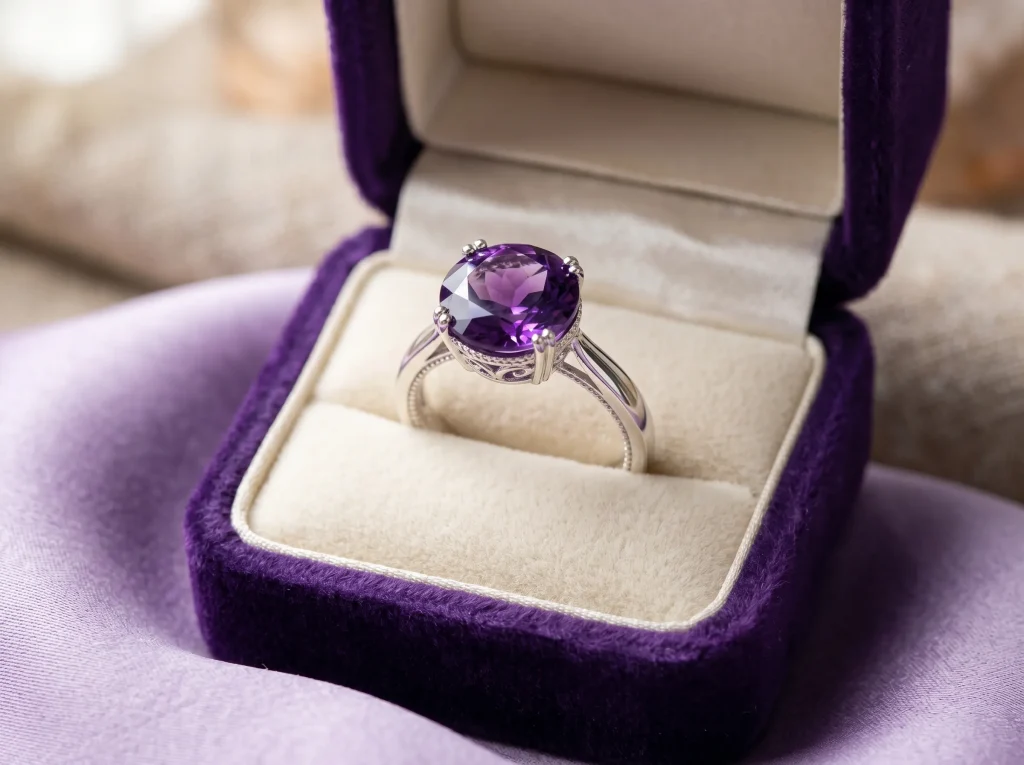
For our collections, the standard is straightforward: 100% natural amethyst, 925 sterling silver. Providing a complete gifting experience—including an unboxing experience that feels deliberate and a card explaining the stone’s history—makes the physical piece feel much more significant. You can view our approach to these pieces in our amethyst jewelry collection.
How to Buy February Birthstone Raw Crystals — For Home & Gifting
Sometimes, the best way to experience the February birthstone isn’t in a jewelry setting, but in its raw, geological form. The buying criteria here are entirely different.
Your choice of form should follow the intended placement:
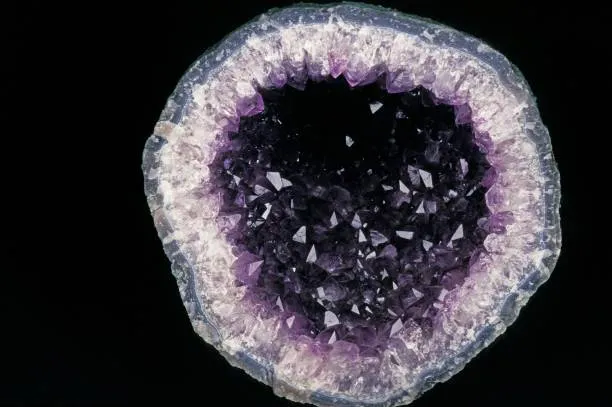
- Geodes and Clusters: These are sections of the host rock with dozens of exposed crystal points. They are visually striking and are traditionally placed in living rooms or entryways to shift the feel of a shared space.
- Towers and Points: These are carved or naturally single-point formations. They give the eyes a natural resting point between screens, making them highly suited for a home office desk.
- Tumbled Stones: Smooth and polished, these are highly durable and portable, serving as excellent entry points for beginners.
When buying raw specimens online, the most critical factor is the seller’s photography policy.
Selling “exactly what is pictured” wasn’t my original business plan; it was forced on me. The first week I launched, I used representative stock photos, and two buyers emailed to say the pieces they received didn’t look like the picture. Now, I photograph and number every single geode individually. It takes three times as long, but I sleep much better. What you see is exactly what will arrive in the box.
Origin also matters. We ensure all our raw pieces are sourced from established wholesale partners in Ametista do Sul, Brazil and Uruguay. You can explore the exact, individually numbered pieces currently available in our natural amethyst crystals inventory.
How to Care for Your February Birthstone
Amethyst is a relatively durable stone (Mohs 7), but it has one specific vulnerability that can ruin the gem if ignored.
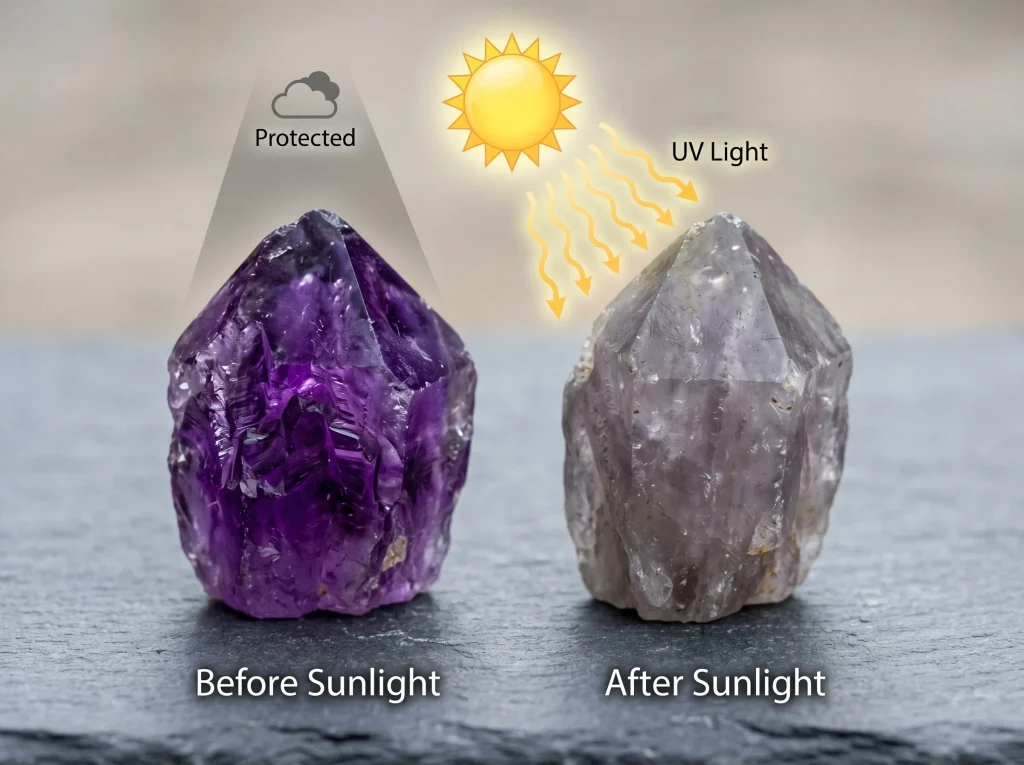
The Sun Warning: You must keep your amethyst out of direct sunlight. A customer recently asked if she could display her raw cluster on a windowsill that gets afternoon light. I told her honestly: there is a problem. Continuous UV exposure causes amethyst to fade from deep purple to a pale, grayish-white, and the process is irreversible. It is a fundamental reaction of the iron trace elements. She asked where to put it instead, and I suggested any spot out of direct sunlight. She thanked me for the warning. I told her it’s simply what you need to know.
Routine Cleaning: Dust raw clusters with a soft, natural-bristle brush. For polished stones and jewelry, use warm water, a very mild soap, and a soft cloth. Never use ultrasonic cleaners, steam cleaners, or harsh chemicals like bleach.
Jewelry Care: Put your amethyst rings and necklaces on after you have applied perfumes, hairspray, and lotions. The chemicals in these products can build up on the stone’s surface, dulling its natural luster.
Cleansing: If you follow traditional energy practices and wish to cleanse the stone, doing so under moonlight is the safest and most traditional method. Do not submerge raw matrix clusters in saltwater, as the salt will degrade the porous basalt rock holding the crystals together. For more detailed traditional care routines, review the amethyst healing properties.
Frequently Asked Questions About the February Birthstone
What is the birthstone for February?
The official and undisputed birthstone for the month of February is amethyst. It was formally codified by the American gem industry in 1912, though its association with the month dates back centuries.
What color is the February birthstone?
The February birthstone is purple. Natural amethyst ranges from a very pale, translucent lavender to a deep, highly saturated royal purple. The color is caused by trace amounts of iron reacting to natural radiation within the earth.
Is amethyst an expensive birthstone?
Amethyst is highly accessible. Following the discovery of massive deposits in South America in the 19th century, it shifted from being as expensive as rubies to being affordable. While deep-colored Uruguayan pieces carry a premium, natural amethyst remains an excellent value for its durability and color.
Can the February birthstone go in water?
Yes, but with caveats. Solid, polished amethyst has a Mohs hardness of 7 and can be rinsed in water safely. However, raw clusters should not be soaked in saltwater, as it can severely damage the host rock (matrix) that holds the crystals together.
What zodiac signs does the February birthstone suit?
February covers two astrological signs: Aquarius (January 20 – February 18) and Pisces (February 19 – March 20). Amethyst is traditionally considered highly supportive for both, offering grounding focus for Aquarians and energetic boundaries for Pisces.
Is the February birthstone good for anxiety?
In traditional crystal practices, amethyst is one of the primary stones associated with calming the mind and reducing tension. While it should never replace medical advice or treatment, many people find that keeping the stone nearby provides a helpful visual and tactile anchor during stressful moments.
Choosing a February birthstone is about finding a piece that resonates with your personal aesthetic and daily routines. If you are looking for a wearable reminder or a structured gift, explore our collection of amethyst jewelry. Alternatively, if you are drawn to the untouched, geological presence of the stone for your home, take a look at our current inventory of raw amethyst geodes.
About this article Written by Serena Delaney, Founder of Zerevia · GIA Gemology Graduate. Content is based on hands-on specimen assessment, GIA gemology coursework, direct supplier sourcing, and questions collected from our customers. Where conclusions are based on personal observation or traditional belief rather than third-party testing, this is noted in the text. Last reviewed: April 2026
 Crystal Cluster
 Crystal Tower
 amethyst crystal ball
 Amethyst Caves for Sale
 Amethyst Bracelets
 Amethyst Earrings
 Amethyst Necklaces
 Amethyst Rings
 amethyst crystal healing
 Amethyst Beauty & Wellness
 Crystal Home Decor
 Spiritual & Divination Tools