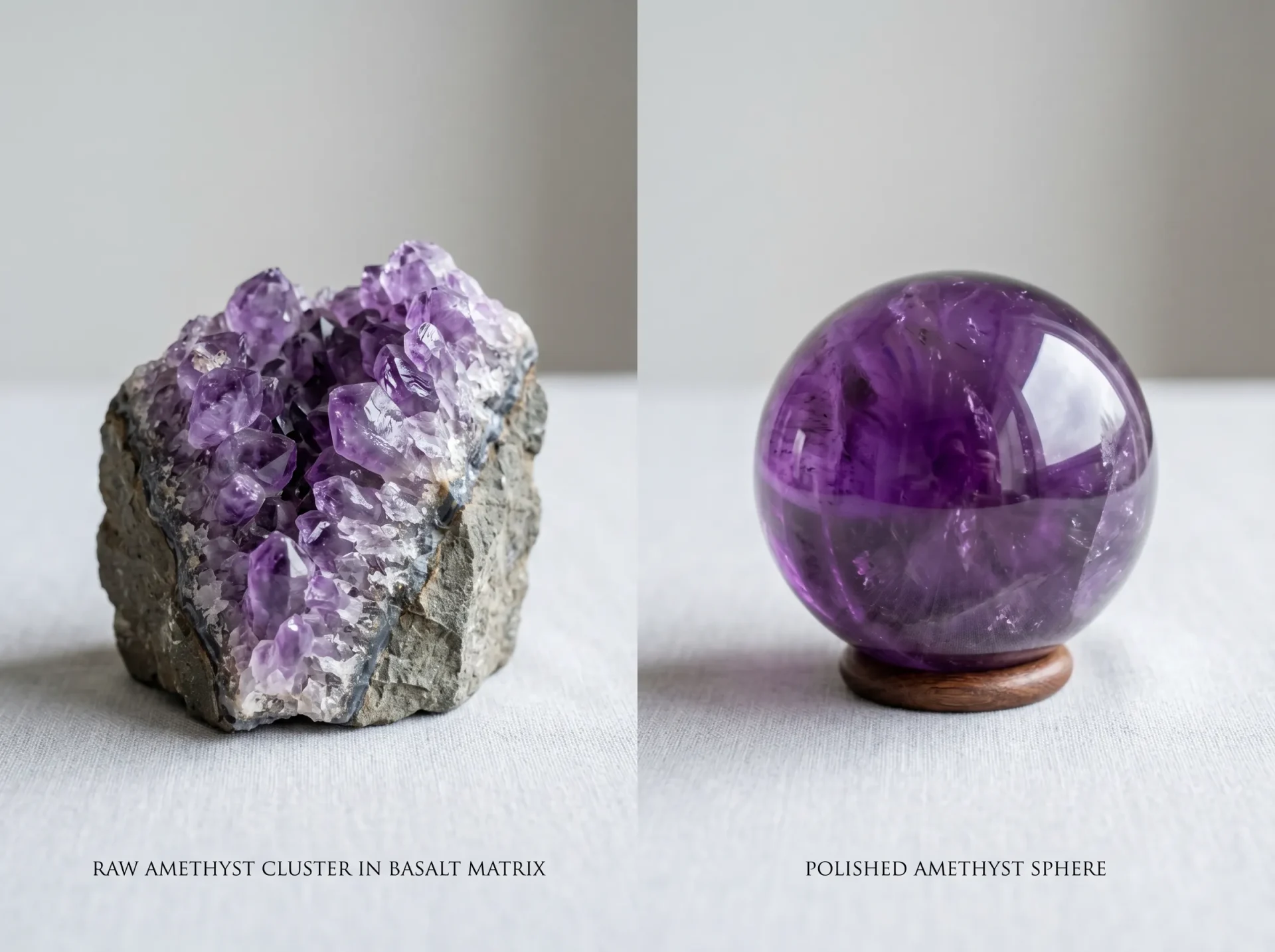
Raw vs Polished Amethyst Crystal: Which Should You Buy?

“In my time studying and sourcing these stones, I’ve held thousands of amethyst crystals in my hands—everything from a 47-pound raw Uruguayan geode that arrived at our warehouse still coated in red laterite dust, to the most perfectly faceted oval cabochon you’ve ever seen under a jeweler’s loupe. Both are genuinely beautiful. Both are genuinely useful. But they are not interchangeable. Choosing the wrong form for your specific intention is the single most common mistake I see first-time crystal buyers make—and it is entirely avoidable if you understand what actually changes during the polishing process at the molecular level.”
You’ve decided you want an amethyst crystal. Congratulations—you’re about to bring one of the earth’s most well-documented purple gems into your life — amethyst has been in continuous use for over two thousand years.
Now comes the question that stops almost every first-time buyer cold: amethyst crystal raw vs polished—what’s the actual difference, and which one should you get?
It sounds like a simple aesthetic preference. It is not. The form of your crystal directly affects its energetic output, its practical applications, its durability, its care requirements, and—critically—how easy it is for unscrupulous sellers to hide quality problems inside a highly polished, mirror-bright surface.
This guide will walk you through everything: what physically happens to amethyst during the polishing process, how each form serves different healing and decorative purposes, what amethyst crystal grades quality markers to look for, and a simple decision framework to tell you exactly which form is right for your specific situation.
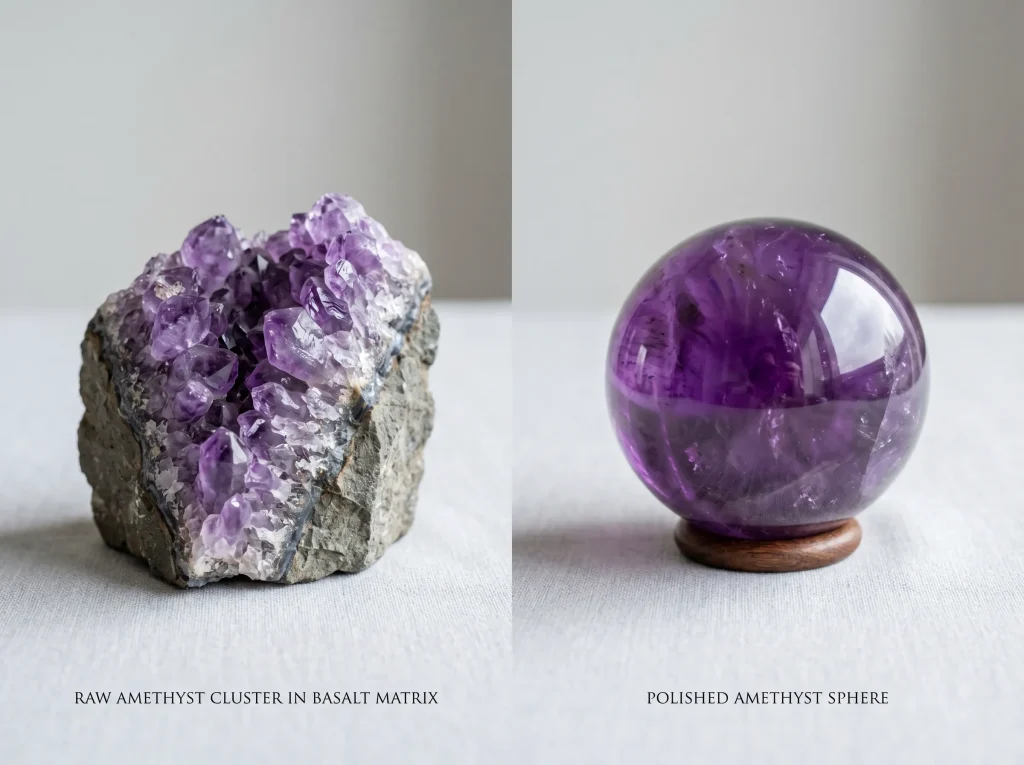
1. What Actually Happens When Amethyst Gets Polished?
Before we compare the amethyst crystal polished vs unpolished forms, you need to understand what polishing is—and what it costs the stone.
1.1 The Journey from Raw Crystal to Polished Gem
When a natural amethyst crystal comes out of the earth, it is embedded in its host rock matrix. The crystal points themselves are naturally faceted by geological processes over millions of years as silicon dioxide (SiO₂) molecules align.
Polishing is a human intervention. Depending on the end form, the process requires intense physical abrasion:
- Tumbled stones: Raw rough is placed in a rotating drum with progressively finer grits of abrasive material. In professional lapidary work, we usually start with a harsh 60-grit silicon carbide to strip the outer layers, move through 400 to 1200-grit to smooth it, and finish with a cerium oxide polish for that glass-like shine.
- Carved shapes (towers, spheres): A lapidary uses diamond-tipped grinding wheels to shape the rough into a precise geometric form.
1.2 What Polishing Removes
This is the part most mass-market crystal sellers won’t tell you: the polishing process completely removes the natural crystal faces. In energy work, those geometrically precise termination points are considered the stone’s primary broadcast mechanism.
It also removes the outer layer of the stone. Any color zoning visible on the surface of a polished piece represents only what survived the grinding wheel. None of this makes polished amethyst inferior—but it makes the two forms genuinely different objects.
2. Raw Amethyst Crystal: The Case for Keeping It Wild
2.1 What “Raw” Actually Means
When we say raw amethyst crystal at Zerevia, we mean pieces that have been removed from their host rock with minimal human intervention. This includes raw clusters, geodes, and single unpolished points.
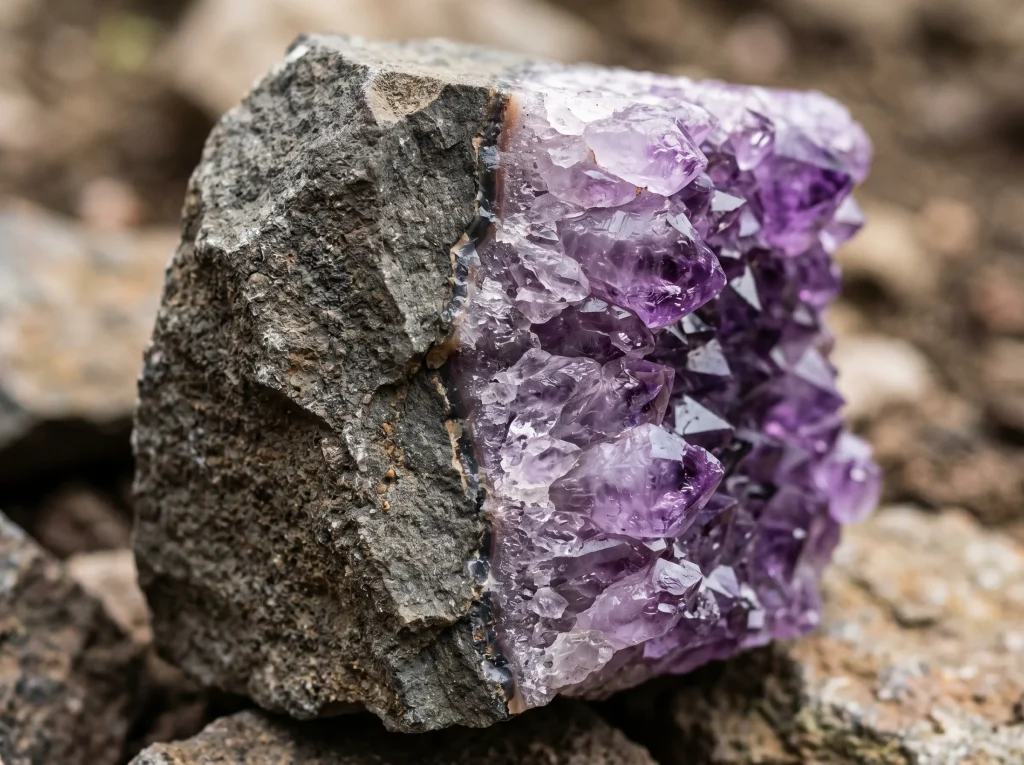
The defining characteristic of a genuinely natural raw amethyst is the presence of its matrix—the host basalt rock. At our warehouse, we specifically seek pieces where this matrix is still intact because it is one of the most reliable authenticity markers available.
2.2 The Energetic and Geological Argument for Raw
Among energy practitioners, raw forms are almost universally considered highly effective for environmental healing. Among energy practitioners, each termination point is believed to direct energy outward along its natural axis — which is why clusters, with dozens of points, are preferred for room-wide placement.
From a gemological standpoint, raw stones give you significantly more visual information to authenticate the piece. You can clearly see natural color zoning and internal inclusions (phantoms and ice cracks), confirming the geological authenticity of your piece.
2.3 Honest Limitations of Raw Amethyst
- Durability: The natural crystal points are fragile. A hard knock will chip them.
- Cleaning: Dust accumulates in the crevices. Cleaning requires a soft brush and water, not a quick wipe.
3. Polished Amethyst Crystal: The Case for Human Craft
3.1 What Polishing Reveals (and Unlocks)
Polishing sometimes improves the visual experience. When you take a Brazilian amethyst rough with a milky outer layer and grind through to the highly transparent interior, you reveal a depth of color completely invisible in the raw state. Light enters the curved surface of a polished sphere from all angles, illuminating its internal landscape.
3.2 Forms and Their Specific Uses
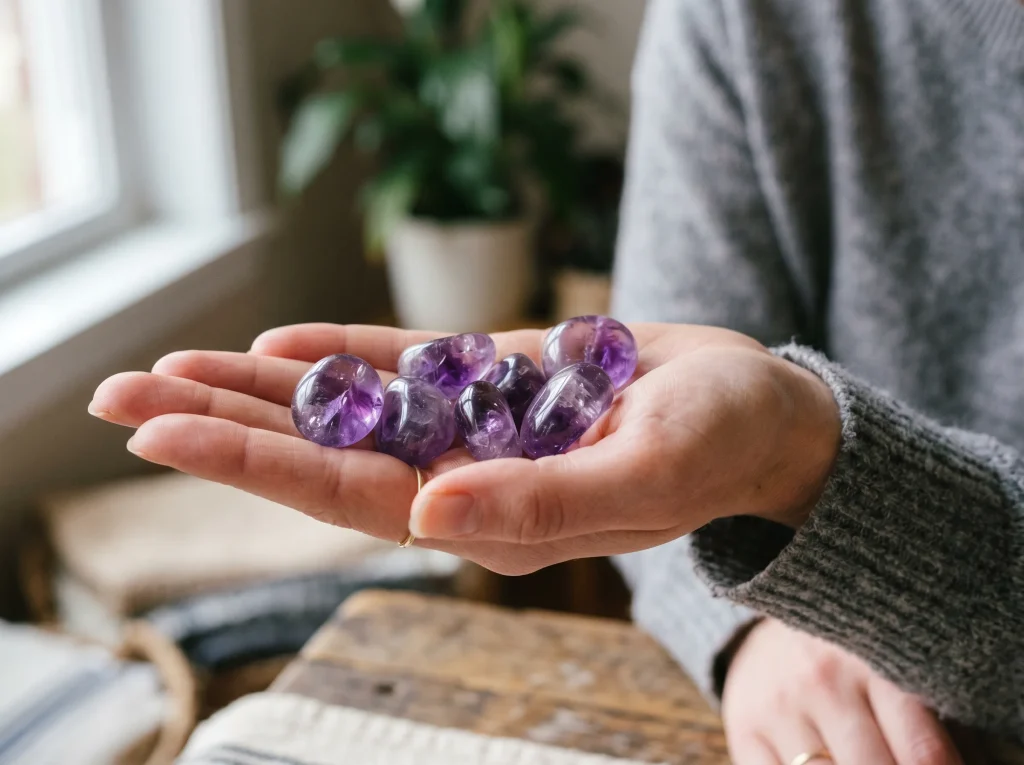
- Tumbled stones: Best for pockets, meditation, and beginners.
- Towers (Obelisks): Shaped to direct energy upward and outward. Perfect for desk focus or crystal grids.
- Spheres: Broadcast energy evenly in all directions. Ideal for sleep support on a nightstand.
3.3 The Quality Trap: Why Polishing Can Hide Problems (A Real-World Example)
Polishing can conceal quality issues that would be immediately obvious in raw form. Surface fractures are ground away, and pale amethyst is easily dyed before the final polish.
A story from our inspection table: In November 2025, we received a sample batch of polished amethyst spheres from a new supplier in Brazil, labeled as “premium natural deep purple.” When I put them under my gemological flashlight, about 30% of the samples showed an unnaturally uniform, slightly magenta-pink hue pooling near the microscopic surface abrasions. This is the classic visual signature of dye getting trapped in surface tension on a high-refractive polish. We rejected the entire batch. If those spheres made it into an online shop, almost no standard buyer would be able to spot the fake from a photo. This is exactly why we refuse to buy finished polished pieces from anonymous secondary wholesalers.
4. Side-by-Side Comparison: Raw vs Polished Amethyst
| Feature | Raw Amethyst | Polished Amethyst |
|---|---|---|
| Energy Broadcast | Omnidirectional, expansive, wild | Directional (towers), even (spheres) |
| Best Use: Space | Living room, office, meditation room | Bedroom nightstand, altar, travel |
| Authenticity Check | Easier (matrix, natural faces visible) | Harder (requires scrutiny for dye/heat) |
| Durability | Fragile (exposed termination points) | Robust (smooth surfaces) |
| Price (Equivalent Quality) | Generally lower per gram | Higher due to lapidary labor costs |
5. Amethyst Crystal Grades and Quality: What to Look For
Understanding amethyst crystal grades quality markers is your most important protection against overpaying.
5.1 Geographic Color Grading
Not all natural amethyst looks the same. In my time studying these stones, I look for specific regional signatures:
- Uruguayan: Tends to be a deep, cool blue-violet with highly saturated tips.
- Brazilian: Often a warmer reddish-violet, forming in larger but slightly lighter geodes.
- Zambian: Features a very dark, deep blue-violet, often with high internal transparency and fascinating “color banding.”
5.2 Density and Weight Tests
For polished pieces, pick it up. Genuine quartz (SiO₂) has a specific gravity of exactly 2.65—it should feel noticeably dense and heavy for its size, and remain cold to the touch longer than glass or plastic imitations.
6. The Decision Framework: Which Form Is Right for You?
Stop overthinking it. Answer these questions honestly:
- Where will it live? A permanent spot in your home? Choose a raw cluster. In your pocket or bra? Choose a tumbled stone.
- What is your primary intention? To clear a room’s energy? Raw geode. To improve sleep? Polished sphere near the bed.
- Who is it for? A beginner? Tumbled stones are the least fragile. An interior design lover? The dramatic geological beauty of a raw cluster wins every time.
7. Care Guide: The Sunlight Warning
We have seen the worst-case scenario. Last year, a heartbroken customer from Seattle placed one of our Uruguayan raw clusters on her south-facing windowsill for the entire summer. Three months later, she sent me a photo: the once-saturated, deep purple had faded to an almost transparent, dull grayish-lavender.
The Fe³⁺ iron ions responsible for amethyst’s color are highly photosensitive. Direct UV radiation causes an irreversible reduction reaction. The stone was completely authentic, but the color was gone forever.
- For Raw: Keep out of direct sun. Dust with a soft natural-bristle brush.
- For Polished: Keep out of direct sun. Wipe with a soft, lint-free cloth. Cleanse both under moonlight, never sunlight.
8. A Note on “Natural Amethyst Crystal”
The phrase natural amethyst crystal is used everywhere online—and it means almost nothing without context. “Natural” technically only means the stone wasn’t grown in a lab. It doesn’t mean it wasn’t heat-treated or irradiated.
At Zerevia, we are building a sourcing system where our raw pieces come with origin cards detailing exactly which region (often down to the specific mining cooperative) the stone was sourced from. If a seller cannot tell you the origin or show you the exact piece you are buying, consider that a major red flag.
9. Frequently Asked Questions
Q: Is raw amethyst considered more effective than polished? For space clearing, raw forms are generally considered highly potent due to multiple terminations. For focused body placement or meditation, polished forms are preferred. They serve different purposes optimally.
Q: Can I mix raw and polished amethyst in a crystal grid? Absolutely. A common configuration uses a large raw cluster or tower at the center as the energy generator, surrounded by polished tumbled stones to focus and direct that energy.
Transparency Disclosure: All product recommendations in this guide link to our own inventory, sourced directly from documented wholesale partners in Brazil and Uruguay, at Zerevia. We include these links because we personally vet, test, and guarantee the geological authenticity of every piece we sell.
 Crystal Cluster
 Crystal Tower
 amethyst crystal ball
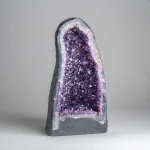 Amethyst Caves for Sale
 Amethyst Bracelets
 Amethyst Earrings
 Amethyst Necklaces
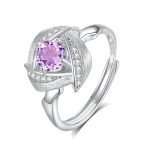 Amethyst Rings
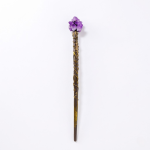 amethyst crystal healing
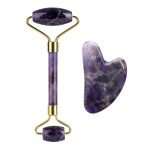 Amethyst Beauty & Wellness
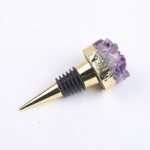 Crystal Home Decor
 Spiritual & Divination Tools