
How to Tell If Your Amethyst Crystal Is Real: 7 Key Checks

How to Tell If Your Amethyst Crystal Is Real: A Practical Guide
You picked up an amethyst — maybe from a crystal shop, a market stall, or an online listing — and now you’re wondering: is this actually real? That question is more common than most sellers admit, and it’s the right one to ask. Learning how to tell if your amethyst crystal is real doesn’t require lab equipment or gemological training. It requires patience, your hands, and a willingness to look closely.
I’ve been studying amethyst since a $12 stone with a handwritten label changed how I thought about minerals. That piece — dull, slightly gray at the base, heavier than it looked — sent me down a path through GIA coursework, mineral shows, and hundreds of conversations with vendors. What follows is the checklist I wish I’d had on day one.
Why Most “Fake” Amethyst Isn’t What You Think
Before you learn how to tell if something is real amethyst, it helps to understand what “real” actually means in this context. A real amethyst is naturally formed silicon dioxide (SiO₂) — quartz — whose purple color comes from trace amounts of iron ions (Fe³⁺) activated by natural radiation over millions of years. That purple isn’t painted on or mixed in. It grew there, slowly, inside the earth.
Most “fake” amethyst on the market isn’t a deliberate forgery. It’s more often glass, dyed quartz, or a completely different mineral mislabeled as amethyst. Synthetic amethyst does exist, but it’s uncommon in the casual retail market. Your bigger risks are dyed stones, colored glass, and sellers who don’t know — or don’t care about — the difference.
Understanding what makes amethyst purple gives you a foundation for everything that follows. The color mechanism is specific: iron, radiation, time. If a stone’s purple seems to have come from somewhere else, trust that instinct.
Step 1: The Visual Inspection — Look for Nature’s Fingerprints
Your eyes are your first and most useful tool. Before you touch anything, look at the stone under good light — natural daylight if possible, or a neutral white light indoors.
Color Zoning
Real amethyst rarely has a perfectly even purple. Look for gradients, swirls, or bands where the color deepens in some areas and fades to lighter lavender or even clear in others. This uneven distribution is called color zoning, and it’s one of the strongest indicators that you’re looking at a naturally formed crystal.
If you’re trying to figure out how to tell if purple amethyst is real, this is your single most reliable visual clue. Perfectly uniform, intensely saturated purple throughout — especially in a larger stone — should make you pause.
Internal Features
Natural inclusions — tiny feather-like veils, wispy internal fractures, or small mineral deposits — are normal and expected. These aren’t flaws. They’re geological evidence that the stone formed over a long period in the earth. Glass and synthetics tend to have either no inclusions at all or suspiciously uniform bubble patterns.
Surface and Shape
Raw crystals will have natural growth lines, irregular faces, and a matrix rock (the base stone they grew from). Tumbled stones should show subtle variations in tone even when polished. If a piece looks like it was poured into a mold — overly glossy, uniformly shaped, with no variation — it’s worth questioning.
For a deeper breakdown of what to look for in terms of color depth and crystal structure, this amethyst quality and value guide covers grading considerations in practical terms.
Step 2: The Hands-On Test — Weight, Temperature, and Hardness
Once you’ve looked, pick the stone up. This is where many people start to feel the difference, and it’s the part of learning how to tell if the amethyst is real that I find most satisfying.
Weight
Genuine quartz is dense. When I pick up a real amethyst, it feels heavier than I expect for its size — noticeably heavier than glass of similar dimensions, and dramatically heavier than plastic or resin. If you have access to a similar-sized piece of confirmed glass, hold one in each hand. The difference is usually obvious.
Temperature
Press the stone against the inside of your wrist or your cheek. Real amethyst will feel cool at first contact and warm slowly against your skin. Glass also feels cool, but it tends to match your body temperature faster. Plastic warms almost immediately. This test isn’t foolproof on its own — glass can fool you — but combined with the visual and weight checks, it adds another data point.
Hardness
Amethyst registers at 7 on the Mohs hardness scale, which means it should be able to scratch glass. If you try this, use a small, inconspicuous area and apply gentle pressure. A real amethyst will leave a visible scratch on a glass surface. However, be aware that this test carries a small risk of chipping your stone, so only attempt it if you’re comfortable with that trade-off. It’s more useful for loose rough stones than for finished jewelry.
If you want to keep your stone in good condition long-term, our amethyst care and cleansing guide covers safe handling, storage, and the UV exposure issue I’ll mention below.
Step 3: Context Matters — Form and Sourcing
How to tell if raw amethyst is real requires a slightly different approach than evaluating a ring or a tumbled stone. The product type changes what you should look for.
Raw Crystals and Geodes
For raw pieces, the presence of a natural matrix rock — the rough, often gray or brownish base from which the crystals grew — is a strong indicator of authenticity. Real geodes and cathedral formations have irregular exteriors and crystalline interiors that vary in color and clarity. Sellers who photograph the exact piece you’ll receive (often labeled “WYSIWYG” — what you see is what you get) are showing you a level of transparency worth noticing.
Tumbled Stones
When you need to tell if tumbled amethyst is real, rely on the weight and temperature tests described above. Polishing removes surface irregularities, but it shouldn’t eliminate color variation entirely. A tumbled stone that’s a single shade of purple with a waxy, overly uniform surface is more likely dyed than genuine.
Jewelry: Rings, Necklaces, and Settings
For a real amethyst crystal ring or amethyst crystal necklace, the stone itself should pass the same visual and tactile checks. But the setting matters too. Reputable jewelry uses 925 sterling silver (marked with a “925” stamp), which is nickel-free and won’t turn your skin green. If a listing doesn’t specify the metal, or says only “silver-tone” or “silver-plated,” that’s a flag worth raising.
Ask whether the stone is 100% natural amethyst. The answer — and the seller’s willingness to answer — tells you something.
The Sourcing Question
This is the hardest part, and also the most important. A seller who can tell you where the stone came from — whether it’s Brazilian amethyst, known for larger crystals and a range from lavender to medium purple, or Uruguayan amethyst, prized for deeper color and finer crystal structure — is a seller who knows their supply chain. At my first mineral show, I spent twenty minutes asking a vendor about a geode’s origin. He answered every question. I didn’t buy that piece, but I went back the following week. He remembered me.
For more detail on origin differences and how to identify real amethyst across forms, that guide covers the comparison in depth.
Red Flags and Common Misconceptions
A few things that trip people up when they’re trying to figure out how to tell if tumbled amethyst is real — or any form, really:
- Color that’s too perfect. Vivid, completely uniform purple with no variation is more common in dyed glass than in nature. Real amethyst has personality.
- Price that doesn’t match the size. A large, deep purple, flawless crystal for a very low price should prompt questions, not excitement.
- Relying on a single test. The “cold to the touch” test alone won’t distinguish amethyst from glass. Neither will a hardness test alone. Use multiple checks together.
- Confusing treated stones with fakes. Some amethyst is heat-treated to produce a yellow or orange color marketed as citrine. The material is still amethyst — the color was just changed. This is different from glass masquerading as a crystal, and many sellers disclose it. I don’t use terms like “AAAA grade” because there’s no standardized grading system for amethyst, and those labels mean whatever the seller wants them to mean.
Always ask for information about the stone’s background — origin, treatment, and care instructions. A seller who answers clearly is one worth returning to.
Frequently Asked Questions
Can you tell if amethyst is real by its smell?
No. Amethyst is odorless. If a stone smells like chemicals or plastic, that’s a sign it may be synthetic resin or dyed material, not natural quartz — but the absence of smell tells you nothing either way.
How can I tell if an amethyst rock is real without breaking it?
You don’t need to break anything. The visual inspection (color zoning, inclusions), weight test, temperature test, and hardness check (carefully) provide enough evidence in most cases. Breaking a stone is unnecessary and destructive.
Is my amethyst real if it has a perfectly smooth, polished surface?
Polishing is standard for tumbled stones and jewelry settings. A smooth surface doesn’t indicate a fake. The material underneath should still pass the weight and temperature tests, and polished natural amethyst will still show subtle color variation when you look closely.
Does real amethyst glow under UV light?
Some natural amethyst fluoresces under UV light, but many don’t. Fluorescence is inconsistent and not a reliable way to determine authenticity. Don’t rely on it as a primary test.
What’s the easiest way to tell if something is real amethyst when buying online?
Look for sellers who provide WYSIWYG photos of the exact piece, state the origin (Brazil, Uruguay, etc.), disclose any treatments, and specify material details like “100% natural amethyst” and “925 sterling silver” for jewelry. Ask questions. If the seller can’t or won’t answer, that’s information too.
Ready to find a stone you can trust? Browse our collection of documented-origin amethyst, where every piece comes with details on its source, color, weight, and care.
 Crystal Cluster
 Crystal Tower
 amethyst crystal ball
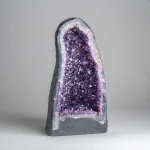 Amethyst Caves for Sale
 Amethyst Bracelets
 Amethyst Earrings
 Amethyst Necklaces
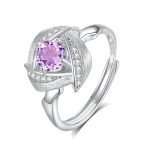 Amethyst Rings
 amethyst crystal healing
 Amethyst Beauty & Wellness
 Crystal Home Decor
 Spiritual & Divination Tools