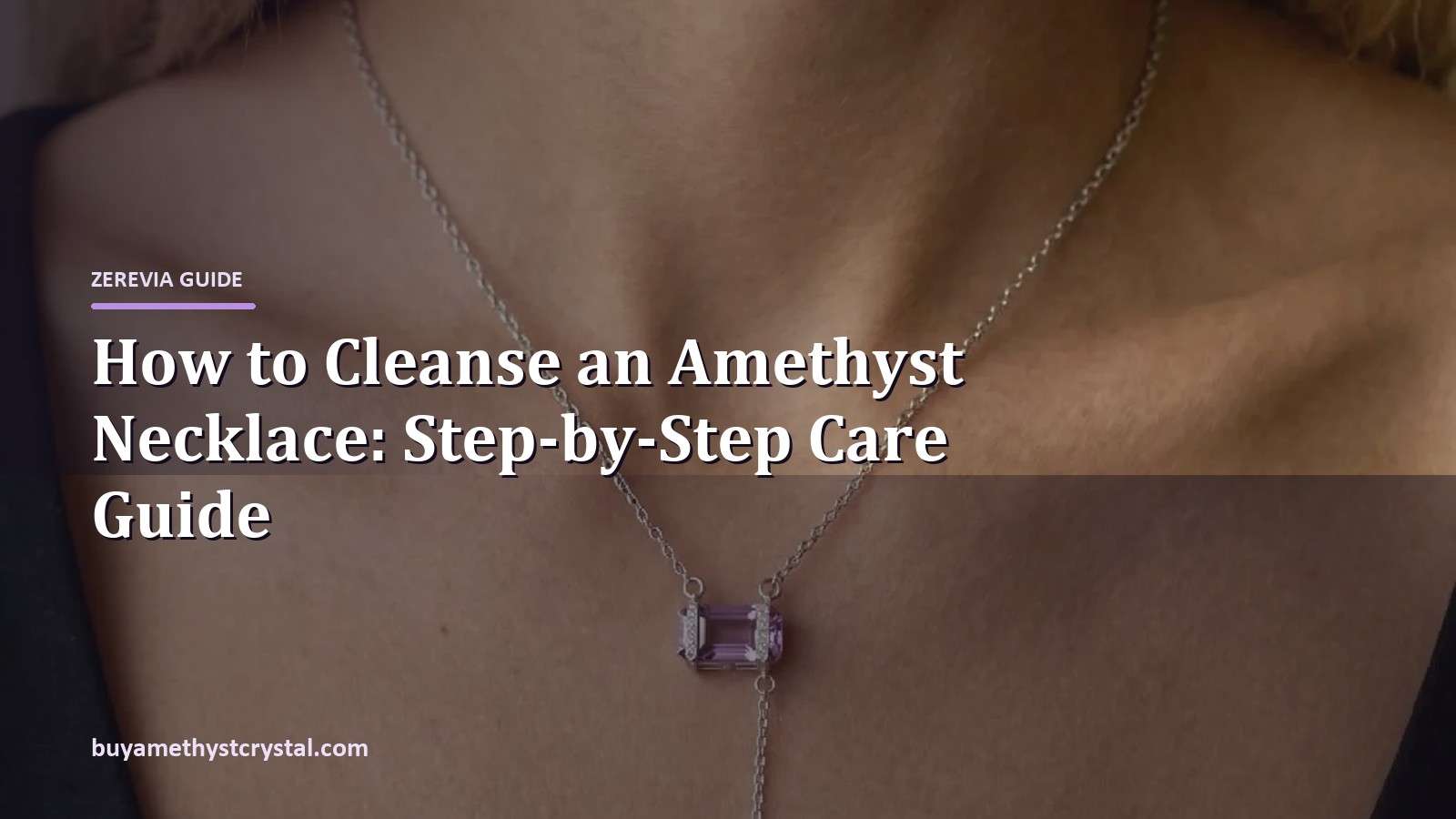

How to Cleanse an Amethyst Necklace: Step-by-Step Care Guide
If you’re wondering how to cleanse an amethyst necklace, you’re in the right place. Whether you wear yours for the traditional associations with calm and clarity, as a February birthstone, or simply because you like the way the purple catches the light at your collarbone — your necklace needs occasional care. The good news is that cleansing an amethyst necklace is straightforward, and the safest methods are also the simplest.
This guide covers five safe cleansing methods, the ones that will actually damage your necklace, and the difference between wiping off skin oils and the ritual practices many wearers value. Everything here is written for jewelry specifically — meaning natural amethyst set in 925 sterling silver — not raw stones or geodes, which have different care needs.
Why Cleanse Your Amethyst Necklace
Before getting into methods, it helps to understand what “cleansing” means in this context. There are really two kinds of care happening, and they serve different purposes.
Physical cleaning is the practical side. Your necklace sits against your skin for hours. It collects oils, dust, hair product residue, and general grime. The sterling silver setting — 92.5% pure silver alloyed with copper — naturally tarnishes when exposed to moisture, air, and certain chemicals. A regular wipe-down prevents buildup and keeps both the stone and the metal looking the way they should.
Traditional energetic cleansing is the ritual side. In many crystal traditions, practitioners believe that a stone absorbs or holds impressions from its environment and the people who handle it. Cleansing, in this view, resets the stone. There’s no scientific mechanism behind this — it’s a personal practice, and its value is personal too. Many wearers find the act of pausing, holding their necklace with intention, and performing a simple ritual meaningful in the same way that lighting a candle or tidying a room can be meaningful. That’s reason enough for some people.
Amethyst itself is a durable stone — it scores a 7 on the Mohs hardness scale, meaning it resists scratching from most everyday contact. But it has one real vulnerability: prolonged UV exposure causes irreversible fading. The purple color comes from trace amounts of iron (Fe3+) in the quartz crystal structure, activated by natural radiation over millions of years. Under sustained ultraviolet light, that iron reduces back, and the purple lightens — permanently. This isn’t theoretical. I learned it the hard way, and I’ll share that story in the section on what to avoid.
For a deeper look at what amethyst is traditionally believed to represent, see our guide on amethyst healing properties and traditional meanings. For broader crystal cleansing methods that apply to raw stones and geodes, our amethyst care and cleansing guide covers those.
Before You Start: What You Need to Know About Your Necklace
A few things to confirm before choosing a cleansing method:
Is your stone natural amethyst? This guide assumes you’re working with 100% natural amethyst, not glass, resin, or dyed quartz. Natural amethyst has uneven color distribution — some areas deeper, some lighter, sometimes with white or translucent zones. If your pendant is perfectly uniform in color with no variation at all, it might not be natural stone. If you’re unsure, our amethyst quality and value guide covers how to assess what you have.
Is the metal 925 sterling silver? Sterling silver is the standard setting for most amethyst jewelry. It’s nickel-free, which means it won’t cause the green-finger problem that cheaper base metals can. But it is sensitive to prolonged water exposure, salt, and certain chemicals. This matters because some popular crystal cleansing methods — soaking in salt water, for example — are fine for raw stones but genuinely harmful to sterling silver jewelry.
Check the setting and clasp. Before any cleansing, even a gentle one, take ten seconds to look at the prongs or bezel holding your stone, and make sure the clasp closes properly. If a setting is already loose, you don’t want to discover that over a sink or with smoke swirling around.
The key principle: jewelry requires gentler methods than raw crystals. No soaking. No salt abrasion. No thermal shock. The five methods below all respect that.
5 Safe Ways to Cleanse an Amethyst Necklace
These methods are ranked roughly by ease and safety. All are suitable for natural amethyst in sterling silver settings.
Method 1: Moonlight
This is the safest cleansing method, period. Place your necklace on a clean, dry surface — a windowsill works, a bedside table, a clean cloth on your dresser — where it can sit in moonlight overnight. A full moon is traditional, but any phase works if you’re not tracking lunar cycles.
Why moonlight and not sunlight? Moonlight contains negligible UV radiation. It won’t affect the Fe3+ ions in your amethyst. Sunlight, by contrast, can cause the irreversible fading I mentioned earlier. So moonlight gives you the ritual benefit of “light cleansing” without any risk to the stone’s color.
Steps:
- Wipe the necklace gently with a soft, dry cloth to remove surface oils.
- Lay it on a clean surface where moonlight will reach it (directly or through a window).
- Leave it overnight. Bring it inside in the morning before direct sun hits the spot.
Method 2: Sound Cleansing
Sound cleansing uses the vibrations from a singing bowl, tuning fork, or similar instrument. In traditional practice, the sound is believed to reset or clear the stone’s field. Practically speaking, it’s completely safe for all materials — no water, no heat, no contact damage.
Steps:
- Place your necklace on a soft surface.
- Play your singing bowl or tuning fork near the necklace for 30 seconds to two minutes.
- That’s it. Some practitioners like to set an intention silently while the sound is ringing.
If you don’t own a singing bowl, you can use a recording of one played through a speaker. The traditional argument is that live sound is preferable, but this is personal practice — use what feels right to you.
Method 3: Smoke Cleansing
Passing your necklace through the smoke of sage, palo santo, or incense is a traditional method used across many cultures. The smoke is believed to carry away what needs clearing. For jewelry, it’s gentle — no moisture damage, no abrasion, no UV risk.
Steps:
- Light your sage, palo santo, or incense stick and let it produce a steady stream of smoke.
- Hold the necklace by the chain and pass the pendant gently through the smoke several times.
- Set it down on a clean surface and let the smoke dissipate naturally.
- Make sure your incense or sage is fully extinguished when you’re done.
A note on ventilation: do this in a room with some airflow, especially if you’re sensitive to smoke. Open a window.
Method 4: Selenite Plate or Charging Station
Selenite — a soft, translucent mineral — is traditionally used as a “charging station” for other crystals. The idea is that selenite can both cleanse and recharge stones placed on or near it. Scientifically, there’s no evidence for this transfer. But as a zero-effort, zero-risk resting place for your necklace when you’re not wearing it, it works well practically too.
Steps:
- Place your necklace on a clean selenite plate or selenite charging slab.
- Leave it there overnight or whenever you’re not wearing it.
- No additional steps required.
Selenite is water-soluble, so keep the plate itself dry. If it gets dusty, wipe it with a dry cloth — never rinse it.
Method 5: Breath and Intention
This is the most accessible method because it requires nothing but your hands and a quiet moment. In many crystal traditions, focused breath and clear intention are considered sufficient to cleanse and reset a stone.
Steps:
- Hold your necklace cupped in both hands.
- Take three slow, deliberate breaths. Some people like to visualize the stone being cleared; others simply focus on the physical act of breathing.
- State your intention silently or aloud — what you want this piece to represent or remind you of.
- Put it on or set it down.
This method has zero risk of physical damage and takes under a minute. It’s a good option for daily wearers who want a quick ritual without any setup.
For a fuller overview of crystal cleansing approaches across different forms — clusters, geodes, spheres, and jewelry — see our complete amethyst care and cleansing guide.
Methods to Avoid: What Can Damage Your Amethyst Necklace
This section matters more than the cleansing methods themselves, because the wrong approach can cause permanent damage.
Direct Sunlight
I know — sunlight cleansing sounds natural and intuitive. It’s also the one method that can permanently ruin your amethyst’s color. UV radiation reduces the Fe3+ ions responsible for the purple, turning deep violet into faded lavender over time. This process is irreversible.
I learned this from a buyer who messaged me about her crystal point. She’d kept it on a south-facing windowsill, getting about two hours of direct afternoon sun every day. The deep emperor purple had shifted to a pale lilac. The stone was still real. The color was gone, and it wasn’t coming back. I put a UV warning in every product description after that conversation. If you’re interested in the science behind why amethyst is purple and why that color can fade, our amethyst properties guide explains the Fe3+ color mechanism in more detail.
Bottom line: Keep your necklace out of direct sunlight during any cleansing or storage. Moonlight is the safe alternative.
Salt Water or Salt Soaking
Salt water is a popular recommendation for raw crystal cleansing. For jewelry, it’s a problem. Prolonged salt exposure corrodes sterling silver, accelerates tarnish, and can weaken prong or bezel settings over time. Even a brief soak introduces moisture into the setting where the stone meets the metal — an area that’s hard to dry completely.
Running Water or Submersion
A quick rinse under running water won’t destroy your necklace immediately, but repeated submersion risks tarnishing the silver, loosening the setting, and — if the drain is open — losing the piece entirely. Sterling silver is water-resistant but not water-proof over time. Use dry methods instead.
Steam or Ultrasonic Cleaners
Ultrasonic jewelry cleaners vibrate at high frequencies to dislodge dirt. They work beautifully for diamond and sapphire. For amethyst, the risk is thermal shock and vibration loosening the stone from its setting. Steam cleaners introduce rapid temperature changes that can stress natural inclusions inside the stone. Skip both.
Abrasive Cleaners
Toothpaste, baking soda paste, and commercial “silver polish” abrasives scratch both sterling silver and the surface of amethyst. A soft cloth is all you need.
How Often Should You Cleanse Your Necklace
There’s no strict rule here. This is personal practice, and anyone telling you there’s a mandatory schedule is probably also trying to sell you something.
For physical cleaning: Wipe your necklace with a soft, dry cloth after each wear. This takes ten seconds and prevents oil and dust buildup. Once a month, give it a slightly more deliberate pass — a soft cloth that’s barely damp, then dry it immediately. If you notice tarnish beginning on the silver, a silver polishing cloth handles it.
For traditional energetic cleansing: Traditional practitioners suggest cleansing after wearing the necklace in emotionally heavy or crowded environments, after illness, or at natural cycle points like the new or full moon. Some people cleanse weekly; others do it quarterly. The honest answer is: do it when it feels right to you, or don’t do it at all. Your amethyst necklace will continue to look beautiful either way.
Signs that your necklace might benefit from cleansing, in either sense:
- Visible dullness or grime on the stone or chain
- Tarnish starting to appear on the silver
- A personal sense that the piece feels “worn” or overlooked
Physical Cleaning vs. Energetic Cleansing: Understanding the Difference
It’s worth separating these clearly, because they serve different purposes and they’re not interchangeable.
Physical cleaning is about maintenance. You’re removing oils, sweat, dust, hair product, lotion residue, and the early stages of silver tarnish. This is material care — it preserves the appearance and longevity of your necklace. Use a soft dry or barely damp cloth. Dry immediately. That’s it.
Energetic cleansing is about ritual. It’s the moonlight, sound, smoke, selenite, and intention-setting methods described above. In traditional practice, these are believed to refresh the stone’s connection to its wearer. There’s no scientific evidence that any of this changes the stone’s physical properties — but many wearers find the practice grounding and worthwhile as a personal ritual. The different amethyst forms and their care needs vary, but the ritual practices are similar whether you’re working with a necklace pendant or a cluster on your shelf.
A practical combination: Wipe your necklace clean first, then perform your chosen cleansing method. Physical cleaning removes the grime. Ritual cleansing is the personal part. One doesn’t replace the other.
Frequently Asked Questions
How do you wear an amethyst necklace for traditional practice?
There’s no single correct way. In traditional practice, some wearers prefer the pendant to sit close to the skin — either at the throat or heart area — based on the stone’s association with the third eye (Ajna) and crown (Sahasrara) chakras in Indian philosophical tradition. Others wear it at whatever length looks right with their outfit. Daily wear is perfectly fine with reasonable care. Take it off before showering, swimming, or sleeping to reduce wear on the chain and setting.
What are the traditional meanings of an amethyst necklace?
Amethyst is the official February birthstone, which makes it a common birthday and Valentine’s gift. In crystal tradition, it’s associated with calm, clarity, and quiet focus — though these associations are personal and cultural, not medical. The word “amethyst” comes from the Greek amethystos, meaning “not intoxicated,” reflecting an ancient belief that the stone could prevent drunkenness. Whether you connect with the historical symbolism or just like the color, the meaning is yours to define.
Can I cleanse my amethyst necklace in water?
A brief rinse — ten to fifteen seconds under lukewarm running water — won’t immediately ruin a well-made sterling silver setting. But repeated or prolonged soaking introduces moisture into the prong or bezel area, accelerates tarnish, and risks loosening the stone over time. For jewelry, dry methods are safer and simpler. Reserve water cleansing for raw crystals and geodes that don’t have metal settings.
What is an aura amethyst necklace?
An aura amethyst necklace features a natural amethyst that has been coated with a thin layer of titanium or other metal, creating an iridescent, rainbow-like surface finish. The base stone is still amethyst, but the coating changes the surface properties. You can still use the cleansing methods above, but avoid anything abrasive — the coating can scratch or flake if rubbed aggressively. Moonlight, sound, and intention-setting are the safest choices for coated stones.
What does a tree of life amethyst necklace mean?
The tree of life design is a widely used symbol across many cultures, representing growth, rootedness, interconnection, and the relationship between earth and sky. When combined with amethyst, the symbolism layers the tree’s meaning with whatever the wearer personally associates with the stone — traditionally calm, clarity, or inner stillness. It’s a popular design for meaningful gifts, especially for February birthdays. The amethyst tree of life necklace meaning is ultimately personal to whoever wears it.
How often should I cleanse my amethyst necklace?
Physically: wipe it after each wear, deeper clean monthly. Traditionally: whenever it feels right, or at natural cycle points like the full moon. There’s no required frequency. Some people never perform an energetic cleanse and wear their necklaces happily for years. Others cleanse weekly as part of a personal ritual. Both approaches are valid.
Does cleansing make my amethyst necklace “work better”?
In traditional crystal practice, yes — practitioners believe a cleansed stone is more receptive and aligned. In material terms, regular physical cleaning keeps the stone’s surface clear and the silver untarnished, which means it looks better and lasts longer. Whether you believe in the energetic side, the practical side, or both, cleansing is a net positive for your necklace.
Ready for an amethyst necklace that arrives with documented origin, accurate photography, and care guidance included? Browse our amethyst necklace collection.
 Crystal Cluster
 Crystal Tower
 amethyst crystal ball
 Amethyst Caves for Sale
 Amethyst Bracelets
 Amethyst Earrings
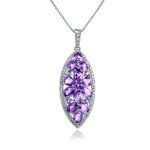 Amethyst Necklaces
 Amethyst Rings
 amethyst crystal healing
 Amethyst Beauty & Wellness
 Crystal Home Decor
 Spiritual & Divination Tools