
Geology & Chemistry
How Is Amethyst Formed? The Science Behind the Purple Crystal
Understanding the natural process that turns common quartz into a purple crystal can change how you see every stone you hold. It’s a story written in silicon, iron, and deep time.
If you’ve ever wondered how is amethyst formed, the answer is a slow, precise combination of geology and chemistry. It begins not with purple rock, but with common silicon dioxide, heat, pressure, and millions of years. For a deeper look at the specific regions where this happens, you can explore amethyst geological origins.
The Foundation: Silicon Dioxide and Volcanic Activity
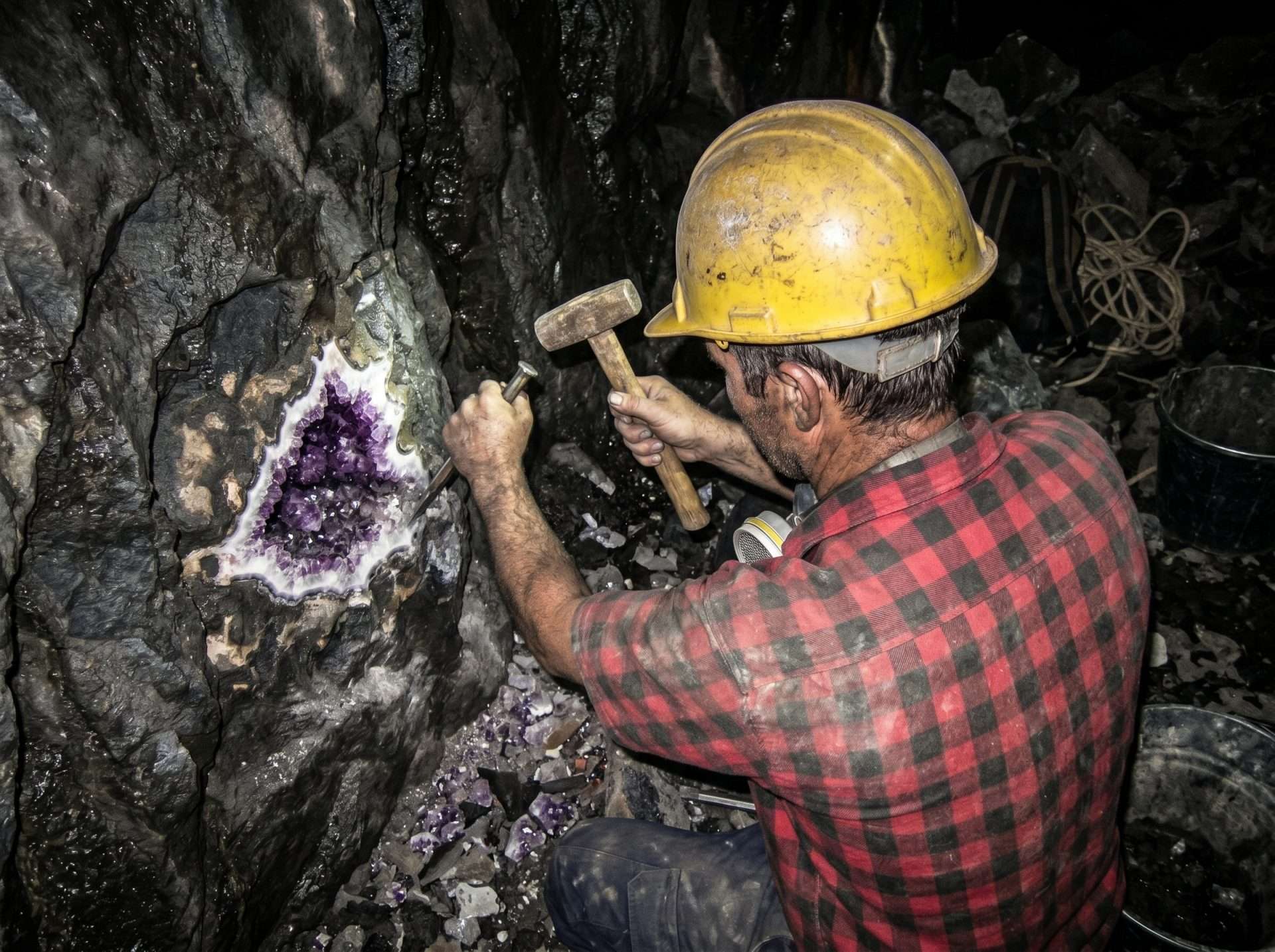
Amethyst is a variety of quartz, a mineral made of silicon dioxide (SiO₂). Its formation starts deep in the Earth’s crust, within cavities and fractures of volcanic rock like basalt. Silica-rich hot water, or hydrothermal fluids, seep into these empty spaces. As these fluids slowly cool over geologic time—often millions of years—silicon dioxide molecules begin to crystallize.
This slow cooling is crucial. It gives the atoms time to arrange themselves into the orderly, repeating pattern that defines a crystal. The result is the base material for all quartz varieties, from rock crystal to amethyst.
The Critical Ingredients: Iron and Natural Radiation
So, what turns clear quartz purple? The answer lies in trace impurities and a bit of natural background radiation. As the quartz crystal grows, tiny amounts of iron (Fe) can be incorporated into its structure, replacing some silicon atoms.
For the purple color to develop, this iron needs to be in its ferric state, or Fe³⁺. Over thousands to millions of years, the surrounding host rock emits low levels of natural gamma radiation. This radiation interacts with the iron within the quartz, activating what are known as color centers. These centers absorb certain wavelengths of light, and what reflects back to our eyes is the familiar purple of amethyst.
I remember reading about this in my GIA coursework—Fe³⁺, the iron ion, sitting in the quartz lattice, activated by radiation over eons. It felt less like magic and more like a very patient, very specific chemical reaction happening on a timescale I can’t fathom.
Crystal Growth and Key Characteristics
The amethyst crystal structure belongs to the trigonal (hexagonal) crystal system, which is why well-formed specimens often have six-sided prisms and pointed terminations. The conditions during growth leave their marks.
- Color Zoning: You’ll often see uneven bands or patches of purple within a crystal. This is natural. It happens as the concentration of iron and the intensity of radiation change slightly during the crystal’s growth, creating a unique fingerprint. Perfectly uniform color can sometimes be a sign of treatment.
- Inclusions: Tiny internal fractures, often called “feathers,” or minerals like goethite are common. These are not flaws; they are evidence of the crystal’s natural growth history and the conditions it endured.
Learning to read these features can help you appreciate the stone’s journey. For a visual guide to the different forms this growth can take, see our amethyst forms and shapes guide.
How Origin Shapes the Stone: Brazil vs. Uruguay
The specific geology of a region directly impacts how amethyst forms there. When people ask about the difference between Brazilian and Uruguayan amethyst, I usually start with a question: “What do you want it for?”
Brazilian Amethyst typically forms in large geodes within vast basalt flows. The growing space is big, so the crystals can get very large, with a range of purple shades from lavender to medium violet. It’s often more affordable per pound, making it ideal for large statement pieces.
Uruguayan Amethyst often forms in smaller, more compact cavities. The crystals are usually finer-grained and grow under conditions that produce a deeper, more saturated color—often a rich emperor purple that’s almost blue-toned. You pay more for that color density, but when you place a high-grade Uruguayan piece next to a standard Brazilian one, the difference is clear in two seconds.
Neither origin is “better.” It depends on whether you prioritize size, color depth, or budget. Our quality and value guide breaks down these factors further.
A Note on Color Stability and Care
I once received a message from a customer whose beautiful deep purple crystal tower had lightened to a pale lavender after sitting on a sunny windowsill for months. The color was gone, and it couldn’t be restored. Understanding the formation chemistry isn’t just academic—it explains a very practical care rule. For all care guidance, including safe cleansing methods, refer to our amethyst care and cleansing guide.
Traditional Use and Personal Ritual
Knowing that a stone formed under specific pressures, with specific trace elements, over millions of years can add a layer of personal meaning to having it in your home. In many traditions, amethyst has been associated with qualities like calm and clarity.
These associations are part of its cultural history. If you find that holding a piece of documented-origin amethyst helps you pause for a quiet moment before bed instead of scrolling on your phone, that is your personal ritual. Its value is in the real stone and your own practice, not in any guaranteed outcome. If you’re curious about the traditional meanings ascribed to it, you can read more in our amethyst healing properties article.
 Crystal Cluster
 Crystal Tower
 amethyst crystal ball
 Amethyst Caves for Sale
 Amethyst Bracelets
 Amethyst Earrings
 Amethyst Necklaces
 Amethyst Rings
 amethyst crystal healing
 Amethyst Beauty & Wellness
 Crystal Home Decor
 Spiritual & Divination Tools