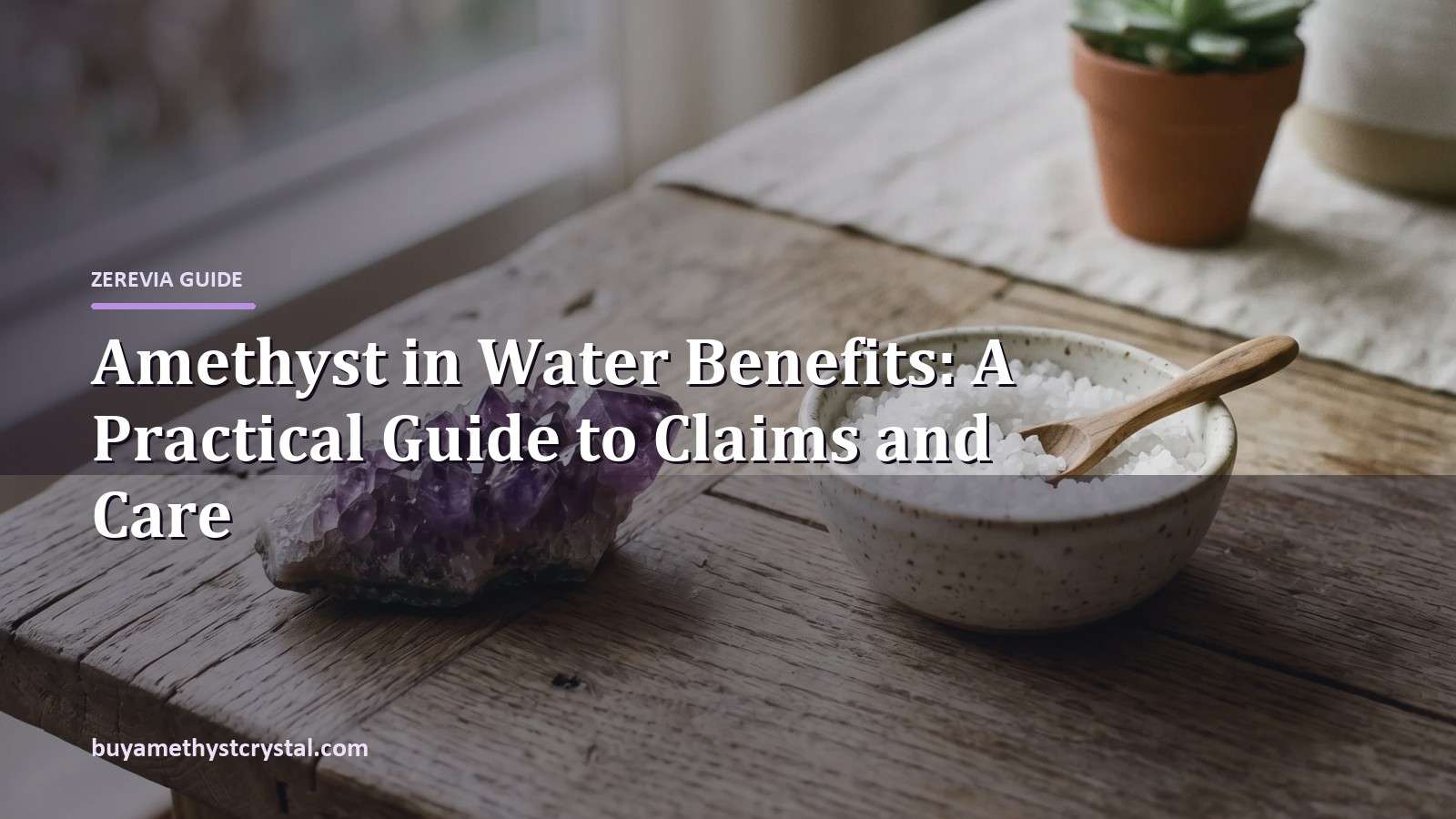

Amethyst in Water Benefits: A Practical Guide to Claims and Care
Introduction: Why Consider Amethyst in Water?
The search for amethyst in water benefits usually starts with a simple question: can I put this purple stone in my water, and what happens if I do? You may have seen crystal water bottles at a wellness market, read about amethyst-infused water rituals on social media, or heard a friend describe how she keeps a tumbled stone in her bedside carafe. The idea has enough surface appeal that it keeps coming back.
Before I ever started Zerevia, I bought a $12 amethyst from a secondhand shop. The label said “for calm nights” in purple ink. I put it on my nightstand and slept better than I had in months. That led me to GIA coursework, mineral shows, and an obsession with Fe3+ color mechanisms that I did not see coming. It did not lead me to put that stone in my water — but it did make me want to understand exactly what the practice involves, what traditions say about it, and what the science actually supports.
This guide will walk you through the traditional beliefs behind amethyst crystal water benefits, the practical realities of submerging a gemstone in drinking water, and the care decisions you need to make if you want to try it. No medical promises. No vague mysticism. Just the information you need to decide for yourself.
For a broader look at what people believe amethyst can offer, our guide to amethyst healing properties covers traditional use in more detail.
What Is Amethyst Infusion? Methods and Meanings
Amethyst infused water benefits refer to the belief — primarily rooted in crystal wellness traditions — that placing amethyst in or near water creates a drink with enhanced qualities. There are two common approaches:
Direct infusion. A polished amethyst tumbled stone is placed directly into water — a glass, a pitcher, or a purpose-built crystal water bottle. The stone sits in the water for a period of time, typically a few hours, before you drink it. Proponents of this method believe the water absorbs the stone’s qualities through physical contact.
Indirect infusion. The amethyst is separated from the drinking water by a physical barrier — usually a glass partition inside a bottle, or the stone is placed in a separate container that sits inside the pitcher. The water does not touch the crystal directly. This method is marketed as “safer” by brands that acknowledge concerns about surface coatings or mineral leaching.
The key question for either method is what, if anything, the water actually takes on. Amethyst is silicon dioxide (SiO2) — the same mineral family as quartz. Its Mohs hardness is 7, which makes it relatively durable. It does not dissolve in water. It does not release ions or compounds into water in any way that would chemically alter the drinking water’s composition. What traditions claim the water absorbs is not a mineral supplement — it is something less measurable.
If you are considering any crystal water practice, choosing polished, uncoated stones matters more than choosing a specific shape. Our amethyst care and cleansing guide covers cleaning and storage in detail.
| Method | Stone Contact | Practical Consideration |
|---|---|---|
| Direct infusion | Stone sits in water | Requires polished, uncoated stone; rinse before each use |
| Indirect infusion | Stone separated by barrier | Reduces surface contact risk; still requires quality stone |
| Nearby placement | Stone placed beside container | No water contact; purely ritual; no contamination concern |
Traditional and Spiritual Perspectives on Amethyst Water
The benefits of amethyst in water, as described in crystal traditions, are not about biochemistry. They are about intention, ritual, and a framework of meaning that some people find genuinely useful.
In various traditions, amethyst has been associated with tranquility, mental clarity, and a sense of groundedness. As the February birthstone, it holds personal significance for people born that month, and some use birthstone rituals — like placing their birth crystal in water overnight — as a way of marking transitions, setting intentions, or creating small moments of pause in an otherwise full day. In chakra frameworks, amethyst is associated with the third eye and crown chakras, linked to intuition and awareness rather than physical wellbeing.
None of this constitutes scientific evidence. What it constitutes is a tradition that people have used for generations, and some buyers describe real personal value in the practice — not because the water changed, but because the act of pausing, choosing a stone, and caring for it changed something about their day.
I had a conversation once with someone who asked me directly: “You really think rocks do anything?” My honest answer was that I did not know if stones have the kind of power he was asking about. But I knew that having a real, documented-origin piece on my nightstand gave me a reason to look at something physical instead of my phone before sleep. That small ritual had value for me. It was not proof of anything. It was enough.
For more on how these traditions developed, learn more about amethyst’s background.
Scientific and Practical Realities of Amethyst in Water
When you search for amethyst crystal water energy benefits with scientific evidence, you are asking the right question. Here is what the science actually says.
Amethyst gets its purple color from trace amounts of Fe3+ — trivalent iron — trapped in the quartz crystal structure and activated by natural background radiation over millions of years. This color mechanism is well-documented in mineralogy. It is a real, specific, chemical fact. But it does not mean that placing amethyst in water transfers iron, radiation resistance, or any other measurable substance into the liquid.
Quartz is one of the least reactive common minerals. It is chemically inert in water at room temperature. Amethyst does not leach beneficial minerals, emit frequencies, or change water’s molecular structure. No peer-reviewed study has demonstrated that amethyst in water produces any physiological benefit in the person who drinks it.
That said, there are real practical concerns:
- UV fading. If you leave amethyst in a clear bottle in direct sunlight, UV radiation will gradually and irreversibly reduce the Fe3+ to Fe2+, fading the purple color. This is not a health risk, but it permanently damages the stone’s appearance. I once had a buyer write to me about her crystal column that had turned from deep violet to lavender after months on a south-facing windowsill. The stone was still real. The color was gone forever. This is the amethyst crystal sunlight water energy healing scientific basis question answered plainly: sunlight does not help amethyst — it hurts it.
- Surface coatings. Some commercially dyed or coated stones marketed for water use may not be pure amethyst. Low-cost crystal water bottles sometimes use stones treated with colorants or lacquers that could leach into water. This is a product quality issue, not an amethyst issue.
- Bacterial growth. Any object sitting in standing water can harbor bacteria over time. Stones require regular cleaning, and water should not be left in a bottle for days without rinsing.
The question of amethyst crystal healing energy, water, sunlight, and its scientific basis comes down to this: the geology is fascinating and real. The water benefits, in a physiological sense, are not supported by current evidence.
To understand where your stone comes from and how to evaluate quality, our amethyst geological origins guide and quality and value guide are worth reading before you buy.
Amethyst Water Bottles: Claims vs. Practical Care
Crystal water bottles have become one of the most visible products in the amethyst space. They are usually glass bottles with a polished amethyst stone sealed in a separate compartment or resting in direct contact with the water. The marketing often centers on amethyst water bottle benefits — the idea that each sip carries a bit of the stone’s energy, its calming association, or its aesthetic presence in your daily routine.
Here is what those bottles actually offer:
- A visual ritual. Seeing purple through glass when you reach for water is a small, tangible reminder of whatever intention you set. That is not nothing — many buyers describe it as a grounding moment during a busy day.
- A gift with meaning. Amethyst is the February birthstone and has a long cultural history. A crystal water bottle is a common gift for birthdays, housewarmings, and self-care milestones.
- Aesthetic appeal. A purple stone in a clear bottle looks distinctive on a desk or nightstand. Decoration is a valid reason to buy one.
Practical advice for using one safely:
- Choose bottles with polished stones in a food-safe compartment. Avoid stones with visible surface coatings or paint.
- Do not leave the bottle in direct sunlight. UV exposure fades amethyst irreversibly and can heat the water unevenly in a glass container.
- Rinse the stone and bottle regularly with clean water. Do not use harsh chemicals or abrasive cleaners on the crystal.
- If you are unsure about the stone’s treatment, use the indirect method — keep the crystal in a separate compartment that does not contact your drinking water.
- Replace the water daily. Standing water with any mineral object is not a long-term storage method.
The amethyst water bottle benefits that buyers describe most often are not chemical. They are about the experience of using something intentional. Whether that is worth the price depends on what you are looking for.
For a breakdown of polished forms and what to look for, see our amethyst forms and shapes guide.
Amethyst Lamps: Ambient Benefits Beyond Water
Amethyst lamps are a related topic that often comes up in searches for amethyst lamp benefits, and they deserve a brief section here because they share some of the same appeal — and the same care requirements — as water-use crystals.
An amethyst lamp is typically a large piece of amethyst geode or cluster fitted with a light source inside or behind it. When lit, the crystals glow. The effect is genuinely beautiful: warm light diffusing through deep purple crystal formations. Many buyers place them in bedrooms, living rooms, or meditation spaces.
The traditional claim is that amethyst lamps promote calm or create a peaceful atmosphere. There is no scientific mechanism for this — the lamp does not emit any special frequencies or purify the air. What it does do is provide soft, low-warmth ambient lighting in a room, which many people find conducive to winding down at the end of the day. That is a real benefit. It just comes from the light, not the crystal chemistry.
Care for amethyst lamps follows the same rule as all amethyst: avoid placing them in direct sunlight. Even when powered off, a lamp sitting in a sunbeam for months will fade. Keep it on a shelf or table away from windows that receive direct afternoon sun.
For cleansing and ongoing care, the same principles apply. Our amethyst care and cleansing guide covers both decorative and ritual pieces.
How to Choose and Care for Amethyst in Water
If you decide to try amethyst stone in water — whether for the ritual, the aesthetics, or simple curiosity — here is what to consider when choosing your stone and keeping it in good condition.
Choosing the Right Stone
Polished over raw. Tumbled stones or polished spheres have a smoother surface that is less likely to harbor dirt, coatings, or bacterial residue. Raw crystals have crevices and matrix rock that are difficult to clean thoroughly and may shed small particles. For any water practice, polished is the safer choice.
Size and color depth. If you are placing the stone in a bottle or glass, choose a tumbled stone sized between 20mm and 40mm — large enough to see, small enough to handle easily. Color depth is a matter of preference. Deeper purple stones tend to come from Uruguayan sources; lighter, larger stones often come from Brazilian deposits. Neither is “better” — it depends on what appeals to you visually and what fits your budget.
Documented origin. Knowing where your amethyst comes from matters for confidence in what you are buying. Brazilian amethyst is widely available and offers good value; Uruguayan amethyst is known for finer crystal structure and deeper color. Reputable sellers will specify origin. If a seller cannot tell you where the stone was sourced, that is worth pausing over.
Care Guidelines
- Rinse polished stones with clean, room-temperature water before each use. Do not use soap, alcohol, or chemical cleaners on the crystal surface.
- After use, dry the stone completely before storing it. Prolonged dampness in storage can promote bacterial growth.
- Store stones away from direct sunlight. UV fading is irreversible and will gradually lighten the purple over weeks or months of exposure.
- If you practice crystal cleansing traditions, moonlight is the safest method for amethyst — no fading risk, and it fits naturally into a monthly rhythm. Sound cleansing with a singing bowl is another common option.
- Inspect the stone periodically. If you notice color change, surface damage, or any unusual residue, discontinue water use and switch to decorative placement instead.
For deeper guidance on evaluating quality, origin, and value, our amethyst quality and value guide walks through what to look for before you buy.
Frequently Asked Questions About Amethyst in Water
Is it safe to put amethyst in drinking water?
Pure, polished amethyst — silicon dioxide with natural iron coloring — is chemically stable and does not dissolve or leach compounds into water. The main safety concerns are surface coatings (on treated or dyed stones), bacterial growth from standing water, and UV fading if the bottle is left in sunlight. Use polished, untreated stones, rinse regularly, and store away from direct sun. The amethyst in water benefits described by practitioners are based on tradition, not medical evidence.
What are the claimed benefits of amethyst water bottles?
Common claims include promoting calm, supporting clarity, and turning hydration into a mindful ritual. These are personal and tradition-based — they describe what users experience during the practice, not a physiological change in the water. The aesthetic appeal and intention-setting aspect are the most consistently described amethyst water bottle benefits.
Does amethyst in water have scientific evidence for healing?
No. Amethyst crystal water energy benefits lack scientific evidence for any healing or physiological effect. The stone’s purple color comes from Fe3+ ions activated by natural radiation — a real and documented geological process — but placing amethyst in water does not transfer any beneficial compound into the liquid. Quartz is chemically inert at room temperature. The amethyst crystal sunlight water energy healing scientific basis is well understood: sunlight damages the stone (UV fading) rather than enhancing it.
How do I choose amethyst for water use?
Choose polished tumbled stones from a seller who can document the stone’s origin. Brazilian amethyst offers good value and a range of color depths; Uruguayan amethyst tends toward deeper, more saturated purple. Avoid raw or rough stones, which are harder to clean and may have unstable surface features. For more detail, our quality and value guide covers grading, color zoning, and what to look for.
What are the benefits of amethyst lamps?
Amethyst lamps provide soft, warm ambient lighting through purple crystal formations. The amethyst lamp benefits most commonly cited are decorative: they add color and visual warmth to a room. Traditional beliefs associate them with calm environments, but this comes from the ambient lighting and personal ritual, not from any proven energy emitted by the crystal. The same UV fading rule applies — keep lamps out of direct sunlight to preserve the stone’s color.
What are the main benefits of amethyst overall?
Amethyst main benefits, as traditionally described, center on tranquility, focus, and personal ritual. As a gemstone, its verified qualities include Mohs hardness 7 (durable for jewelry and display), a rich purple color caused by documented geological processes, and cultural significance as the February birthstone. For a full overview, see our guide to amethyst healing properties.
Next Steps: Making an Informed Choice
Amethyst in water benefits, in the way most people search for them, sit at an intersection of tradition, aesthetics, and personal practice. The science is clear: amethyst does not alter water’s composition in any measurable way, and no peer-reviewed evidence supports healing claims from drinking crystal-infused water. That is the baseline.
What is also true is that many people find value in the ritual itself — choosing a stone, placing it in water, pausing for a moment before drinking. Whether that practice is worth your time and money depends on what you are looking for. If you want a decoration, a gift, or a small daily ritual with a February birthstone connection, polished amethyst tumbled stones work well. If you want evidence-based health benefits, amethyst water is not the place to look.
Before you buy, consider:
- Your goal. Ritual, decoration, or gift? Choose accordingly.
- The stone’s quality. Polished, documented-origin, untreated.
- Care requirements. UV protection, regular rinsing, proper storage.
If you are curious about amethyst’s deeper traditions and how people use it across different practices, our guide to amethyst healing properties is a good place to continue reading. Whatever you decide, understanding what you are buying is always worth the five minutes it takes.
 Crystal Cluster
 Crystal Tower
 amethyst crystal ball
 Amethyst Caves for Sale
 Amethyst Bracelets
 Amethyst Earrings
 Amethyst Necklaces
 Amethyst Rings
 amethyst crystal healing
 Amethyst Beauty & Wellness
 Crystal Home Decor
 Spiritual & Divination Tools