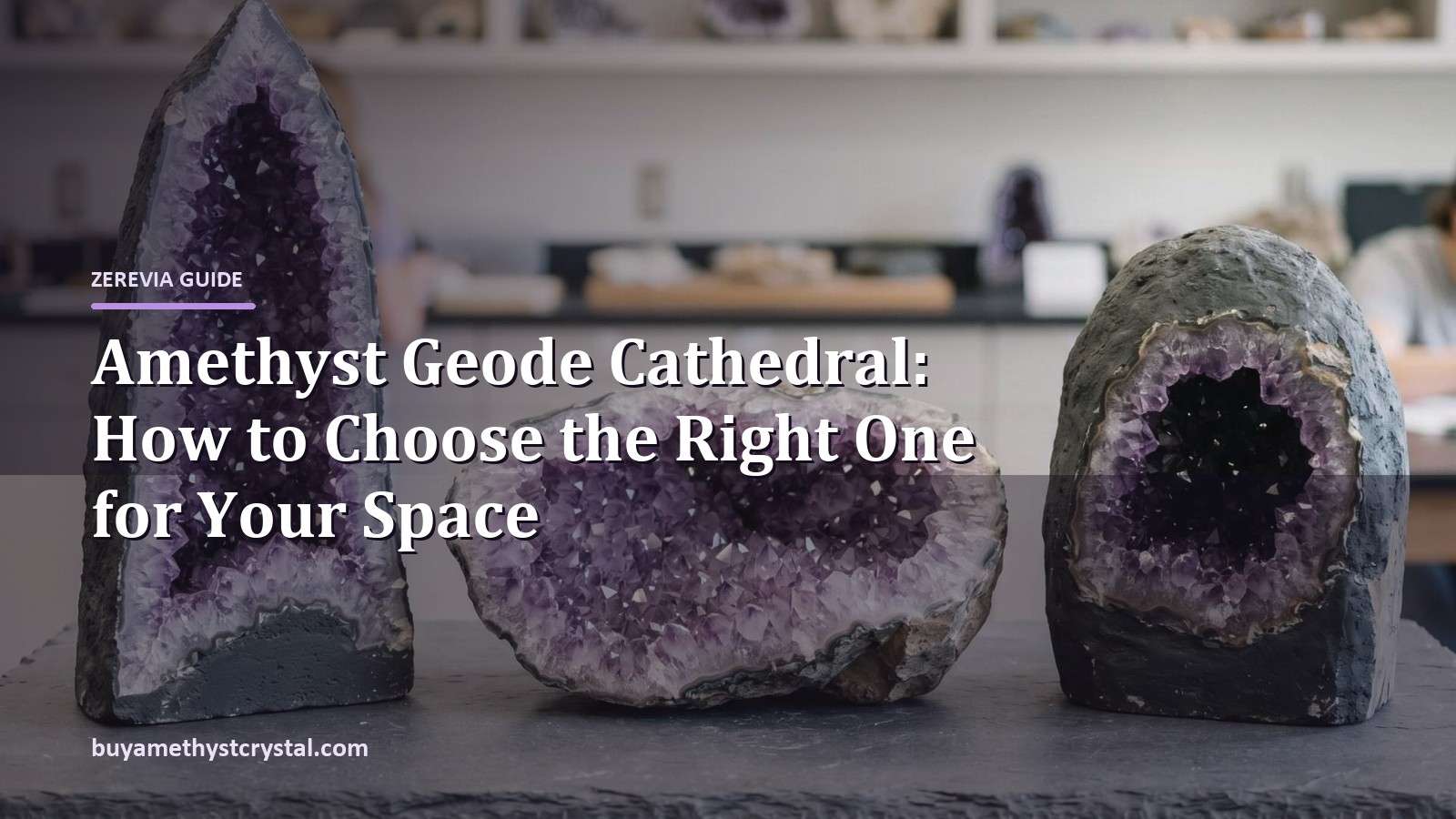

Amethyst Geode Cathedral: How to Choose the Right One for Your Space
An amethyst geode cathedral is one of those things that changes a room. Not in a loud way — more like the way a window changes a room. You walk past it, and something in your attention settles. If you are shopping for one, the choices come down to form, origin, color depth, and whether the stone in front of you is what the seller says it is. This guide covers all of it.
What Is an Amethyst Geode Cathedral?
A cathedral geode is a tall, upright geode shaped like an arch — a hollow cavity of rock lined on the inside with amethyst crystals, the outside usually rough matrix rock. The name comes from the resemblance to a church interior: the tall opening, the inward-leaning walls, the crystal-covered interior catching light.
I first saw a real cathedral geode at a mineral show — one about waist height, leaning against the back wall of a booth. The interior purple was so dark it looked almost black until the booth light hit it, and then every crystal tip went transparent. The dealer spent twenty minutes explaining how the color depth and crystal density worked. I did not buy that one. I could not afford it at the time. But I wrote down everything he said.
Cathedral geodes range from small tabletop pieces (a few inches tall, maybe two or three pounds) to museum-scale specimens that need a freight truck. Height, wall thickness, and interior crystal coverage all affect the price and where you can realistically put one.
They are different from other amethyst forms in specific ways:
- Amethyst geode slice: a flat cross-section cut from a geode, showing crystal banding in two dimensions. Can be wall-mounted or set on a small stand. Lighter, thinner, easier to display in tight spaces.
- Amethyst points (also called towers or obelisks): single terminated crystals, usually polished into a standing shape. Smaller, portable, often placed on a desk or nightstand.
- Amethyst clusters: multiple crystals growing from a shared base. Decorative and traditional, but not hollow like a geode.
For a fuller comparison of forms, see our amethyst crystal forms and shapes guide.
What Does an Amethyst Cathedral Geode Mean?
In traditional crystal use, the cathedral shape carries a particular kind of symbolism. The arch interior evokes a contained, private space — a quiet room inside a stone. Buyers often describe cathedral geodes as representing openness, sanctuary, and contemplative stillness. The purple color, meanwhile, is traditionally associated with clarity, calm, and intentional rest.
The amethyst crystal geode meaning that resonates most with buyers is not about mystical power. It is about placing something real — something that took millions of years to form — in a room where you want to slow down. The geode shape matters because it turns inward. You do not just look at the surface; you look inside.
Some buyers connect cathedral geodes with the traditional third eye and crown chakra associations — intuition and awareness, respectively. Others use them as a focal point for intention setting: placing the geode in a specific room and using its presence as a reminder of a personal goal. None of this is medical or guaranteed. It is ritual, and ritual works differently for everyone.
You can read more about what tradition and buyers describe around amethyst healing properties in our dedicated guide.
How to Tell If Your Amethyst Geode Is Real
This is the question I wish someone had answered for me clearly when I bought my first stone. The real vs fake amethyst geode distinction matters because fakes exist — resin casts dyed purple, glass imitations, even cement geodes with crystals glued in. Here is how to tell if your amethyst geode is real:
| Test | What to Look For | Red Flag |
|---|---|---|
| Weight | Real quartz (Mohs hardness 7) is noticeably heavier than glass or resin of the same size. | Feels suspiciously light for its size. |
| Temperature | Press the stone against your skin. Real amethyst feels cool initially and warms slowly in your hand. | Glass also feels cool, but warms faster and more uniformly. Resin may feel room-temperature from the start. |
| Color zoning | Natural amethyst shows uneven purple — deeper zones, lighter zones, sometimes white or gray matrix areas visible between crystals. | Uniform, even purple across the entire interior. Perfect consistency usually means dye. |
| Crystal structure | Look inside the geode. Individual crystal points with natural terminations (pointed tips) growing from the wall. Each one is slightly different. | Smooth, bubbly, or uniform interior surface. No individual crystal points visible. |
| Inclusions | Natural inclusions like feather-like patterns or small mineral traces are signs of real formation, not defects. | No inclusions at all can sometimes indicate a synthetic or heavily treated piece. |
| Seller transparency | Documented-origin sellers will name the country — Brazil or Uruguay — and sometimes the specific district. They answer questions about sourcing. | “Natural amethyst” on a label with no origin, no weight, no dimensions. The words alone prove nothing. |
I started paying attention to this because of a $12 stone I bought on impulse. It had a handwritten label and it was not particularly beautiful — pale color, grayish base. But it turned out to be real, and the questions I asked about it led me to everything I know now. For a deeper look at quality markers, see our amethyst quality and value guide.
Purple Amethyst Geode vs Pink Amethyst Geode: What Changes?
A standard purple amethyst geode gets its color from trace amounts of Fe³⁺ — three-valent iron ions — in the quartz crystal lattice, activated by natural radiation over millions of years. When I studied the Fe³⁺ color mechanism during GIA coursework, I remember thinking: there is a real, specific, chemical reason this stone is purple. Not a vague one. A measurable one.
Pink amethyst is less common. It occurs in some of the same geode formations but its color varies based on different trace element concentrations and local radiation exposure. It is still quartz. It is still amethyst, technically — just a different color expression.
When people search for “pink amethyst geode benefits,” they are usually asking what makes pink worth choosing over purple. The honest answer is not about medical benefits. It is about what you value:
- Rarity: pink amethyst is significantly less common, which affects price and availability.
- Color palette: softer pinks and mauves work differently in certain room aesthetics — especially spaces with warm tones, blush accents, or lighter design schemes.
- Display energy: buyers who collect both often describe pink as quieter, more diffuse, while purple reads as more concentrated and intense.
Practically speaking, purple amethyst geodes are far easier to find, come in a wider size range, and cost less at every tier. If you want a statement piece at a reasonable price, purple is the straightforward choice. If color rarity matters to you and the budget allows, pink is worth exploring.
For more on how color forms in different geological settings, see our guide to amethyst geological origins.
Cathedral Geode vs Geode Slice: Which Form Fits Your Space?
An amethyst geode slice and a cathedral geode come from the same natural formation — a hollow rock cavity lined with crystals. The difference is how that cavity is presented.
| Feature | Cathedral Geode | Geode Slice |
|---|---|---|
| Shape | Three-dimensional, freestanding, hollow interior visible through an opening | Flat cross-section, two-dimensional crystal banding visible on both faces |
| Display | Needs a sturdy shelf, console table, or floor space; the opening faces outward | Can be wall-mounted, placed on a small stand, or set on a shelf leaning against a wall |
| Weight | Heavier — the matrix rock walls add significant mass | Lighter — a slice is a thin section, sometimes translucent |
| Visual effect | Depth and interior perspective — you look into it; light refracts through crystal tips | Pattern and banding — concentric rings of color, sometimes with agate or chalcedony borders |
| Best for | Rooms where you want a focal point; entryways, living rooms, meditation spaces | Smaller spaces, gallery walls, shelves, windowsills, or gifts |
Both forms show the same geological story — silica-rich fluid filling a cavity in volcanic rock, cooling slowly, growing crystals over thousands of years. The cathedral gives you the interior experience. The slice gives you the cross-section. Your space and your wall situation will usually make the decision for you.
More comparisons across forms are in our amethyst forms and shapes guide.
Choosing by Origin: Brazil vs Uruguay
If you are choosing a purple amethyst geode and the seller can tell you where it came from, you have two main options: Brazil or Uruguay. Here is how they compare.
Brazilian amethyst geodes are typically larger. The color range runs from soft lavender to medium purple. Because the geodes are bigger, you get more visual impact per dollar — a good choice when you want a statement piece that fills a space. The main producing region is Ametista do Sul in Rio Grande do Sul.
Uruguayan amethyst geodes tend to be smaller, but the crystal structure is denser and the color runs deeper — sometimes reaching the deep, near-black purple called emperor purple. At a mineral show, a dealer once told me to put a Uruguayan piece next to a same-price Brazilian piece and spend two seconds looking at both. The color difference was immediate. You pay more per inch, but the intensity is in a different category.
Neither origin is better. I usually ask: do you want something large, or something deeply colored? If the answer is “large and beautiful on a reasonable budget,” Brazil. If the answer is “I want the deepest purple I can get,” Uruguay.
You can see a documented-origin example in our Uruguayan amethyst geode listing. For the full story of how origin affects color and value, see amethyst geological origins.
Traditional Associations and What Buyers Actually Use Them For
When people search for amethyst geode healing properties or the benefits of amethyst geode, they are usually looking for two things: what tradition says, and what real people actually do with these stones.
In traditional crystal use, amethyst geodes are associated with calm, clarity, and contemplative space. The cathedral shape — that open arch, the interior you look into — reinforces this. It reads as a small sanctuary. Some buyers describe the benefits of amethyst geode as “having something in the room that reminds me to slow down,” which is not a medical claim. It is a description of attention.
Here is what I can say from personal experience, without overstating it: the first stone I bought — that $12 piece with the handwritten label — sat on my nightstand. I do not know if stones have mysterious power. I still do not fully believe that. But the night I put it there was the first night in months I fell asleep without waking at 3 a.m. I cannot prove the stone caused that. What I know is that I spent a few minutes looking at it before I turned off the light instead of scrolling on my phone. That was the difference.
Buyers commonly place cathedral geodes in specific settings:
- Bedside: as a visual anchor that marks the transition from screen time to rest time.
- Meditation corner: as a focal point for intention setting or quiet sitting.
- Living room: as a statement piece that also happens to be a real geological object, not just decor.
- Office or desk: as a grounding object during a workday — something to look at that is not a screen.
Whether you follow a specific crystal tradition, practice intention setting, or simply like having a real mineral in your space, the amethyst cathedral geode meaning is whatever you assign to it. The stone does not come with instructions. That is part of why it works for people — it leaves room for your own version.
For a fuller discussion of traditional associations and buyer experiences, see our guide to amethyst healing properties.
Caring for Your Amethyst Cathedral Geode
This section exists because of a mistake I learned from — not my own, but one a buyer shared with me. She had placed her crystal on a bedroom windowsill. South-facing window. Direct sunlight for about two hours every afternoon. A few months later, the deep emperor purple had faded to lavender.
The color change is irreversible. Fe³⁺ ions in the quartz lattice break down under sustained UV exposure, and the purple does not come back. This is not a theory — it is a documented mineralogical process. So here is the care checklist I now include with every geode:
- Avoid direct sunlight. Indirect light is fine — and actually ideal for display, since it makes the crystal tips refract without UV damage. LED accent lighting achieves the same effect with zero fading risk.
- Dust with a soft brush. A clean paintbrush or makeup brush works. The crystal points catch dust, and you want something that gets between them without scratching. Avoid harsh chemicals or ultrasonic cleaners.
- Clean the matrix exterior with a slightly damp cloth if needed. The rough outer rock can accumulate grime; it does not need anything fancy.
- Place on a stable surface. Cathedral geodes are heavier than they look. A sturdy shelf, a reinforced console table, or the floor are all fine. Avoid high-traffic areas where someone might bump into it.
- If you want to cleanse it in a traditional ritual sense, moonlight is the safest option — set it near a window on a clear night. Sound cleansing with a singing bowl is also safe and does not involve moisture or UV exposure.
A cathedral geode that is cared for properly will keep its color for decades. One that sits in direct sun will not. It is the single most important thing to get right.
Frequently Asked Questions
How can I tell if my amethyst geode is real?
Check the weight (real quartz is heavier than glass or resin), press it against your skin (real amethyst feels cool and warms slowly), look for uneven color zoning (uniform purple is a red flag), and inspect the interior for individual crystal points with natural tips — not smooth or bubbly surfaces. A transparent seller will also tell you the specific origin country. See our full amethyst quality and value guide for more detail.
What is the meaning of an amethyst cathedral geode?
In traditional crystal use, the cathedral shape is associated with sanctuary, openness, and contemplative space — the arch interior evokes a quiet room. Purple amethyst is traditionally linked to clarity, calm, and intentional rest. These are cultural and personal associations, not medical claims. Many buyers use the geode as a focal point for intention setting or as a visual reminder to slow down.
What is the difference between a cathedral geode and an amethyst geode slice?
A cathedral geode is a freestanding, three-dimensional hollow rock with crystals visible inside through an opening. An amethyst geode slice is a flat cross-section that shows crystal banding in two dimensions. Cathedrals need more floor or shelf space and are heavier. Slices can be wall-mounted or placed on small stands. Both come from the same geological formation — just presented differently.
Is Brazilian or Uruguayan amethyst better?
Neither is better — they serve different priorities. Brazilian amethyst geodes are larger and more affordable per size, with colors ranging from lavender to medium purple. Uruguayan amethyst geodes are smaller but have denser crystals and deeper, more intense color, sometimes reaching emperor purple. If you want visual scale, go Brazilian. If you want color depth, go Uruguayan.
Where to Go from Here
Choosing an amethyst geode cathedral comes down to a few honest questions: How much space do you have? Do you want size or color depth? Does the seller tell you where the stone came from? And are you willing to keep it out of direct sunlight?
If you want to explore documented-origin geodes with accurate photography and real dimensions, start with our collection at Zerevia. Every piece is photographed individually — what you see is what you get.
 Crystal Cluster
 Crystal Tower
 amethyst crystal ball
 Amethyst Caves for Sale
 Amethyst Bracelets
 Amethyst Earrings
 Amethyst Necklaces
 Amethyst Rings
 amethyst crystal healing
 Amethyst Beauty & Wellness
 Crystal Home Decor
 Spiritual & Divination Tools