
Beginner’s guide
How to Use Amethyst: 7 Practical Methods for Beginners
You bought a purple stone — now what? Here are seven concrete, low-pressure ways to bring amethyst into your daily life, plus the care basics most guides skip.
If you have been searching for how to use amethyst, the honest answer is simpler than most websites make it sound. Amethyst is a variety of quartz — silicon dioxide with traces of iron — and it has been shaped into jewelry, home décor, and personal objects for centuries. The real question is not whether it works, but which form fits your life and how to keep it from fading. This beginner’s guide walks through seven practical methods, starting with the easiest and building toward less obvious uses.
Before You Start: What Amethyst Actually Is
Before you decide how to work with amethyst, it helps to understand what you are holding. Amethyst is a member of the quartz family. Its purple color comes from tiny amounts of trivalent iron (Fe³⁺) locked inside the crystal lattice, activated by natural background radiation over millions of years. The purple is not painted on. It grew there.
On the Mohs hardness scale, amethyst sits at 7 — hard enough to scratch glass, durable enough for daily wear in jewelry, but not invincible. It can chip if dropped on tile. And the color, while stable under normal indoor lighting, will fade under prolonged ultraviolet exposure. Once the Fe³⁺ shifts, that fade is permanent.
I remember the first time the chemistry clicked for me. I was reading through a GIA unit on color mechanisms, and the explanation for why this stone is purple — not because of intention or desire, but because of a specific iron ion behaving predictably inside silicon dioxide — felt grounding. There is something reassuring about a color that exists for a reason you can point to. If you are curious about how origin affects color depth, our geological origins of amethyst guide covers the difference between Brazilian and Uruguayan material. For a deeper look at what makes one piece more valuable than another, see the amethyst quality and value guide.
Method 1: Wear It as Jewelry
The most accessible way to use amethyst is to put it on your body. Rings, pendants, earrings, and bracelets let you carry the stone without thinking about placement or ritual. It sits there, doing nothing dramatic, and that is the point.
What to look for
For jewelry that holds up, focus on two material details: the stone should be 100% natural amethyst (not glass, not dyed quartz), and the setting should be 925 sterling silver. Sterling silver stamped “925” contains 92.5% pure silver blended with copper for strength. It is nickel-free, which means no green marks on your skin and no irritation for most people with metal sensitivities.
Care for daily wear
- Remove rings and pendants before showering, swimming, or cleaning with chemicals.
- Store in the gift box or a soft pouch away from direct sunlight.
- Polish the silver occasionally with a soft cloth — tarnish is normal, not a defect.
Choosing jewelry is mostly about what you will actually wear. A ring you forget about is more useful than a pendant that stays in a drawer. If you are browsing, our amethyst healing properties page covers traditional associations that some people find meaningful when choosing a piece for personal use.
Method 2: Place It in Your Home
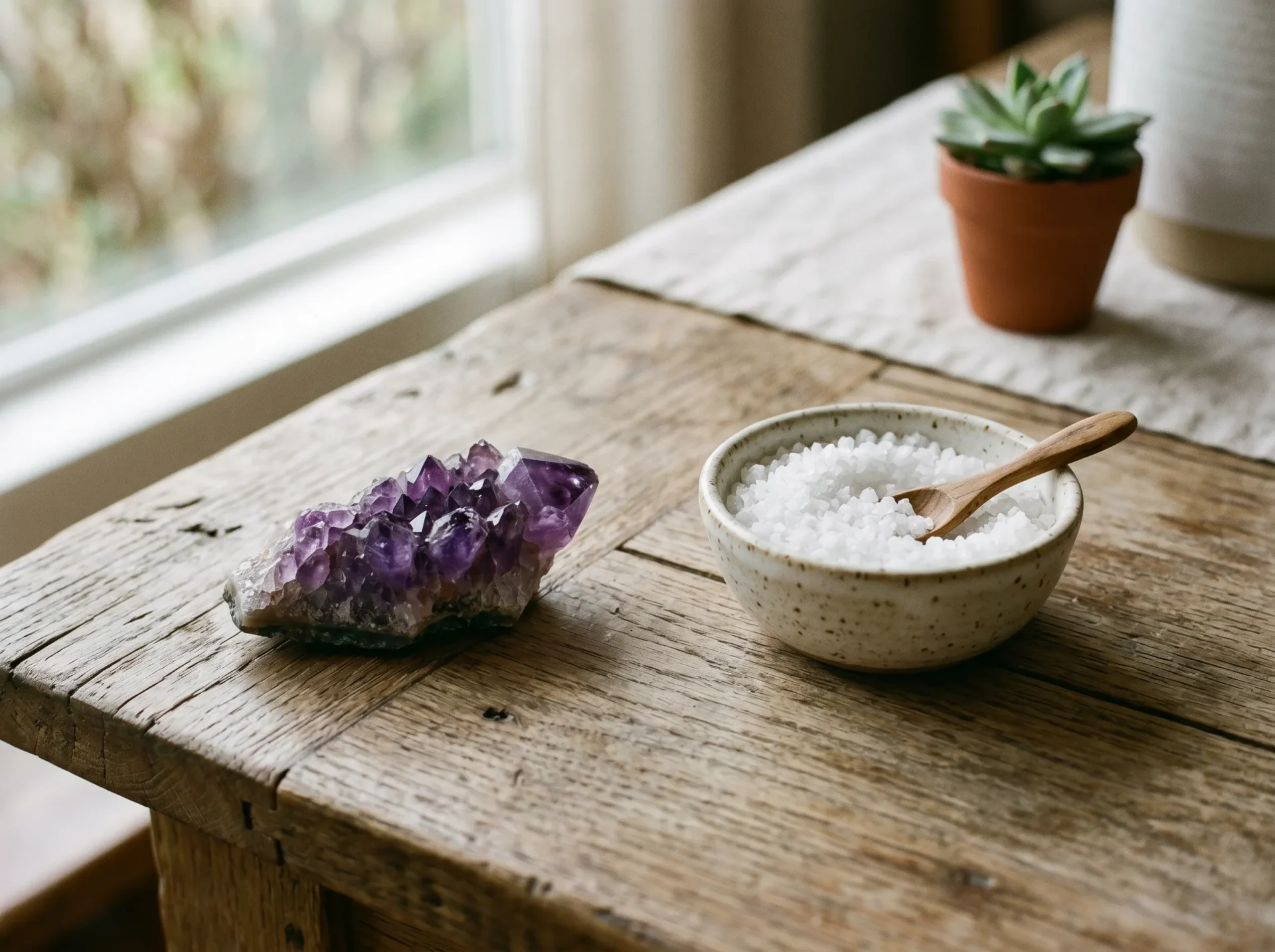
Amethyst comes in forms that work as décor first and everything else second. A geode split open to reveal purple crystals makes a visual statement on a coffee table or bookshelf. A cluster adds texture to a shelf. A sphere sits quietly on a desk. These are objects that happen to be made of a mineral, not spiritual obligations.
Choosing a form for your space
When someone asks me which shape to start with, I usually ask: where will it live? A geode needs floor space or a sturdy side table. A cluster fits on a bookshelf. A sphere works on a nightstand. The answer has more to do with your furniture layout than with any traditional framework.
That said, some people use placement traditions as a starting framework. In Feng Shui, for instance, the southeast corner of a room is sometimes called the “wealth corner,” and placing a geode there is a common practice. It is not a guarantee of anything — it is a way of giving the stone a deliberate location instead of letting it collect dust behind a lamp.
If you are shopping for raw pieces, look for WYSIWYG photography — what you see is what you get — and documented origin. Brazilian amethyst tends toward larger formations with a wider color range, from soft lavender to medium purple. Uruguayan material is typically smaller but denser in color, sometimes reaching that deep violet-blue people call emperor purple. I usually explain it as: do you want big or do you want deep? Our amethyst forms and shapes guide walks through the differences in detail.
Method 3: Create a Simple Ritual
A ritual does not have to be complicated. It can be as simple as holding a stone, taking three slow breaths, and naming something you want to pay attention to. That is it. No candles required, though you can add them if you like the mood.
The point is not to summon anything. It is to create a short, deliberate pause — a few minutes where you are holding something real instead of scrolling. Some people use this practice before bed. Others use it at the start of a work session. The stone becomes a physical anchor for a moment of focus.
A tumbled stone or palm stone works well for this. They are smooth, comfortable to hold, and sized for one hand. You can keep one on your nightstand or desk and reach for it when you want a quiet minute.
I had a conversation once with someone who asked me straight out: “Do you really think the stone does something?” I told him I did not know whether the stone had any measurable effect. What I knew was that having a piece of real mineral on my nightstand — something I pause to look at instead of picking up my phone — changed my last few minutes before sleep. He said, “Okay, I can accept that.” That is the level of honesty this practice deserves. If you want to explore the broader context of amethyst care and cleansing, including ways some people refresh their stones between uses, that guide covers moonlight, sound, and other safe methods.
Method 4: Carry a Small Stone
Tumbled stones are the lowest-commitment way to start. They are smooth, pocket-sized, and usually a few dollars. You can drop one in a coat pocket, a bag, or keep it on your desk at work. The tactile quality — the weight, the coolness against your palm — is what makes it useful as a personal reminder.
A practical caution
Even small stones should not live in direct sunlight for hours. A tumbled stone on your car dashboard in July is getting the same UV exposure as a geode on a windowsill. The color will fade. Keep it in a pocket, a bag, or a drawer when you are not actively holding it.
Method 5: Combine It with Other Crystals
If you already own other stones, placing them near your amethyst is a simple way to create a small arrangement. There is no required formula, but people often pair stones by complementary intention: amethyst for calm alongside clear quartz for clarity, or rose quartz for softness next to amethyst for quiet focus. These pairings are personal choices, not rules.
A more structured version of this is the crystal grid — stones arranged in a geometric pattern, often with a central piece and surrounding stones placed with a specific intention in mind. It is a creative practice, and the layout matters less than the act of doing it deliberately. If you want to try it, start with two or three stones on a small tray or cloth. You can always add more later.
Method 6: Use It for Birthstone or Zodiac Gifts
Amethyst is the official birthstone for February. It is also traditionally associated with the zodiac sign Aquarius, which covers late January through mid-February. This makes it a natural gift for birthdays, Valentine’s Day, or anyone with a connection to those dates.
For gifts, jewelry is usually the safest choice — a pendant, a pair of earrings, or an adjustable ring that removes the guesswork of sizing. Some pieces come with a birthstone meaning card, which gives the recipient context without making claims you are not comfortable making yourself.
The value of a birthstone gift is personal, not magical. You are giving someone a real mineral associated with their month of birth, set in a material that will last. That is enough. Browse birthstone jewelry options if you are shopping for someone specific.
Method 7: Charge or Display Other Crystals
In traditional crystal practice, a large amethyst cluster can serve as a “charging station” — a place where smaller stones are set on or around it between uses. The idea is that the larger stone acts as a restorative base for the smaller ones.
I want to be clear: this is a ritual practice, not a scientifically measurable process. There is no instrument that detects a “charge” transferring between two pieces of quartz. But as a display arrangement, it works beautifully. A large cluster on a shelf with a few smaller stones placed around it looks intentional. It gives all of your pieces a home. And if the practice of placing them there with a purpose feels meaningful to you, that is reason enough to do it.
Common Beginner Questions
Ready to Find Your First Piece?
Whether you want a ring you can wear every day, a geode for your living room, or a small tumbled stone to carry in your pocket, start with something that fits your actual life. Explore Zerevia’s documented-origin amethyst, from beginner-friendly tumbled stones to statement geodes, on our amethyst healing properties page.
 Crystal Cluster
 Crystal Tower
 amethyst crystal ball
 Amethyst Caves for Sale
 Amethyst Bracelets
 Amethyst Earrings
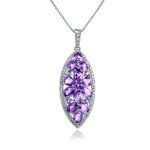 Amethyst Necklaces
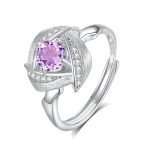 Amethyst Rings
 amethyst crystal healing
 Amethyst Beauty & Wellness
 Crystal Home Decor
 Spiritual & Divination Tools