
Zerevia guide
Amethyst Crystal Benefits for Anxiety: 5 Calming Techniques Practitioners Actually Use
Specific, repeatable practices that crystal practitioners use with amethyst for settling the mind — plus how to choose the right form, care for your stone, and set honest expectations.
People have reached for amethyst during anxious moments for centuries. The name itself — from the Greek amethystos, meaning “not intoxicated” — hints at the stone’s long association with a steadier, quieter state of mind. Today, crystal practitioners use amethyst in specific, repeatable ways that are more ritual than magic: physical objects that prompt a pause, a breath, a moment of presence.
This guide covers five techniques practitioners actually use, how to match an amethyst form to your preferred practice, and what to know about care and expectations. These are traditional practices and personal rituals — not medical treatments. If you’re experiencing clinical anxiety, a healthcare provider is the right first step.
What Crystal Practitioners Mean by ‘Amethyst for Anxiety’
When someone says amethyst helps with anxiety, they’re usually describing something more specific and more modest than it sounds. They mean: “I have a physical object that reminds me to stop, breathe, and be present for sixty seconds.”
In traditional crystal practice, amethyst is associated with the Third Eye and Crown chakras — energy centers linked to intuition and awareness in Indian philosophical tradition. Practitioners who work with amethyst for calm tend to use it as a grounding anchor during specific moments: before sleep, during a panic spike, or in a designated quiet space. The traditional uses of amethyst and their meaning across cultures are well documented — but they’re tradition, not prescription.
I bought a $12 amethyst labeled “for calm nights” after a difficult personal transition. It wasn’t a beautiful specimen — the color was pale, the matrix was grayish. But I put it on my nightstand, and that night was the first in months I didn’t wake up at 3 a.m. That doesn’t prove anything. But it’s where my study of amethyst started.
The five techniques below are what practitioners describe most often. None of them involve sitting in silence for an hour or buying an expensive crystal. They’re small, specific, and fit into routines that already exist.
5 Calming Techniques Crystal Practitioners Use with Amethyst
Each of these is a standalone practice. You can try one or all five. The goal isn’t to add complexity to your day — it’s to use a physical object as a prompt for a moment of calm that you were probably already looking for.
1. Bedside Wind-Down Stone
Place a raw amethyst piece or a palm stone on your nightstand. Before you reach for your phone at night, pick up the stone. Hold it for a few seconds. Look at it. Then put it down and get into bed.
This is the technique that started everything for me. That $12 stone sat on my nightstand for months. The act of pausing to look at it — instead of scrolling — became a small ritual that my brain started associating with winding down. The stone didn’t do anything to me. It gave me something to do instead of the thing that was keeping me awake.
Best form: Raw crystal or palm stone — something with enough weight and texture to feel distinct in your hand. A stone between 2 and 4 inches works well.
2. Palm Stone Grounding Hold
Keep a tumbled amethyst in your pocket, bag, or desk drawer. When you notice anxiety building — a tight chest, racing thoughts, that specific restless feeling — hold the stone for 60 seconds. Focus entirely on the physical sensation: the weight, the coolness, the smooth texture warming against your skin.
This is a sensory grounding method. The stone is a tactile anchor — something concrete to focus on when your mind is doing too many things at once. Tumbled stones work best here because they’re smooth, pocket-sized, and easy to grip without drawing attention.
Best form: Tumbled stone or small palm stone. Keep it in the same pocket every day so the habit forms around the location.
3. Dedicated Calm Corner
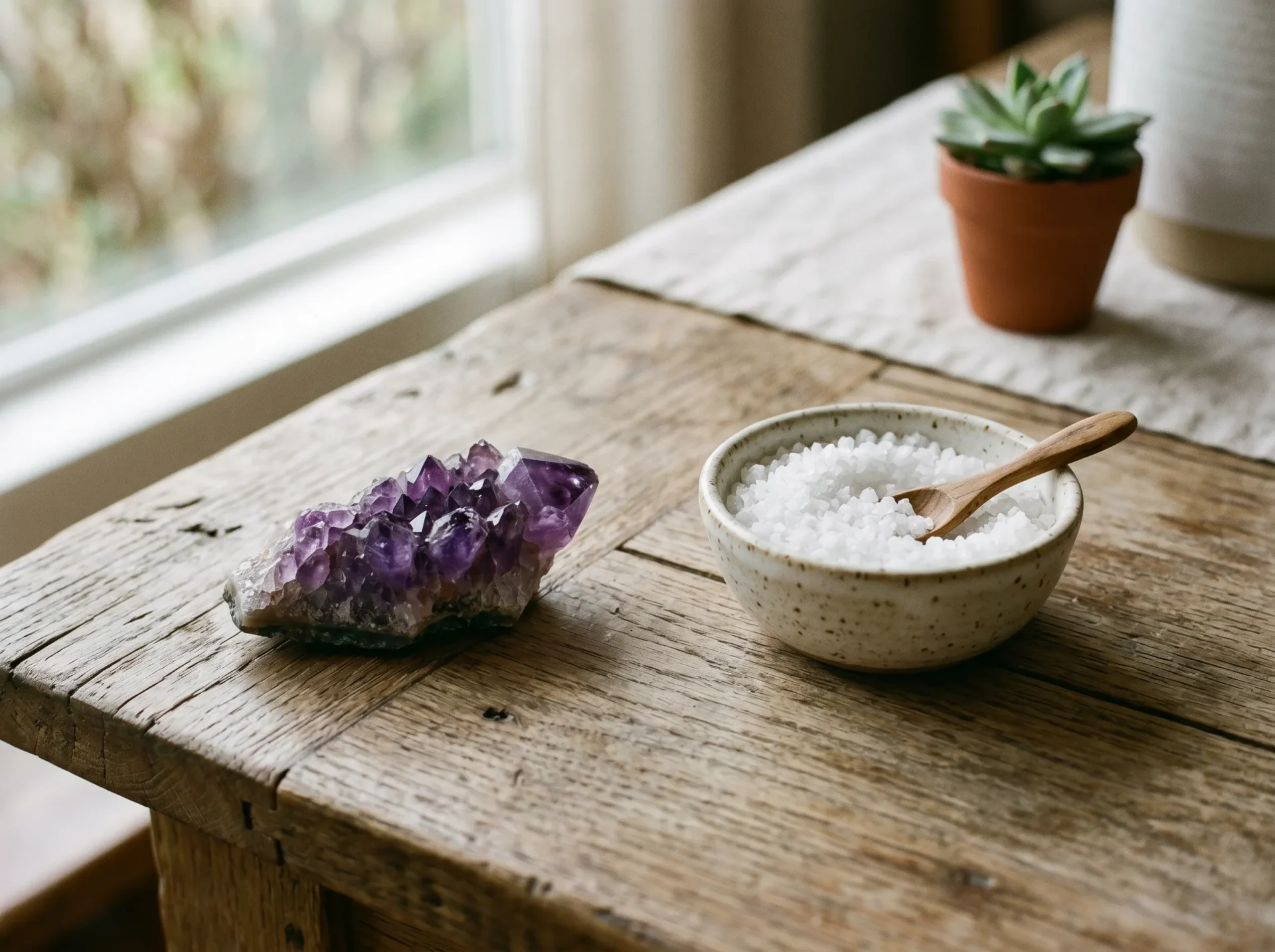
Choose a small surface — a shelf, a windowsill away from direct sunlight, the top of a dresser — and set up a quiet corner with an amethyst cluster or geode, a candle, and one other object that signals slowness to you (a plant, a book, a small bowl). This becomes a visual cue for your nervous system: when you see that corner, your body starts to downshift.
Practitioners who use this technique describe it as creating a physical boundary between “busy” and “not busy” in a home that serves a lot of functions. The crystal doesn’t need to be large. It needs to be visible and placed somewhere you pass regularly.
Best form: Cluster, small geode, or crystal tower. You want something with vertical presence — enough to register visually without dominating the room.
4. Breathwork Companion
Hold a crystal tower or point during a structured breathing exercise. A common pattern practitioners use is 4-4-4: breathe in for 4 counts, hold for 4 counts, exhale for 4 counts. Repeat for 4 minutes.
The tower gives your hand something intentional to hold. Some people describe it as a way to externalize their focus — the pointed shape provides a tactile reference that keeps the mind from drifting. The stone is not the source of calm. The breathing is. The stone is what keeps your hands from fidgeting and your attention on the rhythm.
Best form: Crystal tower or obelisk, 3 to 5 inches. The pointed top gives your grip a clear orientation.
5. Intention-Set Tumbled Stone
Write a single word or short phrase on a small piece of paper — something like “steady,” “pause,” or “one thing at a time.” Place a tumbled amethyst on the paper and leave it overnight. The next morning, put the stone in your pocket and carry it through the day.
This is a traditional intention-setting practice. The overnight rest is a ritual marker — it gives the stone a specific role in your day before you’ve even started. When you reach into your pocket and feel it, you’re reminded of the word you chose. That’s the practice: a physical object carrying a specific, chosen reminder.
Best form: Tumbled stone. Small, smooth, durable enough for daily carry. If you want to cleanse it between uses, a moonlight bath overnight is the safest method — it won’t affect the stone’s color.
Choosing the Right Amethyst Form for Your Calm Practice
The techniques above each work best with a specific form of amethyst. Here’s a quick reference to help you match form to practice before you buy.
When shopping for any of these, look for sellers who photograph each stone individually — that’s the “what you see is what you get” standard. Understanding amethyst quality markers like natural color zoning, weight, and origin documentation helps you avoid dyed or misrepresented stones.
Amethyst Care Checklist for Your Calm Practice
A stone you’re using daily needs basic care to keep it looking the way it did when you brought it home. Amethyst is durable — it’s a 7 on the Mohs hardness scale, which means it can handle regular handling. But it has one important vulnerability.
Your Amethyst Care Checklist
- Avoid direct sunlight. UV exposure causes the iron ions (Fe3+) that create amethyst’s purple color to undergo an irreversible change. The purple fades toward lavender or gray, and it doesn’t come back. I learned this the hard way when a buyer messaged me about her crystal tower that had been sitting on a south-facing windowsill. Two months of afternoon sun turned her deep violet into a pale lavender. The stone was still real — but that color was gone permanently.
- Cleanse with moonlight, not sunlight. Place your stone under moonlight overnight for the safest color-preserving cleansing. Sound cleansing with a singing bowl also works and adds a sensory ritual element.
- Place it away from windows. Nightstands, shelves, and desks away from direct sun are all safe spots for a calm-practice stone.
- Handle with reasonable care. Mohs 7 means your amethyst can scratch glass and handle daily touch. It can still chip if dropped on tile or concrete, so set it down gently.
- Watch for pre-existing fading. If a stone arrives looking significantly paler than its product photos, it may have had UV exposure before it reached you. This is one reason documented-origin amethyst with individual product photography matters — you can see the actual stone’s color, not a stock image.
What to Expect — and What Not to Expect
Here’s the honest version.
Traditional practitioners describe amethyst as a companion for calm rituals. They don’t describe it as a treatment. The most common benefit people report isn’t mystical — it’s practical. They have a physical object that prompts them to pause, take a breath, and be present for a moment. That pause is the practice. The stone is what triggers it.
Someone once asked me, “You really think the stone does something?” I said, “I think real things have value.” He said, “That’s avoiding my question.” I paused. “I don’t know if stones have the kind of mysterious energy people talk about. I really don’t. But I know that when there’s a piece of amethyst from a documented source on my nightstand, I spend a minute or two looking at it before I sleep instead of scrolling. That works for me.” He thought about it. “Okay, I can accept that.”
If you have clinical anxiety — the kind that disrupts your daily functioning, your relationships, or your ability to work — a therapist or healthcare provider is the right starting point. Amethyst can be a complementary ritual alongside professional care. It’s not a substitute for it.
And when you’re choosing where to buy: be cautious of sellers who promise specific outcomes from their stones. Look for sellers who describe origin, form, color, and care honestly — and who show you the actual stone you’ll receive. That’s the standard worth holding.
Find the Right Amethyst for Your Calm Practice
Ready to choose a stone? Browse our documented-origin amethyst collection — each stone photographed individually so you know exactly what you’re getting, with origin, weight, and dimensions listed for every piece.
 Crystal Cluster
 Crystal Tower
 amethyst crystal ball
 Amethyst Caves for Sale
 Amethyst Bracelets
 Amethyst Earrings
 Amethyst Necklaces
 Amethyst Rings
 amethyst crystal healing
 Amethyst Beauty & Wellness
 Crystal Home Decor
 Spiritual & Divination Tools