
Zerevia buying guide
Purple Crystal Cave: A Complete Guide for Buyers & Collectors
How to choose a quality amethyst geode, compare origins, check for authenticity, and keep its color from fading — without relying on vague grading claims.
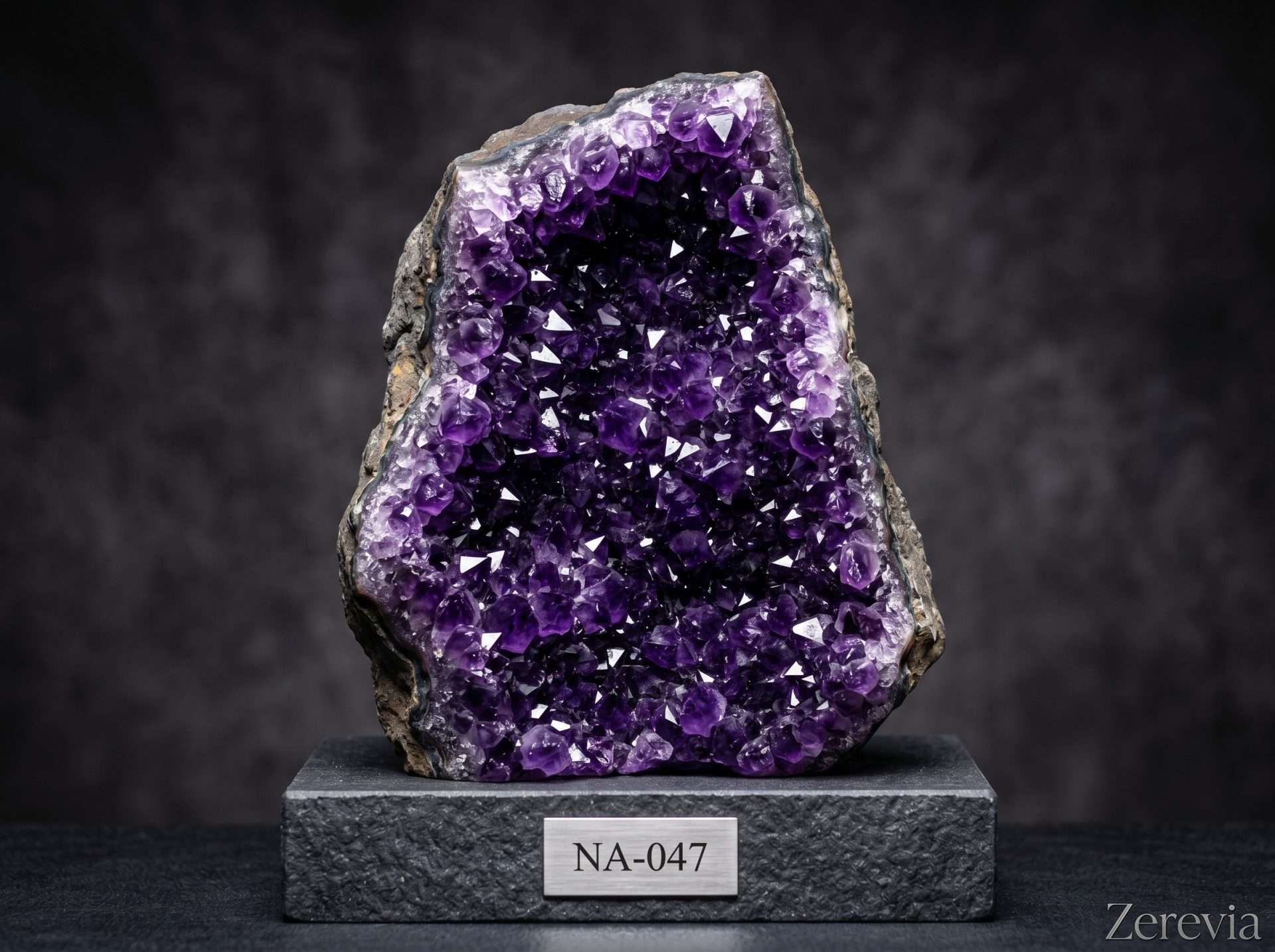
A purple crystal cave — also called an amethyst geode or amethyst cave — is a hollow rock lined with natural amethyst crystals. It is one of the most visually striking forms you can bring into a room, and also one of the easiest to misjudge if you do not know what you are looking at. This guide covers how to evaluate origin, color depth, crystal density, and care needs so you can choose with confidence rather than guesswork.
For a broader look at how geodes compare to clusters, towers, and spheres, see our overview of amethyst forms and shapes.
What Is a Purple Crystal Cave?
A purple crystal cave is a geode — a hollow cavity inside a rock — whose inner walls are covered with amethyst crystals. These formations begin millions of years ago when silica-rich fluids flow into a void in volcanic basalt and slowly deposit quartz crystals along the interior surface. The purple color comes from trace amounts of iron (Fe3+) that are activated by natural background radiation over geological time.
The outer shell is typically rough basalt or another matrix rock, sometimes called the “mother rock.” When the geode is cut open, the contrast between the plain exterior and the sparkling purple interior is what gives these pieces their visual impact. Some are small enough to hold in one hand. Others — cathedral geodes — stand taller than a person.
What you see in a product photo should be what you receive. Look for listings that use one-of-a-kind photography, meaning each image shows the exact piece you are buying rather than a representative sample. This matters because no two geodes are identical — color distribution, crystal size, and cavity shape vary from one piece to the next.
When someone asks me whether Brazilian or Uruguayan amethyst is better, I usually start with a different question: “Do you want something big, or something deep?” That distinction matters more than any grade label ever could.
How to Choose a Purple Crystal Cave
Buying a purple crystal cave comes down to four decisions: how big, what color depth, which origin, and how much you want to spend. Here is how to think through each one.
Size and Placement
Measure the space where the geode will live before you start browsing. A small to medium cave (roughly 10–30 cm / 4–12 inches) works on a bookshelf, side table, or desk. A larger piece (40 cm / 16 inches and above) becomes a statement item — a floor display, a mantle centerpiece, or an entryway feature. Think about whether you want to walk past it casually or sit with it nearby.
Color Depth: Brazil vs. Uruguay
The two dominant commercial origins for amethyst geodes are southern Brazil and Uruguay. They produce noticeably different looks:
Neither origin is universally “better.” If you want a large visual presence in a living room at a reasonable price, Brazilian geodes deliver. If you want the deepest possible purple — the kind that holds its color even in lower light — Uruguayan pieces tend to win. The right answer depends on your room, your eye, and your budget.
Crystal Density and Natural Variation
Look closely at photos for color zoning — patches where the purple is darker or lighter, sometimes with white or clear quartz showing through. This unevenness is normal. It is, in fact, one of the most reliable signs that the amethyst is natural rather than dyed or synthetic. A piece with perfectly uniform purple throughout should raise questions, not celebrations.
Also check whether the listing specifies individual photos. If you are buying a geode, you should see the exact piece — its weight in grams or kilograms, its height and width, and ideally a photo that shows both the open face and the back.
Ready to compare specific pieces? Browse our amethyst crystal caves collection with documented-origin photography.
Quality Markers in Amethyst Crystal Caves
There is no internationally recognized grading system for amethyst — no equivalent to the GIA diamond scale. Terms like “AAAA” or “collector grade” are used inconsistently across sellers, and sometimes applied to everything in a shop. Instead of relying on those labels, use these concrete checks:
- Color zoning: Look for natural variation in purple intensity across the crystal face. Uneven distribution is expected and indicates natural formation. Avoid pieces that look artificially uniform unless confirmed as untreated.
- Inclusions: Feather-like internal features, small needle formations, or slight cloudiness inside crystals are signs of natural growth. These are not flaws — they are formation records.
- Matrix rock: The basalt or rock base should be present and intact. A clean, natural matrix edge shows where the geode was cut from its host rock. If the back is covered in resin or painted material, ask why.
- Weight and dimensions: Real amethyst is denser than glass or resin imitations. A piece that feels surprisingly heavy for its size is a good sign. Always compare the listed weight to what you would expect from similar-sized pieces.
- UV sensitivity: This is a care marker more than a purchase marker, but it matters. A geode that has been sitting in a sunlit showroom may already have faded at its most exposed crystal tips. Ask about the piece’s storage history if possible.
A buyer once wrote to say her geode had turned from deep purple to a washed-out lavender. She had placed it on a south-facing windowsill where it got direct afternoon sun for about two hours a day. The fading was permanent — the Fe3+ color centers had been changed by UV exposure, and no amount of moonlight or cleansing ritual could reverse it. I put UV care warnings in every product description after that.
For more on what amethyst traditionally symbolizes and how people use it in their spaces, see our guide to amethyst meaning and traditional uses.
Placement and Care for Your Amethyst Cave
A geode is a long-term display piece. Where you put it and how you maintain it will determine how it looks five or ten years from now.
Where to Place It
Choose a spot that is away from direct sunlight. A north-facing wall, an interior shelf, or a room that does not get strong afternoon sun works well. If your only option is a bright room, keep the geode on a lower shelf or deeper into the room where light is diffused.
In traditional Feng Shui practice, geodes are sometimes placed in a room’s southeast corner — often called the “wealth corner” — or in a central area to serve as an anchor piece. Others simply use them as living room or entryway decor because they like the way the purple catches ambient light.
Some people set intentions with their geode — pausing near it as part of a morning or evening routine, or placing it in a room where they want a visual reminder to slow down. This is a personal practice, not a medical treatment. The value is in the ritual itself: a specific object in a specific place that signals a transition in your day.
How to Clean It
Dust collects on crystal points. A soft dry brush or microfiber cloth handles most cleaning. If the piece needs more, a brief rinse under lukewarm water is generally safe for natural amethyst — but avoid soaking the matrix rock if it is porous, and never use chemical cleaners, ultrasonic devices, or steam.
Sound Cleansing (Optional)
Some crystal owners use singing bowls or other resonant instruments to “cleanse” or “reset” their pieces as part of a personal ritual. This will not damage the stone and can be a grounding practice in its own right. It is entirely optional — your geode does not require it to remain a geode.
For more ideas on incorporating amethyst into your home, explore our amethyst crystal healing and decor guide.
Purple Crystal Cave vs. Other Amethyst Forms
A geode is not the only way to display amethyst. Depending on your space and purpose, a different form might suit you better:
- Clusters sit flat and show multiple crystal points growing from a shared base. They work well on tables and shelves.
- Crystal towers and obelisks are polished vertical pieces that fit narrow spaces like windowsills or desks.
- Crystal spheres are polished into a round shape and can serve as a focal point on a stand. If you are drawn to that form, see our amethyst crystal balls.
- Tumbled stones are small, smooth, and portable — good for carrying in a pocket or placing in a bowl.
A purple crystal cave is the right choice when you want the natural cavity to be part of the display — when the hollow interior and the crystal-covered walls are the point. It is the most geologically “complete” form: you are seeing the amethyst as it grew, inside the rock that held it.
Frequently Asked Questions
Find Your Purple Crystal Cave
Ready to explore documented-origin amethyst caves? Browse our collection to find the right piece for your space — with accurate photography, detailed measurements, and honest origin information.
 Crystal Cluster
 Crystal Tower
 amethyst crystal ball
 Amethyst Caves for Sale
 Amethyst Bracelets
 Amethyst Earrings
 Amethyst Necklaces
 Amethyst Rings
 amethyst crystal healing
 Amethyst Beauty & Wellness
 Crystal Home Decor
 Spiritual & Divination Tools