Amethyst Stalactite Slice: Meaning, Benefits & Buying Guide

What Is an Amethyst Stalactite Slice? Meaning, Benefits, and How to Choose One
If you have been searching for an amethyst stalactite slice, you have probably noticed two things: the photos look unlike any other crystal product you have seen, and the descriptions range from vague to contradictory. This guide will walk you through what a stalactite slice actually is, what traditional meaning people attach to it, what to look for when buying one, and how to care for it once it is in your home.
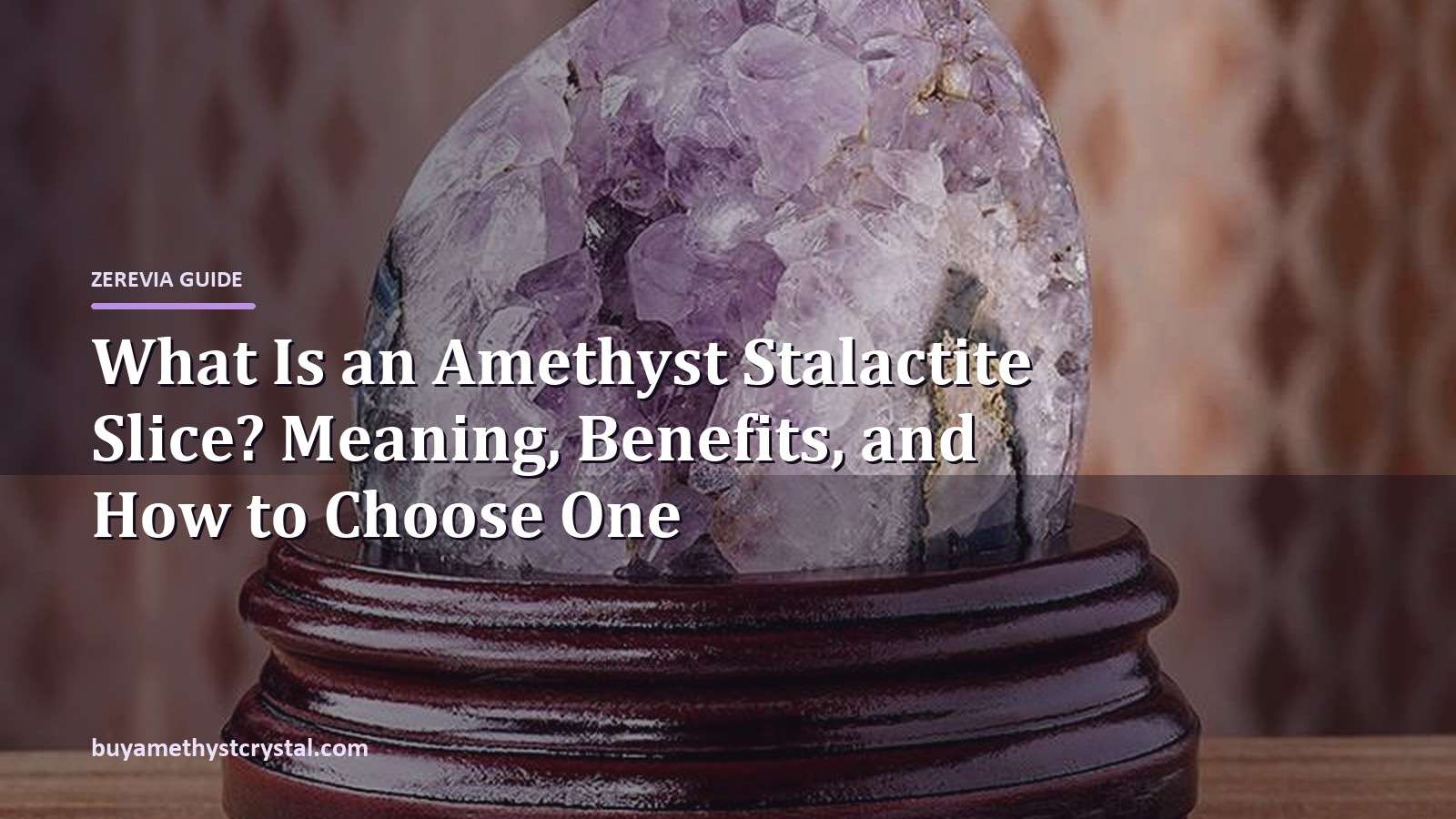
An amethyst stalactite slice is a cross-section cut from a cave stalactite, revealing concentric rings of purple, white, and grey mineral layers. It is not a geode. It is not a cluster. It is its own thing — flat, layered, and often translucent at the edges when held to light. If you want to understand how this form compares to other amethyst shapes, our amethyst forms and shapes guide covers the full range.
What Is an Amethyst Stalactite Slice?
A stalactite begins in a cave. Mineral-rich water drips from the ceiling over thousands of years, depositing thin layers of chalcedony, quartz, and — in the case of amethyst stalactites — iron-bearing silica that turns purple through natural radiation over geological time. The result is a long, tapered formation that hangs from cave ceilings, built up ring by ring, the way a tree adds growth rings from the inside out.
When a lapidary cuts a cross-section from that formation, the slice reveals concentric banding: rings of amethyst purple, white chalcedony, grey quartz, and sometimes agate layers in between. Some slices have a small hollow center where the original drip channel was. Others are solid all the way through. The edge of the slice may be polished smooth or left with a rough, natural perimeter.
Each slice is one-of-a-kind. The banding pattern, color depth, and thickness depend on where in the stalactite the cut was made, how fast the mineral water dripped during the years that particular layer was forming, and what trace elements were present at the time. No two slices look the same, which is exactly why documented origin and accurate photography matter when you are buying one.
The most common source for amethyst stalactite material on the market today is Brazil, where large deposits of cave-formed amethyst have been commercially cut for decades. When a seller can tell you the region — or even the general geological context — that is a meaningful sign of transparency. Vague language like “natural amethyst stalactite” without any origin detail tells you very little.
How Stalactite Slices Differ from Other Amethyst Forms
Amethyst comes in many forms, and the differences matter more than most buyers realize at first. Here is how a stalactite slice compares to the shapes you are more likely to have encountered:
| Feature | Stalactite Slice | Geode / Cave | Cluster | Tower / Obelisk |
|---|---|---|---|---|
| Structure | Flat cross-section with concentric banding | Hollow interior with crystal points lining the cavity | Multiple crystals growing from a shared base | Single piece carved and polished to a point |
| Signature visual | Layered rings of purple, white, and grey | Crystal points facing inward | Terminated points radiating outward | Smooth faceted surface, tapered top |
| Translucency | Often translucent at edges when backlit | Generally opaque (matrix rock) | Varies; points may be translucent | Usually opaque to semi-translucent |
| Display style | Wall mount, easel, backlit on shelf | Floor or shelf display | Table or shelf display | Small shelf, desk, or grid placement |
The defining feature of a stalactite slice is the banding. Geodes show you crystal points. Clusters show you terminated formations. Towers are shaped and polished. A stalactite slice shows you time — layer after layer of mineral deposition, visible in concentric rings. If you hold a thin slice up to a light source, you can sometimes see the light pass through the lighter layers while the deeper purple bands stay opaque. That translucency is unique to sliced forms and is one of the main reasons collectors seek them out.
The Traditional Meaning of Amethyst Stalactite Slices
In crystal tradition, the amethyst stalactite slice carries two layers of symbolic meaning: one from the mineral itself, and one from the form.
Amethyst has been associated with calm, clarity, and inner stillness for centuries. The name comes from the Greek amethystos, meaning “not intoxicated,” and ancient traditions linked it to sobriety of mind. Whether you take that literally or metaphorically is entirely up to you. For a fuller look at how these traditions developed, our guide to amethyst healing properties and traditional uses covers the history without overclaiming.
The stalactite form adds another layer of meaning — no pun intended. A stalactite grows so slowly that the rings visible in a single slice represent centuries of accumulation. In traditional crystal interpretation, this form is sometimes read as a symbol of patience, gradual progress, and the quiet accumulation of something worth having. The concentric rings, in some traditions, are seen as representing cycles: seasons, years, phases of a life that build on each other rather than starting over.
I find this kind of meaning-making interesting without needing it to be literally true. When someone tells me they chose a stalactite slice because it reminded them that “meaningful things build slowly,” I understand the impulse. I do not need to prove that the stone is transmitting patience into their nervous system. The visual metaphor is doing its own work.
These are traditional interpretations and personal readings. They are not scientific claims, and I would not trust anyone who tried to sell you a slice by promising it would change your life. The slice is a piece of geology that also happens to be visually compelling and symbolically rich. That is enough.
Traditional Benefits and What Buyers Value About Stalactite Slices
When people search for amethyst stalactite healing properties or amethyst stalactite benefits, they are usually looking for one of two things: practical reasons to choose this form, or traditional associations they can relate to. Let me address both honestly.
On the practical side, buyers choose stalactite slices for display. A well-cut slice on an easel or wall mount acts as a visual anchor in a room — something specific to look at, with natural color variation and patterns that reward a closer look. Many buyers describe the experience simply: they enjoy having it there. It creates a pause in the room. That is a real benefit, even if it is not mystical.
In traditional crystal practice, amethyst is associated with promoting a sense of calm and mental clarity. The stalactite slice, with its visible layers of geological age, is sometimes described in these traditions as a grounding presence — something that connects you to deep time. You can read more about these traditional associations in our guide to amethyst healing properties.
I think the most honest framing comes from a conversation I had once with someone who did not believe in any of this. He asked me if I really thought crystals “worked.” My answer was that I think real things have value — not because they emit some unmeasurable force, but because having a piece of documented-origin amethyst on my nightstand meant that for one or two minutes before bed, I would look at it instead of scrolling through my phone. That pause was useful to me. That is the level of claim I am comfortable making.
The benefits of amethyst, in any form, are traditionally associated with calm and focus. Whether those traditions resonate with you is a personal question. What I can tell you concretely is that a stalactite slice is a genuine geological artifact with visible structure, natural color, and no two pieces alike. That alone gives it more weight than most decorative objects.
How to Choose the Right Amethyst Stalactite Slice
This is the section that should actually help you buy. Here are the criteria I use when evaluating a stalactite slice:
Color Depth
Amethyst stalactite slices range from pale lavender to deep violet, often within the same piece. Look for at least some zones of saturated purple — a slice that is uniformly pale may have less visual impact on display. Deep color zones are more common in material from certain Brazilian deposits. Color zoning — where some rings are darker and others lighter — is expected and authentic. Perfectly uniform purple across the entire slice would make me suspicious.
Banding Clarity
The concentric rings are the whole point of this form. Well-defined banding indicates slower, more consistent mineral deposition during the stalactite’s growth. Look for distinct separation between the purple, white, and grey layers. Fuzzy or indistinct banding is not necessarily a flaw, but crisp rings are more visually striking and generally more valued.
Size and Thickness
Thicker slices show more depth and dimension on a shelf or easel. Thinner slices are more translucent when backlit, which creates a different kind of visual effect — almost like stained glass. Decide which display style you prefer before you start shopping, because it will narrow your options meaningfully.
Cut Quality
A good lapidary cut is even across the face, with polished surfaces and clean edges. Chipping along the perimeter, uneven thickness, or rough unpolished patches suggest lower cutting standards. These are not subtle differences; they are visible in product photos if you look carefully.
Origin
Brazilian amethyst stalactites are the most commonly available on the commercial market. Sellers who can document the origin — even at the regional level — are giving you more transparency than those who simply write “natural amethyst.” For a deeper dive into how origin affects quality and appearance, our geological origins guide and quality and value guide are worth reading.
WYSIWYG Photography
Every stalactite slice is different. Generic stock photos tell you nothing about the specific piece you will receive. Insist on seeing the actual slice — what the industry calls WYSIWYG (What You See Is What You Get). If a seller cannot show you a photo of the exact piece, you are buying blind.
When I assess a slice — holding it, turning it, checking how the light moves through it — I am looking at all of these things together. The weight should feel consistent with stone, not plastic or resin. The color should show natural variation. The banding should be visible and distinct. A slice that passes those checks is a slice worth having.
Display Ideas, Placement, and Care
Once you have your amethyst stalactite slice, the question becomes where to put it and how to keep it looking the way it does today.
Display Options
A metal or wooden easel on a shelf or console table is the simplest approach. For wall mounting, use proper hardware rated for the slice’s weight — some larger pieces are heavier than they look. If you want to try backlighting, placing a thin slice on a window ledge with indirect light can make the banding glow. This is one of the most striking ways to display this form.
UV Fading: The One Thing You Must Know
This is the care point I will not stop talking about. Amethyst gets its purple from Fe3+ — iron ions in the quartz crystal lattice that were activated by natural underground radiation over millions of years. When that same iron is exposed to ultraviolet light from direct sunlight, the ions can change state, and the purple fades. This process is irreversible.
I learned this the hard way through a buyer who placed her crystal on a south-facing windowsill. Two months of afternoon sun turned her deep violet piece into a washed-out lavender. It was still real amethyst. It was still beautiful in its own way. But the color that made her choose it was gone, and it was not coming back.
Indirect light is fine. Backlighting through glass is fine for short periods. But avoid placing your slice where direct sunlight hits it for hours. If you want to read more about this and other care practices, our amethyst care and cleansing guide covers the details.
Cleaning and Storage
A soft dry cloth handles most dust. If the slice needs more, a gentle rinse with lukewarm water works — but avoid prolonged soaking, especially if the matrix rock (the non-amethyst part of the slice) is porous. Harsh chemicals and ultrasonic cleaners are not appropriate for this material.
If you ever need to store your slice rather than display it, wrap it in a soft cloth. The edges of a stalactite slice can chip if knocked against harder surfaces, and the polished face can scratch.
Frequently Asked Questions
What are the benefits of amethyst?
In traditional practice across many cultures, amethyst is associated with calm, clarity, and inner stillness. Historically, it was linked to sobriety and clear thinking — the Greek root amethystos literally means “not intoxicated.” Many people today choose amethyst as part of personal rituals around focus, rest, or reflection. These are traditions and personal practices, not medical claims. For a fuller picture, see our guide to amethyst healing properties and traditional uses.
Can amethyst help with anxiety?
In traditional crystal practice, amethyst is associated with a sense of calm and mental stillness. Some buyers describe it as a meaningful part of their personal routine — something they hold, look at, or place nearby during stressful moments. I am not going to tell you it cures anxiety, because it does not. What I will say, from my own experience, is that having a real piece of amethyst where I can see it gives me a momentary pause — and sometimes that pause is the most useful thing in the room. Your experience may be different, and that is worth taking seriously.
How do I know if my amethyst stalactite slice is real?
Real amethyst is heavier than glass or resin of the same size. Hold it in your hand — genuine stone has a density that plastic cannot replicate. Press it against your skin: natural mineral feels cool to the touch initially, then gradually warms. Look at the color: authentic slices show natural color zoning, with purple that deepens and fades across the banding rather than staying perfectly uniform. The concentric rings should show some irregularity, because nature does not produce perfect geometry. A seller who provides documented origin and WYSIWYG photos is giving you the best assurance available.
Where do amethyst stalactites come from?
The majority of commercially available amethyst stalactite material comes from Brazil, where large cave systems have produced significant quantities of amethyst-bearing formations. Some material also comes from other regions, but Brazilian sources dominate the market. When a seller specifies the origin, that is a meaningful detail. When they do not, it is worth asking.
How should I cleanse my amethyst stalactite slice?
Moonlight is the safest method: set your slice on a windowsill overnight during a full moon. A sound bath using a singing bowl also works well and adds a ritual element if that matters to you. A soft dry cloth handles surface dust. Avoid prolonged water soaking if the matrix rock is porous, and avoid direct sunlight entirely — UV exposure can permanently fade the purple color. Our amethyst care and cleansing guide covers these methods in more detail.
Ready to explore more? Browse our guide to amethyst forms and shapes to find the piece that fits your space.
 Crystal Cluster
 Crystal Tower
 amethyst crystal ball
 Amethyst Caves for Sale
 Amethyst Bracelets
 Amethyst Earrings
 Amethyst Necklaces
 Amethyst Rings
 amethyst crystal healing
 Amethyst Beauty & Wellness
 Crystal Home Decor
 Spiritual & Divination Tools