
Zerevia · ritual guide
Amethyst Third Eye Chakra Activation: A Grounded Step-by-Step Guide
How to choose your stone, set up a quiet ritual space, and follow a calm meditation sequence for the third eye and crown chakras — without exaggerated promises.
If you’ve been curious about using amethyst for third eye chakra work, you’re not alone. It’s one of the most common questions we hear from first-time crystal buyers — and one of the easiest to overcomplicate. This guide keeps it simple: what tradition actually says, how to prepare, and the exact steps for a grounded amethyst chakra activation session you can start tonight.
Which Chakras Does Amethyst Traditionally Connect To?
In traditional Eastern energy systems, amethyst is linked to two chakras: the third eye (Ajna), located between the eyebrows, and the crown (Sahasrara), at the top of the head. The third eye is associated with intuition and inner insight. The crown is connected to awareness and a sense of spaciousness.
Why purple? The association is rooted in centuries of symbolic tradition — the color violet has long been connected with contemplation and clarity of mind. But there’s also a geological explanation worth knowing. Amethyst’s purple comes from trace amounts of iron (Fe3+) in the quartz crystal lattice, activated by natural radiation over millions of years. The color isn’t added; it grows inside the stone. That’s a real, measurable fact — not a mystical claim.
Neither chakra nor color tradition counts as medical proof of anything. What it does offer is a framework — a reason to sit quietly with a specific object for a specific purpose. And for many people, that’s enough. You can explore more about the broader context in our amethyst healing properties guide, or read about the geological origins of amethyst if the science interests you as much as the ritual.
Preparing for Chakra Activation: What You Need Before You Start
Amethyst chakra activation doesn’t require much. But a few small choices made upfront will shape the quality of the experience.
1. Choose a quiet, undisturbed space
This doesn’t have to be a dedicated meditation room. A corner of your bedroom, a chair by a window without direct sunlight, even a parked car during a lunch break — anywhere you won’t be interrupted for ten to fifteen minutes.
2. Pick the right amethyst form
Different shapes suit different intentions:
- Crystal tower or point: The tapered shape makes it easy to direct the tip toward a specific area — useful for third eye placement.
- Palm stone: Flat and smooth, comfortable to hold in one hand or rest on your forehead during the session.
- Sphere: A good option if you prefer gazing meditation rather than placement. The even surface holds visual focus.
- Small cluster or geode: Best for a dedicated meditation spot or altar — something you leave in place rather than carry.
When choosing, look for documented origin and accurate photography. WYSIWYG listings — where the photo shows the exact piece you’ll receive — remove the guesswork. Our amethyst forms and shapes guide walks through each type in more detail.
3. Set realistic expectations
This is a ritual practice. It’s a deliberate pause in your day, not a medical intervention and not a shortcut to anything. The value is in the stillness itself — a quiet thing on a full shelf, a reason to stop scrolling for a few minutes.
How to Activate Your Amethyst Chakra Practice: Step-by-Step
Here’s the sequence. It takes about ten minutes once you’re set up, though you can shorten or extend it.
Step 1: Cleanse your stone
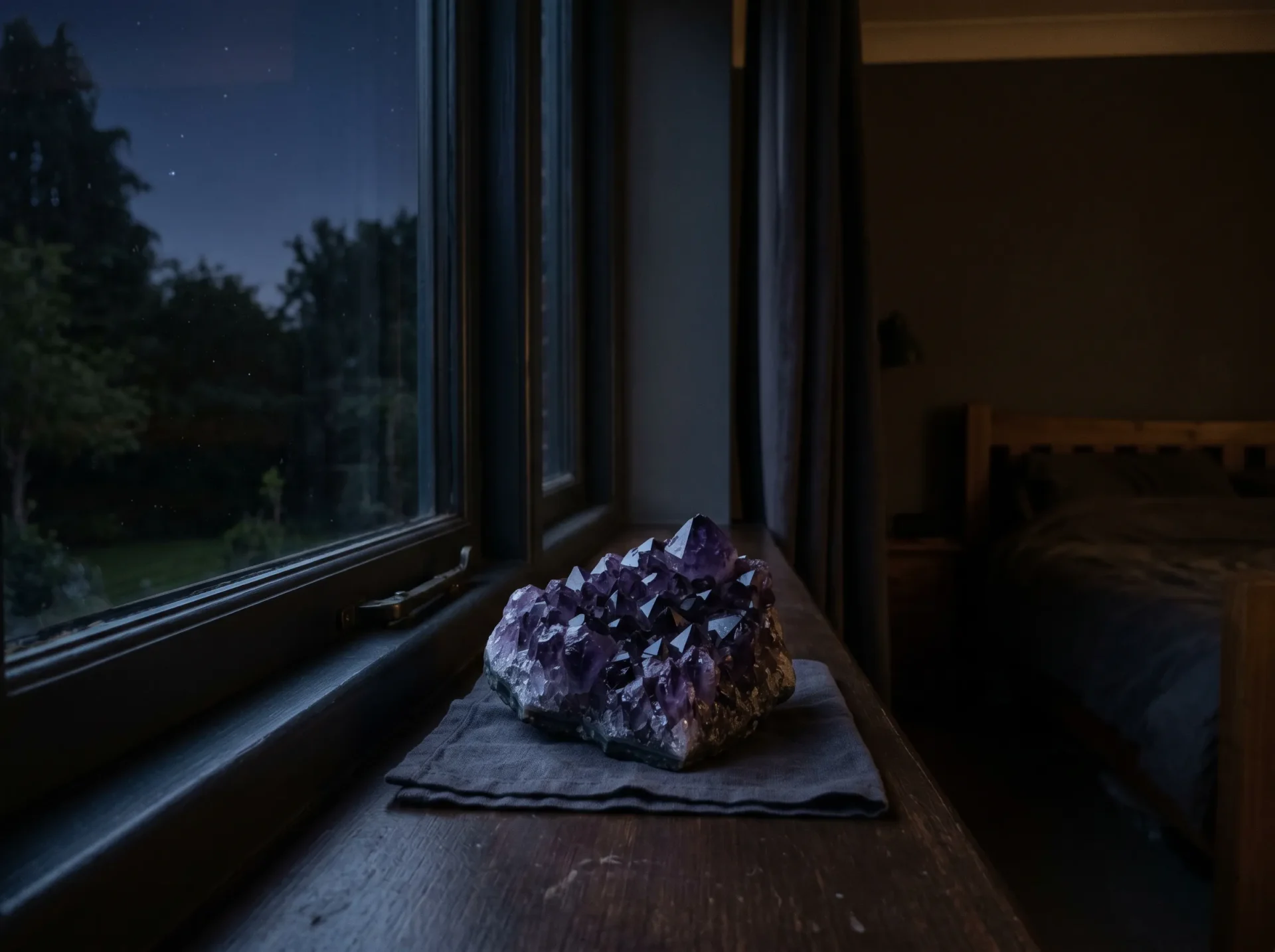
Before your first session — and periodically between sessions — give your amethyst a simple cleanse. The safest method is moonlight: place it on a windowsill overnight during any phase of the moon. A singing bowl or sound bath works too. The idea is to reset the stone before you use it with intention. (More on this in our amethyst care and cleansing guide.)
Step 2: Sit comfortably with the stone within reach
A chair, a cushion on the floor, your bed — wherever you can sit upright for a few minutes without fidgeting. Place the amethyst beside you or in your lap.
Step 3: Position the amethyst
For third eye chakra work: rest the amethyst gently on your forehead between your eyebrows, or hold it a few inches above that spot with your hand. A palm stone works well here. A tower’s pointed tip can be directed toward the area.
For crown chakra work: hold the stone just above the top of your head, or place it on the surface behind you if you’re leaning against something. Some people simply hold it in both hands in their lap and direct their attention upward.
If direct skin contact feels uncomfortable, hovering a few inches away is fine. There’s no rule that says the stone must touch you.
Step 4: Set a quiet intention
This doesn’t need to be a chant or formal affirmation — though it can be if that’s your practice. A simple internal sentence works: I’m here for a few minutes of quiet. Or: I want to notice what’s under the noise. The point is to mark the transition from your regular day to this specific pause.
Step 5: Breathe slowly for 5–15 minutes
Breathe at whatever pace feels natural. Notice physical sensations — the weight of the stone, the temperature of your skin, the sounds around you — without labeling them as good or bad, meaningful or not.
This is where the practice lives. Not in the stone doing something to you, but in you choosing to be still for a stretch of time.
Step 6: Close the session
Place the stone down. Wiggle your fingers. Take one more full breath. That’s it.
Someone once asked me if I really thought stones had any effect. I said I wasn’t sure — but I knew that having a real, specific object on my nightstand gave me a reason to pause for a minute or two before bed instead of picking up my phone. That pause is real. I can’t prove the rest, but the pause is real.
Amethyst Chakra Meditation: Two Simple Approaches
If you want to go a little deeper than the basic activation sequence, here are two meditation styles that pair well with amethyst and the traditional chakra associations.
Third Eye Meditation (Ajna Focus)
Hold or place the amethyst between your brows. Close your eyes and bring your attention to the space behind your forehead — not forcefully, just a gentle inward gaze. If thoughts come, let them pass. If nothing happens, that’s fine too. Start with five minutes. Extend to fifteen if the session feels right.
Traditional practice frames the third eye as the seat of intuition and inner knowing. Whether or not you subscribe to that framework, the act of directing your attention to one quiet point for a few minutes is a useful exercise in focus.
Crown Meditation (Sahasrara Focus)
Hold the amethyst above your head or rest it behind you. Shift your awareness to the very top of your skull — the soft spot where a baby’s fontanelle once was. Focus on the sensation of spaciousness rather than any particular thought.
Traditionally, the crown chakra represents connection to something larger than the personal self. In practice, it’s often just a feeling of quiet openness — the opposite of a crowded mind.
5-minute version: Pick one focus (third eye or crown), place the stone, breathe slowly, stop when a timer sounds. That counts.
15-minute version: Spend five minutes on third eye placement, five minutes on crown placement, and five minutes sitting with the stone in your lap in open awareness.
Choosing the Right Amethyst for Chakra Work
The best amethyst for chakra work is the one that suits your space, your budget, and how you want to practice. Color depth is a matter of aesthetic preference — a deeper purple doesn’t activate anything “more” than a lighter one. Here’s how the main choices compare:
Brazilian vs. Uruguayan Amethyst
If you’re choosing between documented origins, here’s the short version — a question I usually start with: do you want something big, or something deep in color?
Brazilian amethyst tends to be larger, with a range from lavender to medium purple. It’s generally more affordable per pound, which makes it a practical choice for a statement piece on a meditation shelf. Uruguayan amethyst is denser, with finer crystals and a color depth that often reaches close to emperor purple — that deep, near-indigo shade. It costs more, but set a Brazilian and Uruguayan piece of similar size next to each other, and you’ll see the difference in about two seconds.
Neither is “better” for chakra work. The stone doesn’t care about its origin. You might. Our amethyst quality and value guide covers the comparison in more depth.
After Activation: Caring for Your Amethyst
A few simple habits will keep your stone in good shape between sessions:
- Cleanse regularly: Moonlight overnight or a sound bath session once a week is plenty. Some people cleanse before every use; others do it monthly. There’s no required frequency — choose what feels right.
- Avoid direct sunlight: This is the most important care rule for amethyst. UV fading is real, documented, and irreversible. A windowsill with afternoon sun is the most common cause.
- Store thoughtfully: A fabric pouch, a small box, or a shelf away from heat sources and windows. Amethyst has a Mohs hardness of 7 — durable enough for daily handling — but it can scratch softer stones and be scratched by harder ones.
 Crystal Cluster
 Crystal Tower
 amethyst crystal ball
 Amethyst Caves for Sale
 Amethyst Bracelets
 Amethyst Earrings
 Amethyst Necklaces
 Amethyst Rings
 amethyst crystal healing
 Amethyst Beauty & Wellness
 Crystal Home Decor
 Spiritual & Divination Tools