
Amethyst Druze Meaning: Symbolism, Uses, and How to Choose
When people search for amethyst druze meaning, they’re usually looking for two things: what this crystal formation actually is, and why so many cultures have assigned it symbolic weight over centuries. The answer to the first question is geological. The answer to the second is more layered—rooted in tradition, personal ritual, and the quiet ways a piece of stone can mark a shift in how someone moves through their day.
This guide covers both. We’ll start with what druze actually is, move through its cultural symbolism, connect it to jewelry traditions and chakra practice, and end with practical criteria for choosing and caring for a piece that fits your space or routine.
What Is Amethyst Druze?
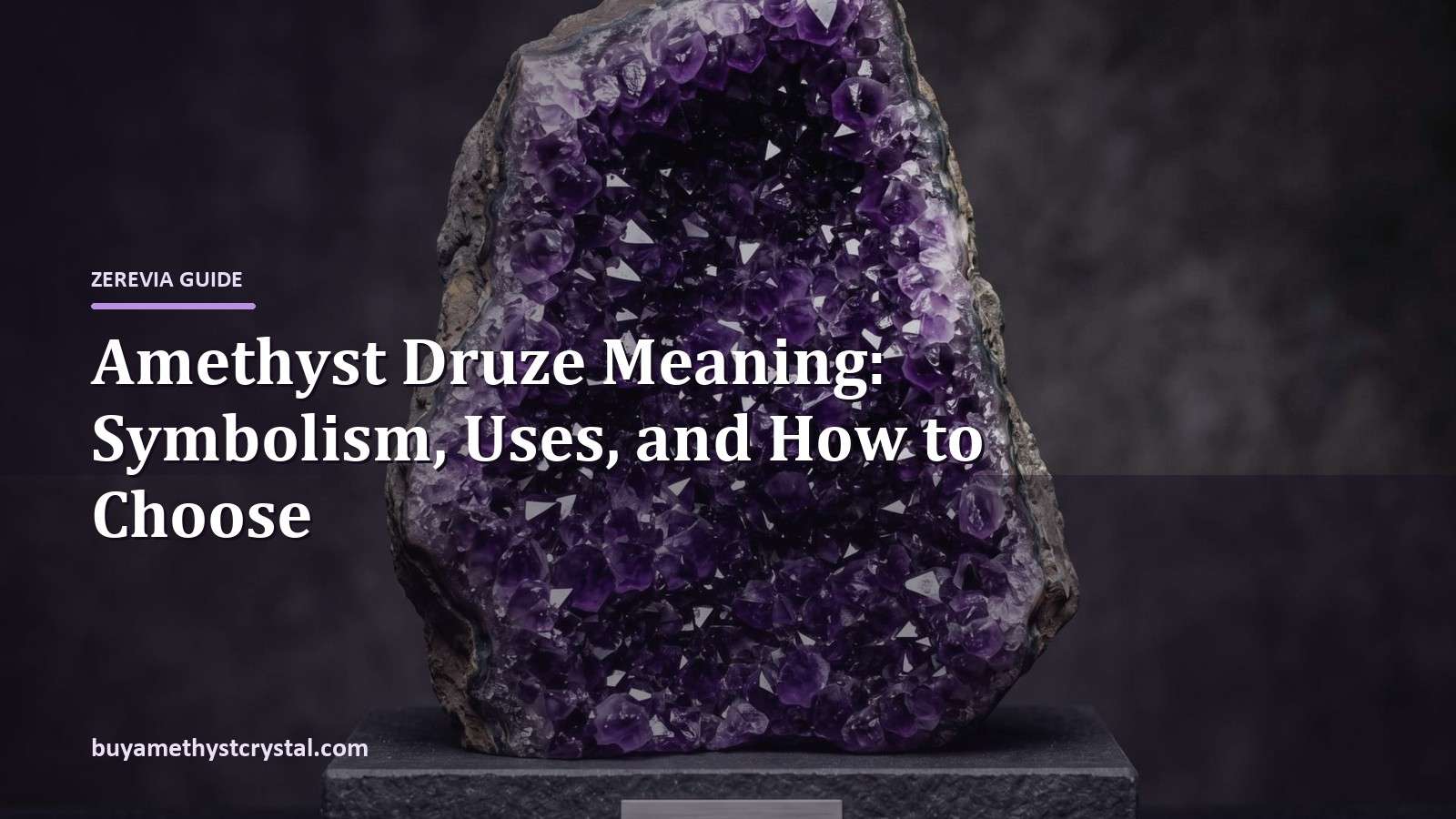
A druze (sometimes spelled “druse” or “druzy”) is a geological formation: a layer of small, sparkling crystals that grow across the surface of a host rock, called matrix rock or basalt. When those crystals are amethyst—SiO₂ colored by trace amounts of Fe³⁺, or iron ions activated by natural radiation over millions of years—you get a piece that shows deep purple crystal points clustered across a rough, natural base.
What makes druze distinct from other amethyst forms is the texture. Where a geode is hollow inside, and a cluster grows upward from a shared point, druze spreads outward like a frozen field of tiny crystal terminations. The matrix rock underneath is usually dark—gray to black—which makes the purple surface stand out visually.
Druze pieces vary widely in color depth, crystal size, and coverage. Some have sparse, widely spaced points; others are so densely coated that the base rock barely shows through. The color can range from pale lavender to deep violet depending on origin and iron concentration. This natural variation is part of what gives each piece its individual character—and it’s worth knowing before you buy, because the photo you see online should represent the exact stone you receive.
If you’re comparing druze to other amethyst shapes—geodes, clusters, towers, spheres—the amethyst forms and shapes guide covers those differences in detail.
The Symbolism and Cultural Meaning of Amethyst Druze
The symbolic weight of amethyst stretches back thousands of years, and the amethyst druze meaning people find today is layered across those traditions. Ancient Greeks associated the stone with clarity and restraint—the word “amethystos” translates roughly to “not intoxicated,” and they carried it as a reminder to stay measured. In medieval European traditions, amethyst appeared in ecclesiastical rings and was connected to inner stillness and spiritual awareness. In modern wellness circles, it’s most often linked to calm, intuition, and quiet reflection.
None of these traditions describe a guaranteed outcome. They describe a relationship—between a person and a stone that they chose to keep close, for reasons that mattered to them.
I think about this sometimes in the context of my own first amethyst. It was a $12 stone, not particularly impressive, with a hand-written label: amethyst — for calm nights. I didn’t believe in crystal energy. I still don’t, fully. But I brought it home and put it on my nightstand, and that night was the first in months I slept through without waking at 3 a.m. That doesn’t prove anything. But it started a relationship with the stone that led me here—to studying its chemistry, its origins, and the ways people use it.
The amethyst druze symbolism that resonates most with modern buyers tends to cluster around a few themes: calm, intuition, emotional steadiness, and the idea of creating a small, deliberate pause in a day that’s already full. Whether that “works” is personal. What’s verifiable is that the stone is real, the formation is natural, and the color comes from a specific chemical process involving Fe³⁺ ions in quartz crystal structure.
For a deeper look at how these meanings developed, the amethyst meaning and uses page covers traditional and contemporary associations across cultures.
Amethyst Crystal Bracelet Meaning: Jewelry Traditions and Wearable Rituals
When druze or amethyst crystals are set into jewelry—particularly bracelets—the symbolic meaning shifts from the decorative to the personal. Wearing a stone changes the relationship. It’s no longer something you look at from across the room; it’s something that touches your skin throughout the day.
The meaning of amethyst bracelet traditions varies by culture, but a few common threads appear consistently:
- Calm and clarity. The most widespread association. People wear amethyst bracelets as a personal touchstone—a way to carry the stone’s traditional connection to steadiness with them through the day.
- February birthstone. Amethyst is the official birthstone for February, which gives it a strong personal-occasion meaning for birthday and Valentine’s gifts. A purple amethyst bracelet meaning often connects to this: a gift that says I thought about you specifically.
- Intention setting. Some wearers choose to set an intention when they first put on the bracelet—something like clarity, patience, or presence—and treat the bracelet as a physical reminder of that choice.
Right Hand vs. Left Hand
A question that comes up frequently: what is the amethyst bracelet meaning on right hand? In traditional crystal practice, the left hand is described as the “receiving” side—where you take in energy, calm, or intention. The right hand is the “giving” side—where you project intention outward. Some people choose to wear an amethyst bracelet on the right hand when they want to extend calm or clarity into their environment or interactions, rather than absorbing it inward.
This isn’t a rule. It’s a framework some people find useful. If you’re deciding which hand feels right, there’s no wrong answer—just the one that matches how you want to use the bracelet.
What If Your Amethyst Bracelet Breaks?
The amethyst bracelet broke meaning is one of the most common questions in crystal communities. The traditional interpretation is that the bracelet has absorbed what it needed to—sometimes described as “taking a hit” for you, or reaching the end of its purpose. Some people see it as a sign of protection. Others view it as simply a broken bracelet that needs replacing.
Both interpretations are valid. The practical reality is that natural stone beads can break under stress, and 925 sterling silver findings can fatigue over time. If you value the symbolic meaning, you might choose to retire the pieces respectfully and begin with a new one. If you value the object, you might have it restrung.
Combining Stones: Rose Quartz and Amethyst
The rose quartz and amethyst bracelet meaning draws on two traditions at once. Rose quartz is traditionally associated with self-acceptance and relational warmth. Amethyst is traditionally associated with clarity and calm. Wearing them together is often described as balancing emotional openness with steady awareness—a combination that appeals to people who want both softness and structure in their daily practice.
All Zerevia jewelry uses 100% natural amethyst and 925 sterling silver, designed to be nickel-free so you won’t get green fingers with regular wear. Each piece comes with a gift box and a meaning card. For more on how these amethyst healing properties are traditionally understood—framed as ritual use, not medical claims—that page goes deeper.
Amethyst Crystal Meaning: Chakra Connections
In the chakra system, which originates from Indian philosophical tradition, amethyst is most commonly associated with two energy centers:
- The Third Eye Chakra (Ajna) — located between the eyebrows, traditionally linked to intuition, insight, and the ability to see situations clearly. The amethyst third eye chakra meaning centers on this: using the stone as a focal point during meditation or quiet reflection to support inner knowing.
- The Crown Chakra (Sahasrara) — located at the top of the head, traditionally linked to broader awareness and a sense of connection beyond the immediate. Amethyst’s association here connects to its historical use in contemplative and spiritual practices.
How does this connect to druze specifically? Some practitioners prefer the textured surface of druze for chakra layouts and meditation because the many small crystal points create a different tactile experience than a smooth sphere or tower. The visual texture—the way light catches hundreds of tiny terminations—can serve as a focus point during contemplative practice.
None of this is clinical or medical. It’s ritual practice, and the value of ritual is personal. What’s measurable about amethyst is its chemistry (SiO₂ with Fe³⁺), its hardness (7 on the Mohs scale), and its color mechanism. The rest belongs to tradition and individual experience.
For more on how these associations are traditionally understood across different practices, the amethyst healing properties resource covers this in more detail.
Choosing and Using Amethyst Druze: A Practical Guide
Understanding amethyst druze meaning is one thing. Choosing a piece that’s worth your money is another. Here are the criteria that matter.
Color Depth
Color is the single biggest factor in how an amethyst druze reads visually. Deep violet to purple pieces have more visual weight and tend to feel more “present” in a room. Paler lavender pieces are lighter, more subtle, and often less expensive. Neither is better—it depends on the space and the mood you’re after.
The color in natural amethyst comes from Fe³⁺ ions in the quartz structure, activated by natural radiation over millions of years. It’s not dyed, not coated, and not artificial. But it can fade: prolonged exposure to direct sunlight causes UV-driven changes to the iron ions, and once that color shifts, it doesn’t come back. I learned this the hard way when a buyer messaged me about her crystal point that had been sitting on a south-facing windowsill. The deep emperor purple had become lavender. It was still real, still amethyst, but that color was gone.
Druze Coverage and Crystal Density
Look at how much of the matrix rock is covered. Dense, full-coverage druze with evenly distributed crystal points is more visually striking and typically commands a higher price. Sparse druze shows more of the dark basalt underneath, which can be attractive in its own right—more mineral specimen, less sparkle.
Origin: Brazil vs. Uruguay
When I’m asked about the difference between Brazilian and Uruguayan amethyst, I usually start with a question: do you want something large, or something deeply colored?
Brazilian amethyst tends to come in larger pieces with a wider color range—from lavender to mid-purple. It’s generally more affordable per weight and works well when you want a statement piece for a room. Uruguayan amethyst tends to be more compact but with denser crystal structure and deeper color—sometimes reaching that emperor purple shade that sits close to deep blue. It costs more, but the color difference is visible within seconds of placing the two side by side.
For documented-origin pieces where the sourcing is specified, the amethyst geological origins guide explains how location affects color, crystal size, and value.
Placement and Use
For home decor, amethyst druze works well on shelves, mantels, side tables, or as a centerpiece. In Feng Shui tradition, the southeast corner of a room—sometimes called the wealth corner—is a common placement for amethyst geodes and druze. For personal practice, smaller druze pieces can sit on a desk, nightstand, or meditation space as a visual anchor.
Care
- Avoid direct sunlight. UV exposure causes irreversible fading. Keep druze away from south-facing windows or any spot where the sun hits directly for more than a few minutes.
- Dust gently. A soft brush or compressed air works well for the textured surface. Avoid submerging druze in water for extended periods, as the matrix rock can absorb moisture.
- Handle by the base. The crystal points are small but can chip. Hold druze by the matrix rock when moving it.
For a broader comparison of quality factors—color zoning, inclusions, and what to look for in a well-formed piece—the amethyst quality and value guide covers this in detail.
Frequently Asked Questions
What does it mean if my amethyst bracelet breaks?
In traditional crystal practice, a broken amethyst bracelet is often interpreted as a sign that the stone has fulfilled its purpose—sometimes described as having absorbed something it needed to, or completed a cycle of use. Some people see it as protection. Others view it as simply wear and tear on natural materials. Both interpretations are reasonable. If the symbolic meaning matters to you, you might retire the pieces and begin fresh. If the object matters more, a jeweler can often restring it.
What is the meaning of wearing an amethyst bracelet on the right hand?
In traditional crystal frameworks, the left hand is considered the receiving side and the right hand the giving side. Wearing an amethyst bracelet on the right hand is sometimes described as projecting calm, clarity, or intention outward—into interactions, conversations, or the environment. It’s a preference, not a requirement. Some people simply wear their bracelet on whichever hand feels more comfortable.
How does amethyst relate to the third eye chakra?
In the chakra tradition, the third eye chakra (Ajna) is located between the eyebrows and is associated with intuition, insight, and inner clarity. Amethyst is one of the stones most commonly linked to this energy center, traditionally used during meditation or quiet reflection as a focus point. This is ritual practice, not medical treatment. For a fuller look at these associations, our amethyst meaning and uses page covers traditional and contemporary connections.
Can amethyst druze be used as a crystal ball?
Not exactly. Druze and crystal spheres (sometimes called crystal balls) are different forms of amethyst. A crystal sphere is a polished ball—smooth, rounded, and uniform. Druze is a rough, textured surface covered in small crystal points on a matrix base. Both carry the same traditional symbolic meanings—calm, clarity, intuition—but they serve different roles. Spheres are typically used as meditation focal points or decor centerpieces. Druze is more often a shelf display, accent piece, or energy anchor.
Is amethyst druze the same as a geode?
They’re related but distinct. A geode is hollow inside, lined with crystal points. Druze is a flat or curved surface coating of crystals on solid matrix rock—no hollow interior. Geodes tend to be more dramatic as standalone pieces; druze works well as a layered, textured accent. The meanings and traditional associations are the same, since the mineral is identical.
Whether you’re drawn to amethyst druze for its symbolism, its visual presence, or the quiet ritual of keeping a real mineral close by, the most useful starting point is understanding what you’re looking at—and what you’re not. This is a natural formation shaped by millions of years of chemistry, not a manufactured promise. What you do with it is yours to decide.
 Crystal Cluster
 Crystal Tower
 amethyst crystal ball
 Amethyst Caves for Sale
 Amethyst Bracelets
 Amethyst Earrings
 Amethyst Necklaces
 Amethyst Rings
 amethyst crystal healing
 Amethyst Beauty & Wellness
 Crystal Home Decor
 Spiritual & Divination Tools