
Amethyst Pendulum Benefits: What to Know Before You Buy
An amethyst pendulum is one of those purchases that starts with a question: what is this actually for? You’ve probably seen them — a single pointed amethyst crystal dangling from a fine chain — and wondered whether the amethyst pendulum benefits people talk about online are grounded in anything real. The short answer is that the benefits are real in the way a practice is real: they depend on what you bring to it, what the stone is made of, and whether you’re holding something genuinely natural.
This guide covers what an amethyst pendulum is, how people use it in dowsing and personal ritual, how amethyst chakra pendulum traditions work, and how to tell natural amethyst benefits from marketing noise. We’ll also compare the pendulum to other forms — crystal balls, necklaces, earrings — and walk through color variants, heat treatment, and care. If you want deeper background on amethyst healing properties in general, that’s a good place to start.
What Is an Amethyst Pendulum?
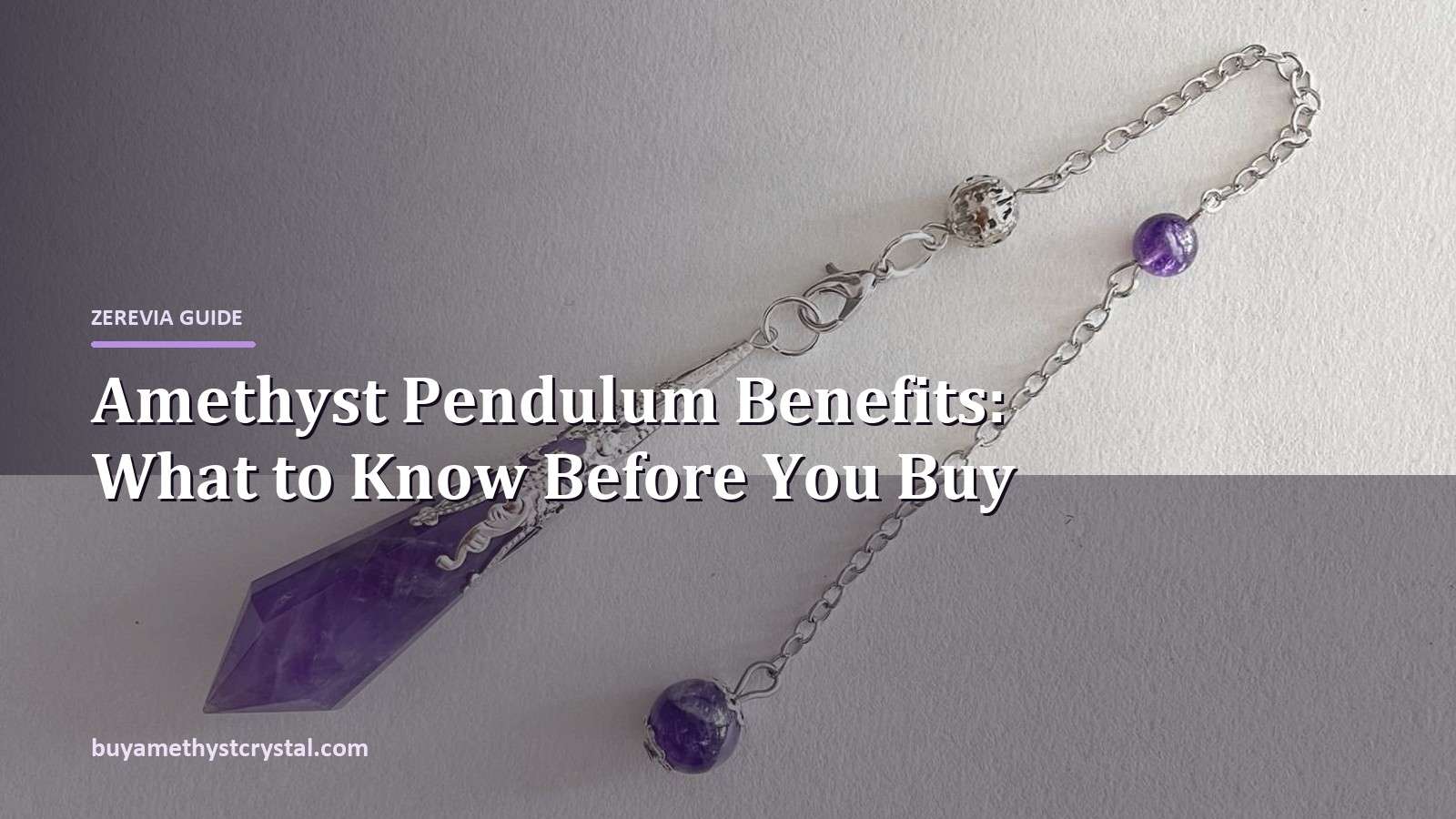
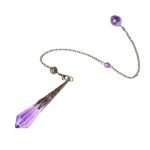
Physically, an amethyst pendulum is a single terminated amethyst point — one end rounded or attached to a cap, the other end tapering to a natural or polished tip — suspended from a chain. The chain is commonly sterling silver 925, which is 92.5% silver blended with copper alloy, stamped with a “925” mark, and nickel-free. That last part matters: nickel is the most common cause of skin irritation in jewelry metals, and 925 sterling silver avoids it.
The amethyst itself is silicon dioxide — SiO₂ — with trace amounts of trivalent iron, Fe³⁺, that produce the purple color. That color isn’t painted on or dipped in. It grew into the crystal over millions of years as natural radiation activated the iron ions within the quartz lattice. Amethyst registers at 7 on the Mohs hardness scale, which means it can scratch glass and resist everyday wear, though it’s softer than topaz, corundum, or diamond.
When people search for amethyst pendulum benefits, they’re usually looking for one of two things: either they want to understand the traditional spiritual uses, or they want to know whether the stone itself has qualities worth paying for. The natural amethyst benefits are straightforward — you’re holding a documented-origin mineral with a specific chemical makeup, measurable hardness, and color that’s verifiably grown in rather than applied. That’s a real starting point, not a vague promise.
My own entry into amethyst wasn’t a pendulum — it was a $12 rough piece with a hand-written label that said amethyst — for calm nights. It wasn’t particularly beautiful. But I bought it, put it on my nightstand, and that night was the first in months I didn’t wake up at three in the morning. That doesn’t prove anything about the stone. But it made me curious enough to keep learning, and eventually to build a company around documenting what’s real about these minerals.
Traditional Uses: How People Work with Amethyst Pendulums
The most common reason someone buys an amethyst pendulum is dowsing — the practice of holding a pendulum still over your hand or a surface and observing its swing. In traditional dowsing, a swing in one direction is interpreted as “yes,” another as “no,” and smaller or circular motions as “maybe” or “unclear.” Some practitioners use printed or hand-drawn pendulum charts — circles divided into labeled segments — for more nuanced responses.
Intention setting is the foundation of this practice. You hold the pendulum, focus on a specific question or decision, and let the tool respond. In tradition, this isn’t about the stone making decisions for you. Practitioners describe it as a way to slow down and access what they already feel. Some users report that the physical act of holding something real and watching it move helps them clarify their own thinking — whether the swing is “coming from” the stone, their hand, or some interaction between the two is something people disagree about.
I had a conversation once with someone who asked, point-blank, “You really think stones work?” I told him I didn’t know whether stones have the kind of mysterious energy he was imagining. I really don’t. But I said I know that when there’s something real and documented on my nightstand — something with a known chemical composition, from a specific place — I stop for a minute instead of reaching for my phone. That pause has value for me. He thought about it and said, “Okay, that I can accept.”
That framing matters for understanding pendulum benefits. The benefit isn’t guaranteed insight from an external source. It’s a structured ritual — a physical, tactile practice — that gives you a quiet minute with a real object. Whether you call that spiritual, psychological, or simply pleasant is up to you. If you want to understand more about how different amethyst forms serve different purposes, our amethyst forms and shapes guide covers the full range.
Amethyst Chakra Pendulum: The Third Eye and Crown Traditions
In the Indian philosophical tradition, the chakra system describes seven energy centers arranged along the spine, each associated with different aspects of human experience. Amethyst has a long traditional association with two of these: Ajna, the Third Eye Chakra, located between the eyebrows, which relates to intuition, clarity, and introspection; and Sahasrara, the Crown Chakra, at the top of the head, which relates to awareness and contemplation.
An amethyst chakra pendulum combines these associations with the dowsing practice. Practitioners who work with chakra pendulums hold the amethyst point over specific body points and observe the swing direction. In this tradition, the swing is read as a diagnostic — indicating whether a particular energy center is “balanced” or “blocked.” This is a ritual practice rooted in tradition, not a clinical or medically verified procedure. It’s important to say that clearly.
Why amethyst specifically? The traditional reasoning links the purple color — associated historically with contemplation, stillness, and the upper chakras — to the Ajna and Sahasrara positions. This is a cultural and philosophical association with roots going back centuries. Whether you find it meaningful depends on your own framework for thinking about ritual and focus.
What I find interesting, from a more material perspective, is that the physical properties of amethyst make it a practical pendulum stone regardless of any chakra framework. It’s hard enough (Mohs 7) to hold its shape, dense enough to swing with a satisfying weight, and distinct enough in color that you can easily see the point. Sometimes the practical and the traditional line up, and that’s worth acknowledging.
How Pendulum Benefits Compare to Other Amethyst Forms
A pendulum isn’t the only way to bring amethyst into your daily practice. Here’s how it stacks up against other popular forms.
| Form | How It’s Used | Key Distinction |
|---|---|---|
| Pendulum | Held in hand for dowsing, intention setting, and ritual | Active — you move it, it responds to your focus |
| Crystal ball (sphere) | Placed on a stand for observation, meditation focus, or decorative display | Passive — it sits, you look. The amethyst crystal ball benefits tradition centers on scrying and contemplation |
| Necklace | Worn daily as jewelry, often with 925 sterling silver setting | Continuous wear — the stone stays close to your body throughout the day |
| Earrings | Worn daily, framed near the face | Similar to necklace but positioned at the head — traditional association with the upper chakras |
The benefits of wearing amethyst necklace jewelry are practical: it’s a way to keep a natural stone with you without thinking about it. A well-made necklace in 925 sterling silver is nickel-free, comfortable against skin, and won’t turn your neck green. For February birthdays, amethyst is the official birthstone, which gives it a personal meaning that doesn’t require any spiritual framework — it’s simply your stone. The same applies to amethyst earrings benefits: daily wear convenience, the birthstone connection, and the fact that 925 sterling silver is one of the most skin-friendly metals available.
A crystal ball serves a different role. It’s a stationary object — you place it, you observe it. The traditional crystal ball benefits include meditation focus and scrying (gazing into the sphere’s depths as a contemplative practice). It’s also a statement piece in home decor, especially in a larger size with visible color zoning.
No form is inherently better. A pendulum is the right choice if you want an active ritual tool — something you hold, ask questions with, and use at specific moments. A necklace is right if you want passive, daily presence. A crystal ball is right if you want a visual anchor in your space. Choose by use case, not by hierarchy. For a deeper comparison of all the options, the amethyst forms and shapes guide is worth reading.
Natural vs. Heated Amethyst: What Changes and What Doesn’t
This is a section most amethyst sellers would rather skip, but it matters for pendulums specifically because you’re choosing a single stone and holding it in your hand. You should know what you’re holding.
Heat treatment is common in the amethyst industry. Moderate heat — roughly 400–500°C — can deepen a pale purple stone or shift its color toward yellow or red, effectively converting it toward citrine. This isn’t the same as dyeing or coating; heated amethyst is still real quartz. The Fe³⁺ is still there. But the color you’re seeing is no longer entirely the result of millions of years of natural formation. It’s been assisted.
Natural amethyst benefits, by contrast, come from a color that grew in over geological time. The Fe³⁺ ions sat in the crystal lattice and were activated by natural background radiation — a process that took thousands to millions of years. When you hold a natural amethyst pendulum, the purple you’re looking at is the result of that process, not a kiln.
For some buyers, this distinction matters deeply. For others, heated amethyst is perfectly acceptable — it’s still real quartz, still beautiful, and often more affordable. The issue isn’t whether heated amethyst is “bad.” It’s whether you know what you’re buying. As I’ve said about sourcing in general: reliable sellers will tell you. If they won’t answer the question, that tells you something too.
For pendulums specifically, natural stone tends to show the kind of subtle imperfections — color zoning, slight inclusions — that make each one visually distinct. If that matters to you, ask whether your pendulum stone has been heat-treated before you buy. Our amethyst quality and value guide covers what to look for in more detail.
Choosing Your Pendulum: Color Variants and What They Mean
Amethyst comes in a range of purples, and the color you choose affects both how the pendulum looks and what traditions associate it with. But here’s a critical point: there is no internationally recognized grading system for amethyst. A, AA, AAA, AAAA — these are descriptive terms that each seller defines differently, and some sellers mark everything AAAA because nobody can stop them. So forget the labels. Look at the stone.
Lavender amethyst — sometimes called rose de france — has a lower Fe³⁺ concentration, producing a softer, lighter purple. The lavender amethyst benefits in tradition lean toward gentleness and openness, but from a material standpoint, lighter color simply means less iron and less natural irradiation exposure. It’s no less “real” than a deep purple stone. Light amethyst benefits overlap with this category: a paler tone, often with pinkish undertones, that some buyers find more wearable in jewelry or less visually heavy in a pendant.
Deep purple / emperor purple has higher Fe³⁺ concentration and typically more natural irradiation. The deepest specimens — those rare, saturated purples that lean toward blue-violet — are most often associated with Uruguayan origin. Brazilian amethyst tends toward larger crystals with a wider color range, from lavender to medium purple. Neither is better; it depends on what draws your eye and how much you want to spend for saturation. I usually ask people: do you want something large, or something deeply colored? That helps narrow it down fast.
Phantom amethyst is a variant that deserves its own note. A phantom is a visible, ghost-like outline inside the crystal — a snapshot of the crystal’s growth at an earlier stage, before it continued growing. It looks like a smaller crystal silhouette suspended inside a larger one. Phantom amethyst benefits in collector circles are about visible geological history: you can literally see a pause in the crystal’s growth, millions of years ago, captured in the stone. It’s an inclusion, not a defect.
Color zoning — uneven distribution of purple within the stone — is actually a good sign. It means the color formed naturally, not uniformly in a factory. If your pendulum shows deeper purple near the tip and lighter purple near the base, or white bands interrupting the purple, that’s nature doing what it does. For more on how origin affects color, see our amethyst geological origins guide.
Caring for Your Amethyst Pendulum
The amethyst pendulum benefits you chose it for — its color, its weight, its specific visual character — only persist if you care for it properly. This is the unglamorous part, but it’s the part that protects your investment.
The most important rule: never store your pendulum in direct sunlight. UV radiation can cause the Fe³⁺ in amethyst to undergo a reduction reaction, lightening the purple. This is irreversible. I learned this the hard way through a buyer who left her crystal on a south-facing windowsill where it got about two hours of direct afternoon sun every day. By the time she contacted me, her deep emperor purple had faded to lavender. The stone was still real amethyst, still beautiful — but the color she’d chosen was gone, and it wasn’t coming back.
Safe cleansing traditions avoid UV exposure entirely. Moonlight is the gentlest method: lay your pendulum on a windowsill on a clear night (indoor is fine — glass filters some UV but not moonlight’s gentleness in this tradition). Sound cleansing — using a singing bowl near the pendulum — is another safe option. Smoke cleansing with sage or palo santo is traditional in many practices. All three avoid the UV risk that direct sunlight carries.
Physically, amethyst’s Mohs hardness of 7 means it can scratch softer minerals (calcite, fluorite) and can be scratched by harder ones (topaz at 8, corundum at 9, diamond at 10). Store your pendulum in a soft pouch or its own compartment, not loose in a drawer with other stones or metal objects. If the chain is sterling silver 925, polish it occasionally with a soft cloth. Avoid chemical cleaners near the amethyst itself — mild soap and water for the stone, dry cloth for the silver, and keep them separate when possible.
A well-cared-for pendulum keeps its color, its weight, and the specific character that made you choose it. That’s worth a soft pouch and a few minutes of attention. For a full care walkthrough, see our amethyst care and cleansing guide.
Frequently Asked Questions
Can beginners use an amethyst pendulum?
Yes. An amethyst pendulum doesn’t require certification, training, or prior experience. It requires practice. Start with simple yes/no questions — hold the chain between your thumb and forefinger, keep your hand as still as possible, ask a question you already know the answer to, and observe the swing. That’s the whole starting point. The amethyst chakra pendulum tradition adds another layer if you’re interested, but basic dowsing is accessible to anyone willing to sit still for a few minutes.
Does the size of the pendulum matter?
Practically, yes. Larger points are heavier, produce a more visible swing, and can be easier to read from a distance. Smaller points are more discreet and lighter in the hand — better for travel or subtle use. There’s no spiritual hierarchy by size. Choose what feels comfortable in your hand and what you can see clearly.
Is a pendulum better than wearing amethyst jewelry?
Different tools for different moments. The benefits of wearing amethyst necklace jewelry include continuous presence — the stone is with you all day without any deliberate action. Amethyst earrings benefits are similar, positioned close to the head and easy to forget you’re wearing (in a good way). A pendulum is an active, focused ritual tool you pick up at specific moments. Neither replaces the other. If you want daily passive wear, go with jewelry. If you want a dedicated tool for practice, go with a pendulum.
How do I know my amethyst is natural and not heated?
Ask the seller directly. A good seller will tell you whether the stone has been heat-treated. Documented-origin sellers who know their supply chain have no reason to hide this. Look for natural color zoning — uneven purple distribution, slight color banding, occasional white or translucent zones within the purple. Perfectly uniform, deeply saturated purple at a suspiciously low price can be a sign of heat treatment, though it’s not proof on its own.
How often should I cleanse my amethyst pendulum?
Traditions vary widely. Some practitioners cleanse before every use. Others do it monthly or seasonally. There’s no universal rule. What’s consistent across traditions is the method: moonlight, sound, or smoke are all safe for preserving the stone’s color. Avoid prolonged direct sunlight. Choose a rhythm that feels meaningful to you and stick with it.
If you want to go deeper on how amethyst properties are described — minus the hype — start with our healing properties guide.
 Crystal Cluster
 Crystal Tower
 amethyst crystal ball
 Amethyst Caves for Sale
 Amethyst Bracelets
 Amethyst Earrings
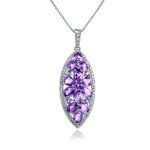 Amethyst Necklaces
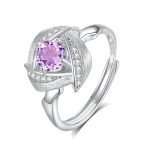 Amethyst Rings
 amethyst crystal healing
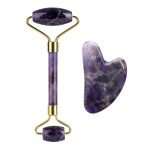 Amethyst Beauty & Wellness
 Crystal Home Decor
 Spiritual & Divination Tools