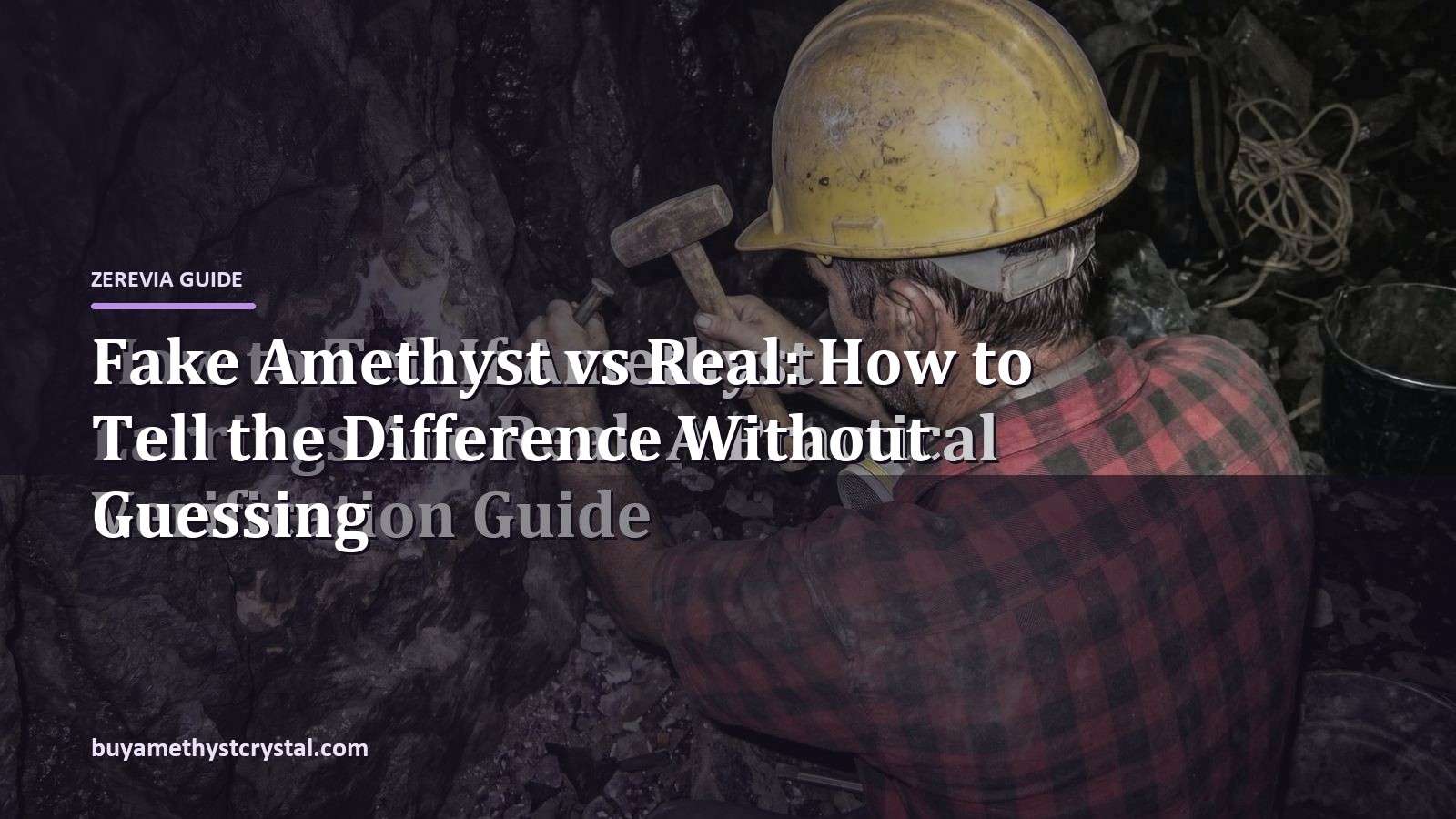

Fake Amethyst vs Real: How to Tell the Difference Without Guessing
The first amethyst I ever bought cost $12. It wasn’t much to look at — a small piece, color on the pale side, with a greyish base that made it look like it had been sitting in a box for a while. The handwritten tag said amethyst — for calm nights — $12. I didn’t know if it was real. I bought it anyway.
That question — is this real? — turned out to be the one that sent me down a years-long path through mineral shows, GIA coursework, and more conversations with sellers than I can count. The distinction between fake amethyst vs real isn’t always obvious, especially when you’re standing in a shop or scrolling through listings online. But there are concrete things you can check, and none of them require special equipment.
Whether you’re looking at beads, tumbled stones, or a raw crystal point, this guide will walk you through what to actually look for — and what to ignore.
Why Learning to Spot Fake Amethyst Matters
The market includes glass, plastic, dyed quartz, and heat-treated stones sold under the label “natural amethyst.” Some of these are honest mistakes — a seller who doesn’t know the difference. Others are deliberate. The result is the same: you pay for something that isn’t what it claims to be.
Understanding the basics of amethyst real vs fake identification protects your money, but it also protects something else. When you know your stone’s color is inherent — produced by trace Fe³⁺ ions activated by natural radiation over millions of years, not painted or melted into it — you know what you actually have on your shelf. That matters if you care about the thing being real.
That $12 stone I mentioned? I eventually figured out it was genuine. The weight was right, the color wasn’t uniform, and the base matrix looked like real basalt. It wasn’t a showpiece, but it was honest. That’s the part I cared about.
For more on what makes amethyst meaningful to the people who keep it — beyond just being a real mineral — you can read our guide to amethyst healing properties and traditional uses.
Quick Checks: 5 Signs of Real Amethyst
These are the tests I still use, whether I’m evaluating a piece at a show or checking a new supplier’s samples. They won’t replace professional gemological testing, but they’ll catch the majority of fakes you’re likely to encounter.
1. Weight and Temperature
Real quartz has a specific gravity of about 2.65. Pick up the stone. It should feel heavier than you expect for its size — noticeably heavier than glass of the same dimensions, and much heavier than plastic. Press it against your cheek or the inside of your wrist. Genuine amethyst feels cool to the touch initially, then slowly warms from your body heat. Glass is cool too, but it tends to warm faster and more uniformly. Plastic warms almost immediately.
2. Color Distribution
This is the single most useful test for telling real vs fake amethyst apart. Natural amethyst has color zoning — the purple isn’t the same shade everywhere. You’ll see patches of deeper color next to lighter areas, sometimes in bands or triangular patterns that follow the crystal’s internal structure. If the purple is perfectly even throughout the entire stone, especially in a cheap piece, that’s a red flag. Dyed glass and synthetic stones tend to have that suspiciously uniform color.
The purple in natural amethyst comes from Fe³⁺ — iron in its trivalent state — within the quartz crystal lattice, activated by natural background radiation. This process doesn’t produce uniform color. It can’t. The iron isn’t distributed evenly, and neither is the radiation.
3. Hardness
Amethyst sits at 7 on the Mohs hardness scale. This means it can scratch glass (Mohs 5.5) and steel (Mohs 5-6.5). If you’re testing a tumbled stone or a bead, try scratching an inconspicuous spot on a glass bottle. Real amethyst will leave a white scratch mark. Glass imitations won’t scratch each other. A word of caution: do this gently, on a spot you don’t mind marking, and don’t do it on finished jewelry settings where you might damage the metal or setting.
4. Inclusions
Counterintuitively, a bit of imperfection is a good sign. Natural amethyst commonly contains tiny fractures, veil-like internal features, or mineral inclusions like hematite needles. These are part of how the stone grew. If a bead or tumbled stone is completely clear with no internal features at all, and it’s priced cheaply, there’s a decent chance it’s glass. Synthetic amethyst can also be inclusion-free, but synthetic material costs more to produce than glass, so it’s less common in the low-end market.
5. Source Transparency
This is the test that separates sellers who know their inventory from those who don’t. Ask where the stone comes from. Reputable sellers can tell you the country — usually Brazil or Uruguay for amethyst — and sometimes even the specific region. If the answer is vague or defensive, that tells you something. The origin of a stone affects its color depth, crystal structure, and price. A seller who knows the origin usually knows the stone.
For a deeper look at how quality varies across sources, our amethyst quality and value guide breaks down what drives price and appearance.
Real vs. Fake in Common Forms: Beads, Tumbled Stones, and Crystals
The same principles apply across all forms, but the evidence looks different depending on what you’re holding. Here’s what to focus on for each type.
Real vs Fake Amethyst Beads
Amethyst beads are one of the most commonly faked forms because they’re small, mass-produced, and easy to imitate with dyed glass. Here’s what to check:
- Color variation between beads. In a real strand, you’ll notice each bead is a slightly different shade. Some deeper, some lighter, some with white streaks. If every bead is exactly the same purple, be suspicious.
- Color within each bead. Hold a single bead up to light. Real amethyst beads show some internal color variation — maybe a darker band or a paler area. Dyed glass beads look the same all the way through.
- Tiny inclusions. A loupe or even a phone camera zoomed in can reveal small internal features in real beads. Glass beads tend to have tiny round bubbles, which are a dead giveaway — natural quartz doesn’t form round bubbles.
- Weight. A real 8mm amethyst bead is noticeably heavier than a glass one of the same size.
Real vs Fake Tumbled Amethyst
Tumbled stones are smooth, pocket-sized, and popular as first purchases. They’re also easy to fake with dyed glass or even dyed quartz (quartz that’s been colored purple by soaking in dye):
- Color in cracks and pits. Dyed stones often show concentrated color in surface cracks, chips, or tiny pits — places where the dye pools. Real amethyst may show deeper color in internal fractures, but the color doesn’t pool on the surface the same way.
- Temperature behavior. Hold the tumbled stone in your closed fist for 30 seconds. Real amethyst stays cool longer than glass. Dyed quartz is trickier since it’s still real quartz — but if the color seems to sit in surface flaws rather than running through the body, it’s likely been treated.
- Surface texture. A properly tumbled natural stone has a smooth, glassy surface but still feels mineral-like. Plastic or resin imitations can feel slightly waxy or warm, even before you’ve held them long.
Real vs Fake Amethyst Crystals and Points
Raw crystal points and geodes show the most obvious differences because you can see the natural structure directly:
- Color zoning is usually very clear. You’ll see bands or patches of deeper purple alternating with lighter areas, sometimes following the trigonal crystal geometry. Look for a “phantom” pattern where the color seems to record the crystal’s growth over time.
- Natural irregularity. Real crystal points don’t have perfectly symmetrical facets. They have subtle angles, small chips, and natural growth steps. If a point is geometrically perfect at a low price, it may be glass that’s been cut and polished into a shape.
- Matrix rock. Many real amethyst specimens — especially from Brazil and Uruguay — still have basalt matrix attached at the base. This grey or brownish rock is the original host stone the crystals grew in. Glass fakes rarely bother to replicate this convincingly.
- Crystal termination. The tip of a natural amethyst point is formed by the crystal’s own growth, not cut by a machine. It won’t be perfectly sharp or symmetrical.
If you’re curious about the different forms amethyst comes in and what to expect from each, our amethyst forms and shapes guide covers geodes, clusters, points, spheres, and more.
Common Misconceptions and What to Avoid
The “AAAA Grade” Trap
Before I started studying this seriously, I assumed “AAAA” was a recognized grading standard. It isn’t. Unlike diamonds, amethyst has no internationally recognized grading system. A, AA, AAA, AAAA are descriptive terms the industry invented, and every seller defines them differently. Some mark all their stones AAAA because nobody can prove otherwise.
When you see fake vs real amethyst claims backed only by a grade label, that label tells you almost nothing. What does tell you something: the stone’s actual color depth, its origin, its weight and dimensions, and whether the seller shows you the specific piece you’ll receive.
Treated vs. Fake
This is a distinction worth understanding. Some amethyst is heat-treated — often material from Brazilian deposits — to deepen or shift its color toward a more saturated purple. The stone is still real quartz, but the color has been permanently altered. This isn’t the same as a glass fake, but it’s not entirely natural either. If exact natural color matters to you, ask the seller whether the stone has been heated. A good seller will answer honestly.
Another common treatment: citrine-colored quartz that’s been heated from amethyst stock, or amethyst that’s been re-heat-treated to appear more purple. The process is permanent and undetectable to the naked eye in most cases, which is why origin transparency and seller trust matter.
Dyed Quartz vs. Natural Color
Dyed quartz — real quartz that’s been soaked in purple dye — falls somewhere between “fake” and “treated.” The stone is real, but the color isn’t. Watch for dye pooling in surface cracks, overly vivid or “electric” purple tones that don’t match any natural amethyst you’ve seen, and color that fades or transfers when rubbed with acetone.
Spiritual and Ritual Claims
Many people keep amethyst as part of personal rituals — on a nightstand, in a meditation space, near a workspace. These are meaningful personal practices. But no stone, however genuine, is a medical treatment. A real amethyst’s value is that it’s a real thing: a specific mineral from a specific place, with a verifiable composition. That’s already enough. Adding medical claims doesn’t make it more real; it just makes the conversation less honest.
From Spotting Fakes to Choosing with Confidence
Once you know the signs of real amethyst crystal vs fake, the question shifts. It’s no longer “is this fake?” but “is this the right piece for me?” That’s a better question, and it has a more useful answer.
Here’s what I look for when I’m choosing a piece — and what we focus on at Zerevia:
- Documented origin. We list the country of origin for our raw crystals and geodes. Brazilian amethyst tends to come in larger pieces with a wider color range; Uruguayan amethyst is known for deeper, denser purple with smaller crystals. Knowing where it’s from helps you set realistic expectations for what you’ll see.
- Accurate photography. Every raw crystal and geode we sell is photographed individually — what you see is what you get. We don’t use stock photos or composite images.
- Specific details. Weight in grams. Dimensions in centimeters. Color description that goes beyond “purple.” Natural features like color zoning, matrix rock, and inclusions are described, not hidden.
This approach won’t win any marketing awards. It’s slower to list products this way, and the descriptions are longer. But it means you know what you’re actually buying, which is the whole point.
You can see how origin affects appearance and pricing in our guide to amethyst geological origins, or browse our amethyst collection where every piece is photographed individually with documented origin details.
For a deeper dive into the specific identification methods covered here, you may also find our full guide on how to identify real amethyst useful — it walks through each test with more visual detail.
Frequently Asked Questions
Can real amethyst fade or change color?
Yes. The Fe³⁺ ions that create amethyst’s purple color can be reduced by sustained UV exposure, causing the color to lighten permanently. I once had a buyer message me about a crystal point that had turned from deep purple to pale lavender after sitting on a south-facing windowsill for a few months. The stone was genuine, but the color was gone and it wasn’t coming back. Keep amethyst out of direct sunlight, especially in bright or south-facing rooms.
Is all dark purple amethyst real?
Not necessarily. Very deep purple can be heat-treated or synthetic. Some Brazilian amethyst is heated to deepen its color before sale. Use the full set of checks — color zoning, weight, inclusions, and source transparency — rather than relying on color depth alone. Uruguayan amethyst naturally reaches very deep “emperor” purple without treatment, which is one reason it commands higher prices.
Where is the best place to buy real amethyst?
Look for sellers who do three things: tell you where the stone is from (Brazil, Uruguay, or another specific origin), show you the exact piece you’ll receive (not a stock photo), and describe specific attributes like weight, dimensions, and natural features. Vague descriptions with only a grade label and no origin information are a warning sign. If you’re ready to browse, our amethyst collection follows these standards.
Does the shape — bead, tumbled, or crystal — affect whether it’s real or fake?
The same core principles apply to every form, but the evidence looks different. Beads: check for color variation between individual beads and tiny inclusions visible under magnification. Tumbled stones: watch for dye pooling in surface cracks and test the weight. Raw crystals and points: color zoning, natural irregularity in facets, and the presence of matrix rock are your strongest indicators. The specific shape doesn’t change what’s real — it just changes where you look.
 Crystal Cluster
 Crystal Tower
 amethyst crystal ball
 Amethyst Caves for Sale
 Amethyst Bracelets
 Amethyst Earrings
 Amethyst Necklaces
 Amethyst Rings
 amethyst crystal healing
 Amethyst Beauty & Wellness
 Crystal Home Decor
 Spiritual & Divination Tools