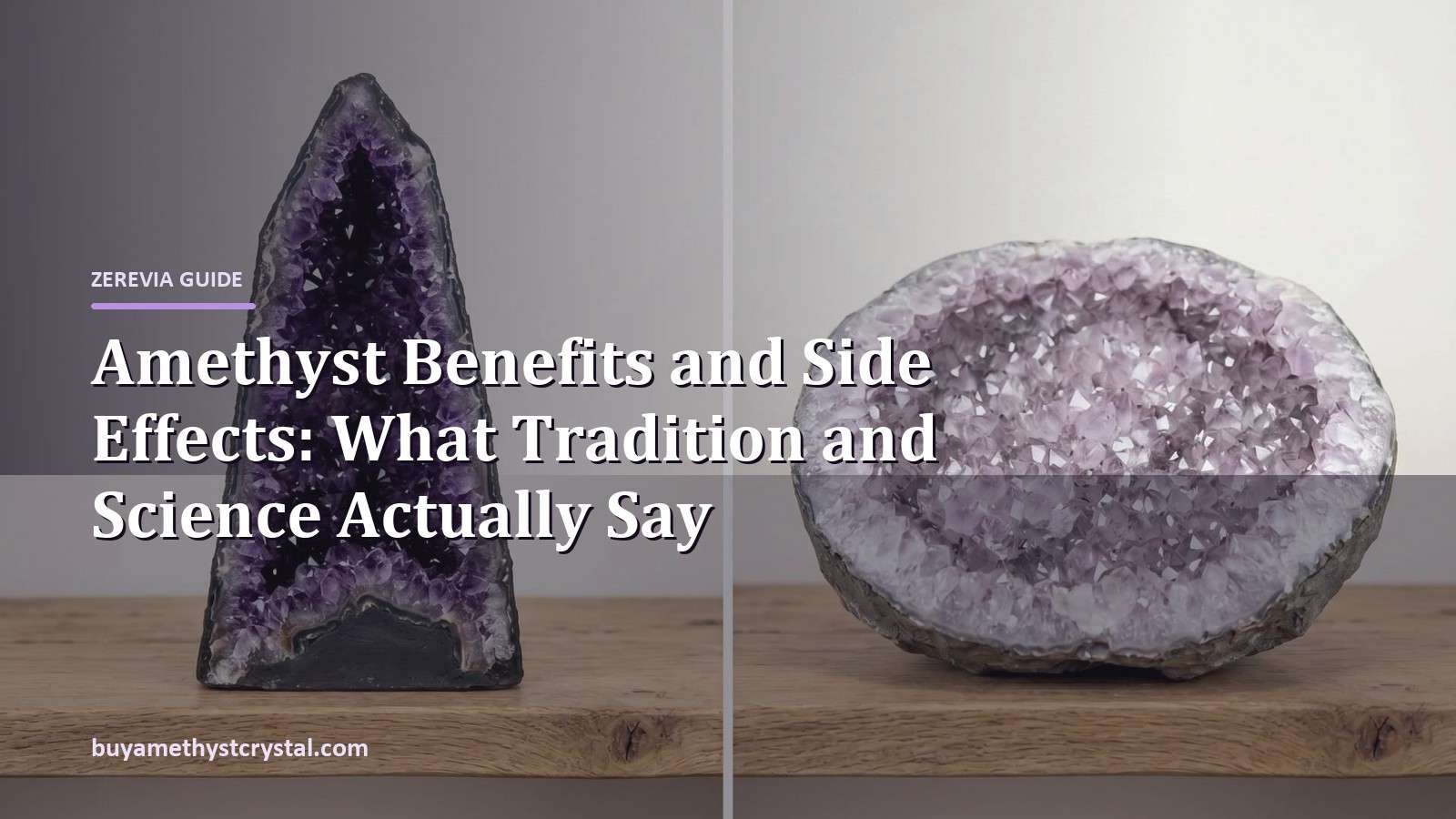
Amethyst Benefits and Side Effects: What Tradition and Science Actually Say
When people search for amethyst benefits and side effects, they usually want two things: a clear list of what amethyst is supposed to do, and an honest answer about what can go wrong. This guide covers both — the traditional beliefs and the real, practical cautions that most crystal sellers skip over.
Amethyst is a natural form of silicon dioxide (SiO2) colored purple by trace amounts of iron — specifically Fe3+ ions activated by natural radiation over millions of years. It registers 7 on the Mohs hardness scale, sits in the trigonal crystal system, and has been recognized as the February birthstone for centuries. Those are verifiable material facts. Everything below that line — the calm, the ritual, the astrology — is tradition, personal practice, or buyer experience. Knowing the difference is the point.
If you want a deeper look at the documented science and cultural symbolism behind this stone, our amethyst healing properties hub and amethyst meaning and uses guide go further.
Traditional Amethyst Benefits and Common Use Cases
Amethyst stone benefits as described in crystal tradition tend to cluster around a few practical themes: calm, clarity, and boundary-setting. None of these are medical claims. They are patterns in how people use the stone — and those patterns are worth understanding if you’re deciding whether amethyst fits your life.
The first piece of amethyst I ever bought cost twelve dollars. It was not a particularly beautiful specimen — the color was pale, the matrix rock was grayish, and it looked like it had been sitting in that wooden box for a long time. The hand-written label said amethyst — for calm nights — $12. I put it on my nightstand. That night was the first time in months I did not wake up at 3 a.m. That does not prove anything medically. But it was the beginning of how I started paying attention to this stone, and the experience that eventually led me to Fe3+ color mechanics and GIA coursework.
Here is how people commonly use amethyst — organized by real-life scenario, not by vague promise:
- Bedside placement and wind-down ritual. In crystal tradition, amethyst is associated with rest and mental quiet. Many buyers describe placing a small stone or tower on the nightstand as a signal to stop scrolling and start winding down. Whether the stone is doing something “energetic” or simply acting as a physical reminder to slow down — that is a personal interpretation.
- Home decor with intention. A geode or cluster in a living room is, first and foremost, a visual anchor. Some buyers choose it because it looks striking. Others set an intention around the space — calm for a bedroom, grounding for an office. The stone does not care about your intention. But having a physical object that reminds you of one? That has practical value. For help choosing the right form, see our amethyst forms and shapes guide.
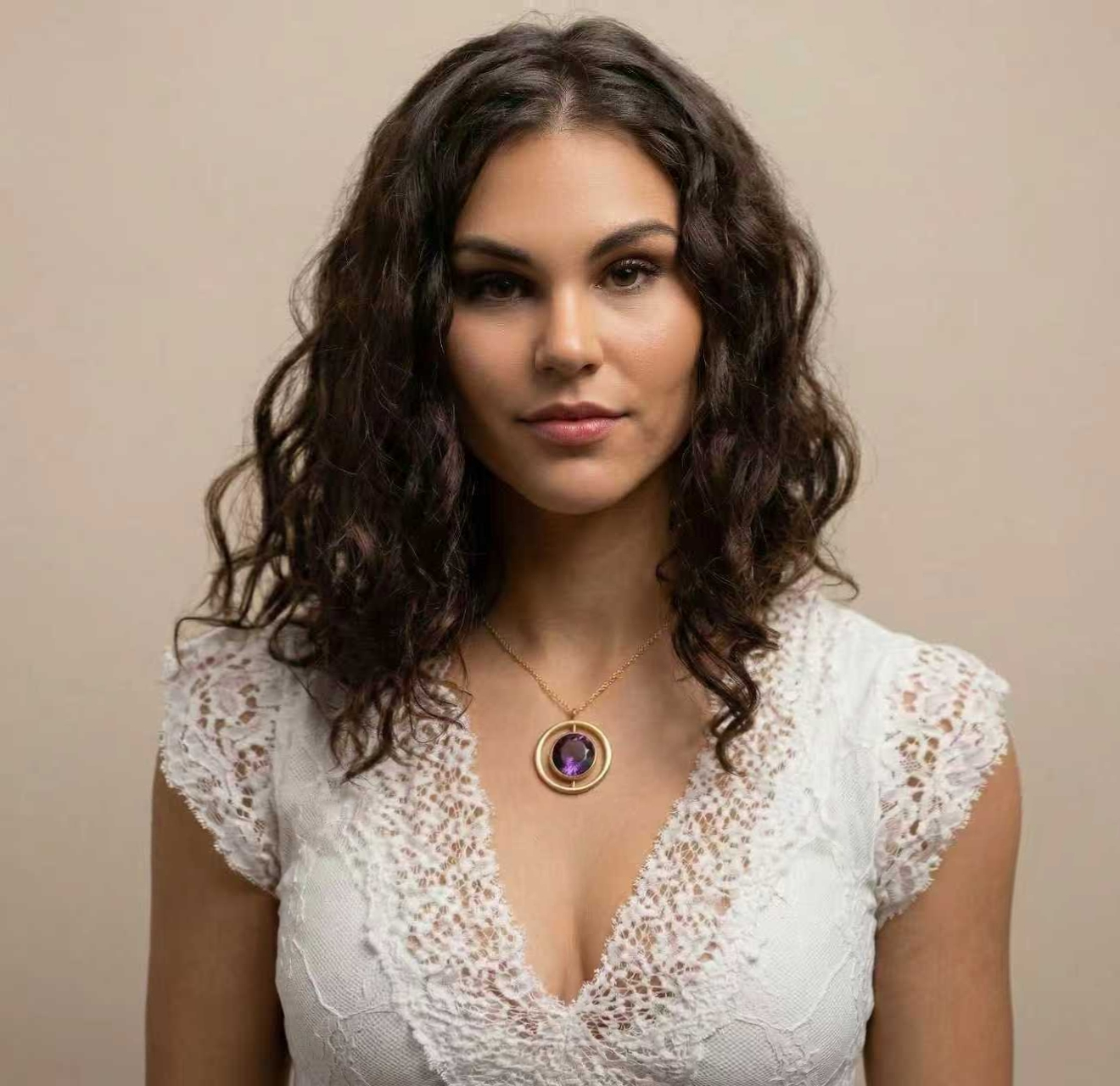
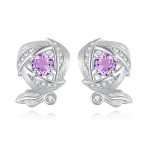
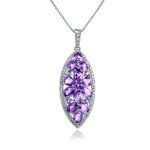
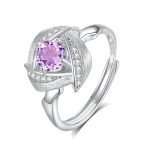
- Wearable reminder. Amethyst jewelry — a ring, a pendant, a pair of earrings — functions as a tactile cue. You touch it, you remember to pause. No mystical claim required.
- Meaningful gift. As the February birthstone and the traditional guardian stone for Aquarius, amethyst carries built-in significance for birthdays, Valentine’s Day, and personal milestones. A well-chosen piece communicates thoughtfulness without you having to explain anything.
I once had a conversation with someone who did not believe in any of this. He asked me directly: “You really think stones do anything?” I told him I did not know. But I knew that having a real piece of something on my nightstand — something that came from a specific place and was treated with care — gave me one or two quiet minutes before sleep instead of screen time. He said, “Okay, I can accept that.” That is about where I land, too.
Amethyst Benefits for Women: Ritual, Rest, and Personal Space
The phrase “amethyst benefits for female” shows up in search data regularly, and it points to something real — not a gendered medical claim, but a cultural pattern. A lot of women in the 25-to-42 age range are looking for small, tangible ways to carve out quiet in lives that are already full enough. That is not a diagnosis. It is a use case.
Practical scenarios where amethyst fits naturally into a woman’s daily routine:
- Bedside or bathroom shelf. A palm stone or small tower near where you get ready in the morning or wind down at night.
- Desk piece. A cluster or point on a workspace as a visual pause between tasks.
- Travel stone. A tumbled stone small enough for a pocket or bag — something familiar in unfamiliar places.
- Jewelry for daily wear. 100% natural amethyst set in 925 sterling silver, nickel-free, no green-finger discoloration. Arrives in a gift box, whether you are buying for someone else or for yourself.
Intention-setting — the practice of holding a stone and naming what you want from a day, a week, a season — is a personal ritual, not a medical prescription. But it is also not nothing. It is a moment of quiet attention. Some people find that valuable. If you are curious about how different shapes serve different intentions, the forms and shapes guide breaks it down by use case.
Amethyst Benefits in Astrology: Sagittarius, Aquarius, Aries, and Pisces
Amethyst benefits in astrology are a matter of tradition, not scientific measurement. Crystal astrology practitioners associate amethyst with specific zodiac signs based on centuries of symbolic correspondence. Here is what those associations look like — and where they are strongest.
Amethyst Benefits for Aquarius (January 20 – February 18)
This is the most direct zodiac-amethyst connection. Amethyst is the official February birthstone, and in traditional crystal astrology, it is also designated as the Aquarius guardian stone. Practitioners associate it with clarity of thought and intuitive balance — qualities that align with Aquarius’s reputation for big ideas and occasional emotional distance. If you are buying a gift for an Aquarius, amethyst has the strongest built-in cultural resonance of any stone.
Amethyst Benefits for Pisces (February 19 – March 20)
Because the February birthstone designation extends into the earliest days of Pisces season, there is a traditional overlap. Crystal practitioners associate amethyst with emotional clarity and groundedness — traits that tradition frames as a counterbalance to Pisces’s tendency toward emotional absorption. The link is less direct than Aquarius, but it is a common choice for Pisces birthdays in late February.
Amethyst Benefits for Sagittarius (November 22 – December 21)
In traditional astrology, Sagittarius is a fire sign associated with enthusiasm, movement, and expansive thinking. Practitioners of crystal astrology sometimes recommend amethyst for Sagittarius as a grounding influence — a way to slow down and reflect before the next big leap. Whether that framing resonates with you depends on how you relate to fire-sign energy. It is a tradition, not a prescription.
Amethyst Benefits for Aries (March 21 – April 19)
Similarly, Aries — another fire sign known for quick action and directness — is traditionally associated with amethyst as a stone of patience and pausing. The idea is that amethyst encourages a moment of reflection before acting. Whether that is a property of the stone or simply the act of holding something still while you think is, again, a personal question.
For more on the cultural history behind these associations, our guide to amethyst meaning and uses covers the symbolism across traditions.
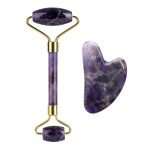
Amethyst Face Roller and Gua Sha: What to Know
Searches for benefits of amethyst face roller and benefits of amethyst gua sha have grown steadily. Zerevia does not sell these products, but because amethyst is in the name, here is what to understand before you buy.
Crystal rolling and gua sha have their own traditional roots in practices adjacent to Chinese medicine. The physical benefit of a face roller or gua sha tool comes from the massage technique — the pressure, the movement, the cool temperature of stone against skin. Amethyst is one of many stones used for these tools. The benefits of amethyst roller tools, specifically, are not different from the benefits of any other genuine stone roller. The technique does the work. The material is the material.
Buying caution: a significant number of mass-market “amethyst” rollers and gua sha tools are made from dyed glass or synthetic material. Some are plastic with a purple coating. To check if the amethyst in your roller is real, use the same verification methods you would for any amethyst specimen:
- Weight. Real amethyst (Mohs 7, specific gravity around 2.65) feels heavier than glass or plastic of similar size.
- Temperature. Genuine stone feels cool against skin for the first few seconds, then gradually warms. Glass feels cool more uniformly and warms faster.
- Color zoning. Natural amethyst has uneven purple distribution — some areas deeper, some lighter, sometimes with white zones. A perfectly uniform purple is a red flag.
Amethyst at Mohs 7 is hard enough for facial tools, but it can chip or crack if dropped on a hard surface. Treat it like a small stone object, not like silicone.
For a deeper dive into evaluating amethyst quality — whether for a roller, a ring, or a raw crystal — see our amethyst quality and value guide.
Side Effects and Cautions: What Can Go Wrong with Amethyst
This is the part most crystal guides leave out. When people search for amethyst benefits and side effects, the “side effects” half usually gets a vague paragraph about “cleansing your stone.” Here is what can actually go wrong.
UV fading is the number one real risk. The purple color in amethyst comes from Fe3+ ions. Under sustained ultraviolet light — direct sunlight, specifically — those iron ions undergo a reduction reaction. The purple fades. This process is irreversible. Once the color is gone, it does not come back with moonlight, sound baths, or intention.
I learned this the hard way through a buyer who placed her crystal point on a south-facing bedroom windowsill. Two hours of direct afternoon sun, every day. Within a few months, her deep emperor purple had become a pale lavender. The stone was still real. The color was gone. I added UV warnings to every product description after that. If you take one thing from this article: keep amethyst out of direct sunlight. Indirect room light is fine. A sunny windowsill is not. For full care guidance, see our amethyst care and cleansing guide.
Other practical cautions:
- Chemical exposure. Household cleaners, perfumes, and chlorine from pools can damage amethyst surfaces and any metal settings. Remove amethyst jewelry before cleaning, swimming, or applying fragrance.
- Buying risk. Dyed stones, glass imitations, and misleading origin claims are common — especially at very low price points. Use the real-stone verification checklist above (weight, temperature, color zoning) before purchasing from an unfamiliar seller.
- Skin discoloration. Genuine 925 sterling silver is nickel-free and should not turn your skin green. Cheap plated settings or base-metal alloys can. If you see “nickel-free” and “925” stamps, you are in a safer category.
- Fragility of points and tips. Crystal towers, obelisks, and raw points can chip or snap if knocked over or dropped. Place them on stable surfaces away from edges.
- Not a medical substitute. Amethyst does not replace professional medical or mental health care. It is a mineral. It is beautiful. People find personal meaning in it. Those things are real and valuable — but they are not a diagnosis or a treatment plan.
How to Choose Amethyst That Fits Your Life
The best way to choose amethyst is not by chasing grading labels — there is no internationally recognized grading system for amethyst, despite what AAAA marketing might suggest. The best way is by asking what you actually need it for.
Here is a simple framework:
| Use Case | Best Form | What to Look For |
|---|---|---|
| Home decor statement | Geode, cluster, cathedral geode | Size, color depth, placement space. Brazilian amethyst tends toward larger pieces; Uruguayan amethyst tends toward deeper, more saturated purple. |
| Personal ritual or intention setting | Tower, palm stone, tumbled stone | Comfortable to hold, color you find appealing, size that fits your space. |
| Everyday wearable reminder | Ring, pendant, bracelet, earrings | 100% natural amethyst, 925 sterling silver, nickel-free. Check that the setting feels secure. |
| Meaningful gift | Birthstone jewelry, small geode, gift-boxed set | February birthstone for birthdays, Aquarius guardian stone for zodiac gifts, housewarming clusters for new homes. |
When evaluating raw crystals and geodes, choose by documented origin, color depth, weight, and dimensions — not by vague grading terms. WYSIWYG photography (what you see is what you get) matters: you want to see the exact piece you will receive, not a stock photo of something similar. For raw crystal pieces from documented Brazilian or Uruguayan origins, the distinction is real: Brazilian material tends to offer size and color range at a lower price point, while Uruguayan material tends toward deeper, denser purple at a higher one. Neither is better. It depends on what you want, where you are placing it, and how much you value that depth of color.
If you want a piece of documented-origin amethyst — a crystal that matches its photo and comes with honest care guidance — browse Zerevia’s collection. No pressure, no urgency countdown. Just real stones, real photos, and the information you need to choose well.
Frequently Asked Questions
What are the real benefits of amethyst?
Amethyst’s verified material properties include Mohs hardness 7, a purple color caused by Fe3+ ions in the crystal lattice, and documented origins in Brazil and Uruguay. Its traditional uses include bedside placement for calm ritual, wearing as jewelry as a personal reminder, and gifting as the February birthstone. These are traditions and personal practices — not medical claims. The value people find in amethyst is real, but it is personal and cultural, not clinical.
Does amethyst have any side effects?
Amethyst does not have medical side effects because it is not a medication. The most significant practical risk is UV fading: direct sunlight causes irreversible color loss in amethyst due to a chemical reduction of the iron ions that create the purple. Other cautions include chemical damage from household cleaners or chlorine, the risk of buying dyed glass imitations, and the fragility of crystal points and towers. Keep amethyst out of direct sun and treat it like the mineral it is.
What zodiac signs benefit most from amethyst?
In traditional crystal astrology, Aquarius has the strongest connection to amethyst — it is both the February birthstone and the traditional Aquarius guardian stone. Pisces shares the February birthstone overlap. Sagittarius and Aries are traditionally associated with amethyst as a grounding or patience-oriented stone, which practitioners recommend as a counterbalance to fire-sign energy. All of these are astrological traditions, not scientific measurements.
Are amethyst face rollers and gua sha tools worth it?
The physical benefits of face rollers and gua sha tools come from the massage technique and cool stone temperature, not from amethyst-specific properties. If you already enjoy facial massage, an amethyst roller can be a pleasant tool — but verify that the stone is real amethyst, not dyed glass or synthetic material. Check for weight, cool-to-touch temperature, and natural color zoning. Zerevia does not sell face rollers or gua sha tools; we focus on raw crystals, geodes, and jewelry.
Can amethyst fade or get damaged?
Yes. UV fading is the most common and most irreversible form of amethyst damage. Fe3+ ions in the crystal structure reduce under ultraviolet light, and the purple permanently fades. This cannot be reversed by moonlight, sound baths, or any ritual. To protect your amethyst, keep it out of direct sunlight and store it in indirect room light. Avoid chemical exposure from cleaners, perfumes, and chlorine. Crystal points and towers can chip if dropped, so place them on stable surfaces.
 Crystal Cluster
 Crystal Tower
 amethyst crystal ball
 Amethyst Caves for Sale
 Amethyst Bracelets
 Amethyst Earrings
 Amethyst Necklaces
 Amethyst Rings
 amethyst crystal healing
 Amethyst Beauty & Wellness
 Crystal Home Decor
 Spiritual & Divination Tools