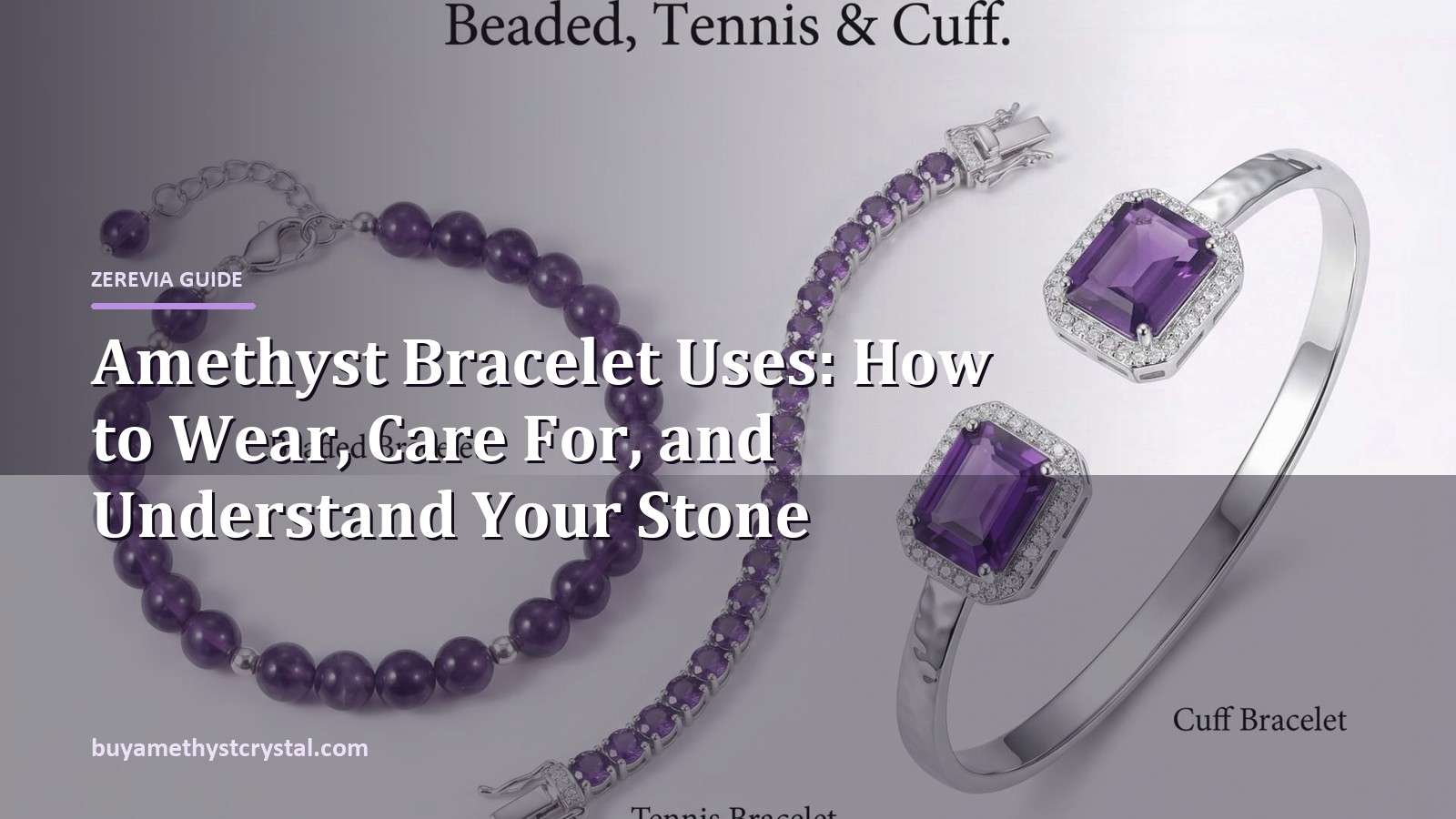

Amethyst Bracelet Uses: How to Wear, Care For, and Understand Your Stone
An amethyst bracelet sits on your wrist. It catches the light when you reach for your coffee, taps against your desk when you type, and stays close to your skin through ordinary, unremarkable hours. Understanding the full range of amethyst bracelet uses — from daily wear to traditional ritual — helps you choose one that actually fits your life, not just your jewelry box.
This guide covers what an amethyst bracelet does, how to wear and care for it, why they sometimes break, and how to choose one you will not regret. If you are curious about the broader context of amethyst meaning and uses, that link goes deeper into the stone itself.
What Does an Amethyst Bracelet Actually Do?
The most straightforward amethyst bracelet uses fall into a few categories: wearable jewelry, a tactile anchor for personal ritual, a meaningful gift tied to February birthdays, and a small piece of natural geology you carry with you. None of these require you to believe in anything mystical. They are reasons people buy and keep wearing them.
Amethyst is a natural quartz variety — silicon dioxide with trace amounts of iron (Fe3+) that produce the purple color through natural radiation over millions of years. It has a Mohs hardness of 7, which makes it durable enough for daily jewelry but not indestructible. Paired with 925 sterling silver — an alloy of 92.5% silver and 7.5% copper that resists tarnish and does not contain nickel — you get a bracelet that holds up to regular wear without turning your skin green.
The benefits of wearing an amethyst bracelet, as most buyers describe them, are personal and quiet. Some people like having something specific to look at during a long meeting. Others set a small intention each morning when they clasp it on. A few just like the way deep violet looks against their skin tone. All of these are valid uses. None of them are medical claims.
For a fuller picture of what makes amethyst distinctive as a mineral, see our guide to amethyst healing properties, where we separate physical facts from traditional associations.
How to Wear an Amethyst Bracelet: Placement and Style
If you have ever wondered how to wear an amethyst bracelet so it feels right — not just physically, but in terms of what you want from it — here are the practical considerations.
Fit and Comfort
A bracelet should not squeeze your wrist. You want enough space to slip one finger between the beads or chain and your skin. Too tight and it will pinch when you flex your hand; too loose and it catches on everything. Most stretch-bead bracelets come in standard sizes (around 7 inches for women), while chain styles with a clasp can be adjusted by one or two links.
Which Wrist?
There is a traditional view that the left hand is for receiving and the right hand is for giving or projecting. In practice, people wear bracelets on whichever wrist feels more comfortable or looks better with their watch or other jewelry. If you like the idea of wearing it as a quiet personal reminder, the non-dominant hand keeps it slightly more protected from daily wear. If you want it visible as a deliberate style choice, the dominant hand works fine.
Layering and Matching
Amethyst pairs well with other natural stones — rose quartz and clear quartz are common companions — and sterling silver complements most metals. If you stack bracelets, keep the amethyst in the middle or closest to your hand so it does not get lost behind larger pieces. Mixing metals is a personal choice; there is no rule against it.
Setting an Intention
Some people pause for a few seconds when putting on their bracelet and think about what they want from the day. This is not a requirement. It is a small ritual that some buyers find grounding. As one conversation I had put it: “I don’t know if stones have that kind of mysterious energy. I really don’t. But when there is something specific on my wrist that I chose carefully, I tend to pause for a moment before I start scrolling. That works for me.” The value is in the pause, not in a guarantee.
Amethyst Bracelet Properties: What You Should Know
When people search for amethyst bracelet properties, they are usually looking for two things: what the stone is made of and what it is traditionally said to do. These are different categories, and it is worth separating them.
Physical Properties
Amethyst’s purple color comes from iron (Fe3+) ions trapped in the quartz crystal lattice, activated by natural background radiation over geological time. This is not a coating or a dye — it is structural. The color is part of the stone.
At Mohs hardness 7, amethyst is harder than glass but softer than sapphire or topaz. It can scratch softer materials and be scratched by harder ones. In a bracelet, the main risk is bumping it against a countertop or wearing it next to a diamond ring. Small chips happen; they do not mean the stone is fake.
One important property that affects jewelry: amethyst can fade under prolonged UV exposure. The same Fe3+ mechanism that creates the color can be slowly reversed by sunlight. A deep violet bracelet left in direct afternoon sun for months will gradually lighten to lavender. This is permanent and irreversible. Keep it off the windowsill.
I learned this the hard way through a buyer’s experience early on — a crystal that went from emperor purple to soft lavender after a few months on a south-facing windowsill. Since then, UV care warnings appear in every product description I write.
Traditional Properties in Jewelry
In traditional and cultural contexts, amethyst has long been associated with calm, mental clarity, and sobriety. The ancient Greek word amethystos means “not intoxicated.” In more recent crystal traditions, people associate it with quiet focus and emotional steadiness.
As a February birthstone, it carries a personal significance for people born in that month — a natural amethyst bracelet becomes a meaningful, wearable birthday marker. Some buyers choose it specifically for this reason.
The natural amethyst bracelet benefits that matter most to buyers tend to be concrete: it is a real stone, not glass or plastic. It has a specific weight against the wrist. Its color varies slightly from bead to bead. These are the qualities that make it feel like something worth wearing, not a vague promise about energy. For more on how amethyst’s geology shapes its appearance, see our guide to amethyst geological origins.
How to Cleanse and Charge Your Amethyst Bracelet
Questions about how to cleanse an amethyst bracelet, how to charge it, how to clean it, and how to activate it come up constantly. Here is what is safe, what is traditional, and what to avoid.
Cleaning vs. Cleansing: Two Different Things
Cleaning means removing physical dirt, oils, and sweat. A soft, slightly damp cloth wiped over the beads and silver setting is all you need. Do this every couple of weeks if you wear the bracelet daily. Avoid soaking in water — sterling silver can develop water spots and prolonged moisture can weaken elastic cord over time.
Cleansing is a ritual practice. In crystal traditions, cleansing is believed to clear absorbed energies and reset the stone’s intention. Whether you subscribe to this or simply enjoy the ritual, here are the safe methods:
- Moonlight cleansing: Place the bracelet on a windowsill or outside during a full moon overnight. This is the gentlest method and will not damage the stone or silver.
- Sound cleansing: A singing bowl, tuning fork, or even a bell can be used. Place the bracelet near the sound source for a few minutes. No physical contact required.
- Brief smoke cleansing: Pass the bracelet through sage or palo santo smoke for a few seconds. Do not hold it in the smoke for extended periods, as residue can build on the silver.
How to Charge an Amethyst Bracelet
“Charging” in this context means refocusing intention. Traditional methods include placing the bracelet on a clear quartz cluster overnight or setting it in moonlight. Some people hold the bracelet, think about what they want from it, and put it back on. The act of deliberate attention is the point — not a transfer of energy from one stone to another.
The term “how to activate an amethyst bracelet” is sometimes used interchangeably with charging. There is no special activation required before first wear. If it feels meaningful to you to do a first-wear ritual — moonlight, intention setting, a quiet moment — go ahead. If it does not, putting it on is sufficient.
What to Avoid
- Direct sunlight: UV fades amethyst. Do not use sunlight as a cleansing method.
- Salt water or prolonged water soaking: Salt is abrasive to both the stone surface and sterling silver. Water weakens elastic and can cause tarnish.
- Chemical cleaners: Ultrasonic jewelry cleaners, bleach, and harsh detergents can damage both the stone and the silver setting.
For a broader look at how different amethyst forms compare in care needs, see our amethyst forms and shapes guide.
Why Did My Amethyst Bracelet Break? (And What To Do)
Breakage is one of the most searched questions about amethyst bracelets, and most of the answers online lean heavily on spiritual interpretation. Here is what is actually happening.
Physical Causes
Elastic cord failure: Stretch bracelets use elastic that degrades over time — heat, sweat, UV exposure, and repeated stretching all weaken it. A cord that lasts eight months of daily wear is normal. One that snaps after two weeks likely had a defect.
Sterling silver clasp or jump ring failure: 925 sterling silver is softer than steel. A thin jump ring or clasp can bend open with enough force — catching on a sweater, pulling it over your head without unclasping, or snagging a door handle.
Stone chipping or cracking: Natural amethyst has inclusions — tiny internal fractures, feather-like patterns, or needle-shaped minerals trapped during growth. These are signs of natural formation, not defects. But they are also weak points. A sharp impact against a hard surface can crack the stone along an inclusion line.
It Is Not About Absorbed Negativity
In some crystal traditions, a broken bracelet is said to have “absorbed too much negative energy” or “served its purpose.” You are welcome to find meaning in that interpretation if it resonates. But the physics explanation is simpler and more reliable: materials have limits, and daily wear tests those limits.
What To Do Next
If the elastic breaks, most beaded bracelets can be re-strung by a local jeweler or at home with stretch cord (0.8mm works for most 6mm-8mm beads). If a clasp breaks, a jeweler can replace the jump ring or clasp for a few dollars. If the stone itself cracks, it is usually not repairable — but the remaining beads can often be re-strung into a shorter bracelet or a new arrangement.
Feng Shui Amethyst Bracelet: Placement and Intention
Feng Shui is a traditional Chinese practice focused on how objects and spatial arrangement affect the flow of energy in a living environment. An amethyst bracelet can be part of a Feng Shui approach, both on the body and in the home.
On the Body
Traditional Feng Shui associates the left wrist with receiving energy and the right wrist with releasing or projecting. Wearing an amethyst bracelet on the left wrist is a common recommendation for those who want to “invite” calm or clarity into their day. On the right wrist, it is sometimes worn as a reminder to let go of tension or overthinking.
These are traditional frameworks, not rules. The most useful wrist is the one where you will actually wear it.
In the Home
If you remove your bracelet at night, placing it on a nightstand is one option — some people find it part of a calming bedtime routine, though results are personal and not medically guaranteed. In Feng Shui terms, the northeast area of a room is traditionally associated with knowledge and self-cultivation; placing a bracelet or crystal in that area is said to support focus and learning.
The underlying principle in both cases is intention. Whether you wear it, place it on a shelf, or tuck it in a drawer, the act of choosing where it goes and why is the practice itself. For more on how amethyst connects to broader meaning and symbolism, our article on amethyst meaning and uses goes further.
Choosing Your Amethyst Bracelet: A Quick Checklist
Before you buy, here are the practical checks that separate a bracelet you will wear from one that sits in a drawer:
- Confirm the materials. The product description should state “natural amethyst” (not dyed quartz or glass) and “925 sterling silver” for the metal components. Vague terms like “amethyst-colored” or “silver-tone” are red flags.
- Check the photography. WYSIWYG — What You See Is What You Get — matters for jewelry. You want to see the actual color depth, clarity, and any natural inclusions before buying, not a stock photo of a different bracelet.
- Consider color preference. Deeper purple stones tend to come from specific deposits (Uruguay is known for its deep violet, while Brazilian material ranges from soft lavender to medium purple). In jewelry, origin is not always stated, so focus on the color you actually see in the photo.
- Verify the closure. Stretch elastic is convenient but wears out. A lobster clasp or toggle clasp with a sterling silver chain lasts longer and is easier to repair if something breaks.
- Think about gifting. If this is a February birthstone gift, a housewarming present, or a birthday gesture, check whether the bracelet comes with a gift box and a meaning card. Presentation matters when the bracelet is not for you.
For a deeper dive into what makes one piece of amethyst more valuable than another, see our amethyst quality and value guide.
Frequently Asked Questions
Can I wear my amethyst bracelet every day?
Yes. A bracelet made with natural amethyst (Mohs hardness 7) and 925 sterling silver is designed for daily wear. Remove it before heavy manual work, swimming, or applying lotions and perfumes directly on it. Wipe it with a soft cloth every week or two.
Which wrist should I wear my amethyst bracelet on?
Traditional views suggest the left wrist for receiving and the right for releasing, but personal comfort and style are the better guides. Wear it on whichever wrist feels right — or whichever one lets you see it more often.
Does my amethyst bracelet need to be cleansed?
Cleansing is a personal ritual practice, not a requirement of the stone. If you feel the bracelet has absorbed energy you want to clear, or you simply enjoy the ritual, moonlight overnight is the safest method. If you do not practice crystal rituals, normal cleaning with a soft cloth is perfectly sufficient.
What should I do if my amethyst bracelet breaks?
Check what broke first. If the elastic cord snapped, a local jeweler can re-string it. If a clasp or jump ring failed, it can be replaced inexpensively. If the stone itself chipped or cracked along a natural inclusion, it cannot be repaired — but the remaining stones can often be re-strung into a shorter bracelet.
Is amethyst jewelry good for sleep?
Some people wear an amethyst bracelet or place it on their nightstand as part of a calming bedtime routine. Others prefer to remove jewelry before sleep. There are no medical guarantees about amethyst and sleep quality — it is a personal practice, and what helps one person relax may not do the same for another.
Ready to find your bracelet? Browse our collection of natural amethyst and sterling silver jewelry — each piece photographed individually so you know exactly what you are getting.
 Crystal Cluster
 Crystal Tower
 amethyst crystal ball
 Amethyst Caves for Sale
 Amethyst Bracelets
 Amethyst Earrings
 Amethyst Necklaces
 Amethyst Rings
 amethyst crystal healing
 Amethyst Beauty & Wellness
 Crystal Home Decor
 Spiritual & Divination Tools