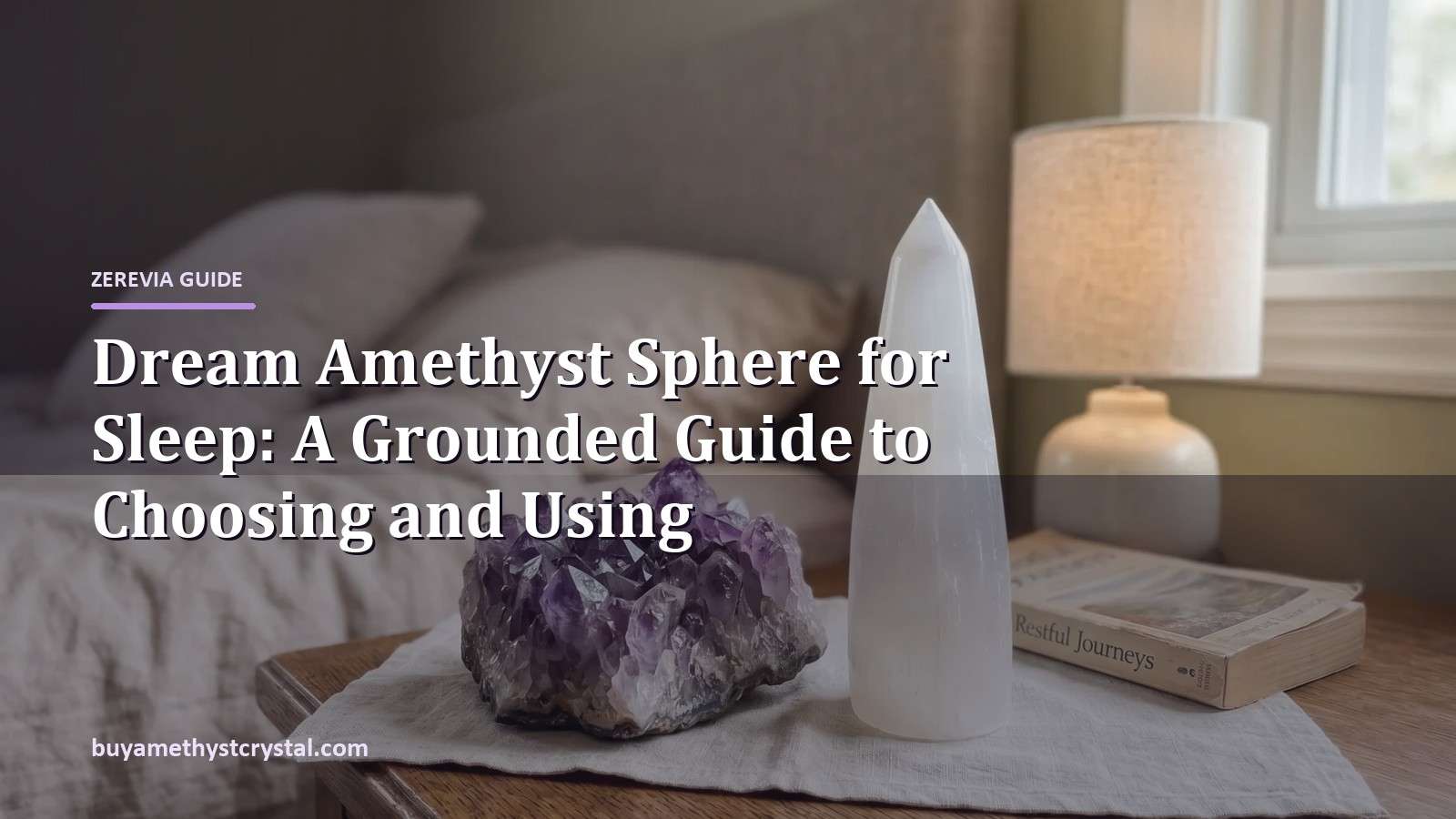

Dream Amethyst Sphere for Sleep: A Grounded Guide to Choosing and Using
The first amethyst I ever bought was not beautiful. It was a small, dull-purple stone with a grayish base, sitting in a wooden box at a secondhand shop like it had been forgotten. The handwritten tag read amethyst — for calm nights — $12. I bought it, put it on my nightstand, and that night was the first in months I did not wake at three a.m. That experience sent me down a path of systematic study — and eventually to the idea that a dream amethyst sphere might be the most useful shape for someone who wants a single, quiet object near their bed.
Whether you are drawn to a dream amethyst sphere for its traditional association with restful sleep, its visual presence on a nightstand, or simply because you want something real and round and purple to look at before the lights go out, this guide will walk you through what the term actually means, how to choose one without getting misled, and how to care for it so it stays the color you fell in love with.
What Is a Dream Amethyst Sphere?
Amethyst is a natural silicon dioxide mineral (SiO2) colored purple by trace amounts of ferric iron (Fe3+) activated by natural radiation in the earth over millions of years. It measures 7 on the Mohs hardness scale — hard enough to scratch glass — and belongs to the trigonal crystal system. When a piece of amethyst is carved and polished into a sphere, you get an even surface that shows color distribution from every angle: some zones deeper purple, some lighter, sometimes with a band of white quartz running through. That variation is a sign the stone grew in the earth rather than a lab.
The phrase “dream amethyst” is not a scientific classification. You will not find it in a GIA textbook. It is a market term that sellers and crystal practitioners use to describe amethyst intended specifically for sleep-related rituals — placed on a nightstand, held before bed, or used as a focal point during a calming routine. The amethyst healing properties page goes deeper into the broader traditional framework, but for this article, think of “dream amethyst” as a functional label: this stone is for bedtime.
A sphere is a particularly common choice for sleep because it has no sharp edges, sits stably on a flat surface, and presents a smooth, continuous surface that some people find calming to touch or simply to glance at. The shape also means the stone’s color is visible from every direction — useful if you move it around your room now and then.
Traditional Benefits and Buyer Experiences
Before listing what tradition and personal experience suggest about dream amethyst benefits, one important distinction: none of what follows is medical advice, a clinical claim, or a guaranteed outcome. Traditional crystal practices describe amethyst as a stone associated with calm, clarity, and restful sleep. Many buyers report subjective experiences that align with these traditions. Those reports are real — but they are observations, not prescriptions.
What Tradition Says
In crystal tradition, amethyst has long been associated with the evening and the mind quieting down. The dream amethyst spiritual meaning most commonly cited is one of mental settling — the idea that having a specific, beautiful, real object near your bed gives your mind something to rest on instead of the day’s noise. Some practitioners associate amethyst with the Third Eye (Ajna) and Crown (Sahasrara) chakras — energy centers linked, in Indian philosophy, to intuition and expanded awareness. In a dream amethyst chakra context, the sphere is sometimes placed at the bedside or under a pillow specifically for these traditional associations.
What I Experienced
I do not claim to understand why that first $12 stone seemed to help me sleep. It could have been the weight of it, the ritual of putting something on the nightstand instead of scrolling through my phone, or the simple fact that I had spent money on my own comfort and that act of self-care mattered. I still do not know. But I noticed the difference, and I know from buyer messages that I am not alone.
What I do know is the chemistry: the purple comes from iron sitting in a quartz crystal lattice, activated by radiation deep underground over geological time. The color is not painted on; it grew there. That fact does not make amethyst medicine. It makes it real. And for some people, having something real nearby at the end of a long day is enough.
Amethyst Sphere Benefits in Practice
When people ask about amethyst sphere benefits, the most honest answer I can give is this: the sphere itself does not perform an action on you. Instead, it serves as an anchor for a bedtime routine. Some buyers light a candle, hold the sphere for a minute, set a simple intention like “I am done for today,” and put it back on the nightstand. Others simply like having it there — a purple shape that catches the lamp light and reminds them the room is theirs. Dream amethyst crystal benefits, in this framing, are less about what the stone does and more about what you do around it.
Choosing the Right Dream Amethyst Sphere
Not every purple sphere is the same, and not every seller is honest about what they are selling. Here is how to choose a dream amethyst sphere that matches your space, your budget, and your standards.
Size
Spheres range from roughly 40 mm (about the size of a golf ball) to over 150 mm (larger than a softball). For a nightstand, 50–80 mm is the most common range — large enough to have visual presence, small enough not to crowd your alarm clock or water glass. A larger sphere makes a stronger visual statement but takes up more surface area; consider where it will sit before you buy.
Color Depth
Natural amethyst color is uneven. That is a feature, not a flaw. Look for zones of deeper purple mixed with lighter areas. Some spheres have a visible band of white or clear quartz — that is the transition between different growth stages in the crystal’s formation. A perfectly uniform purple throughout may indicate dye, and deep blackish-purple that looks painted on should raise questions. Read our amethyst quality and value guide for a detailed breakdown of what to look for and what grading terms actually mean (spoiler: “AAAA” is not a real standard).
Origin
Documented-origin amethyst — meaning the seller can tell you whether it came from Brazil, Uruguay, or another source — is a sign of a seller who pays attention to their supply chain. Brazilian amethyst tends toward larger pieces with a wider color range, from lavender to mid-purple. Uruguayan amethyst tends toward deeper, denser color with finer crystal structure. Neither is categorically “better”; they are different. Our amethyst geological origins guide explains the differences in more detail.
Aura Amethyst Sphere: A Note on Treated Stone
You may come across an aura amethyst sphere — amethyst coated with a thin layer of metal (often titanium or gold) to produce an iridescent surface. These are visually striking, but they are not the same as untreated natural amethyst. The coating changes the surface appearance and may obscure the stone’s natural color distribution. If you want the stone’s own purple visible and untouched, choose uncoated. If you enjoy the rainbow shimmer and understand the treatment, that is a valid choice too — just know what you are buying.
Authenticity Checks
Here is what I do when evaluating a stone, adapted from years of practice and one memorable conversation with a mineral show dealer who taught me more in twenty minutes than I had learned in weeks of reading:
- Weight: Real quartz is heavier than glass and significantly heavier than plastic. Pick it up. It should feel dense.
- Temperature on contact: Press the sphere against your cheek or inner wrist. Real mineral feels cool at first contact, then gradually warms. Glass feels cool too, but the transition is faster and more uniform.
- Color distribution: Look for unevenness — some areas darker, some lighter, possibly a white band or small inclusions. Perfect uniformity is suspicious.
- Seller transparency: Ask where the stone is from. A seller who can name the country — or even the region — is more likely to have sourced carefully. “Natural amethyst” on its own proves nothing.
How to Use Your Dream Amethyst Sphere for Sleep
There is no single correct way to use a dream amethyst sphere. What follows are common approaches drawn from buyer routines and traditional practice. Pick what fits your life; skip what does not.
Placement
The most common spot is the nightstand, within arm’s reach and within your line of sight when you lie down. Some people prefer a shelf above the bed or a windowsill away from direct sunlight (more on that in the care section). The point is visibility — you want to see it as part of winding down, not buried in a drawer.
Ritual and Intention Setting
In traditional crystal practice, intention setting means holding the stone and naming what you want from it. This can be as simple as holding the sphere in both hands for a minute and thinking, “Tonight I rest.” You do not need incense, chanting, or elaborate ceremony. Some buyers prefer a brief moonlight cleansing — placing the sphere on a windowsill during a full moon — as a way to “reset” the stone. There is no scientific mechanism here, but there is a psychological one: the act of pausing, holding something, and stating a purpose is itself a transition ritual. It tells your nervous system that the day is over.
Chakra Associations
In traditional frameworks, amethyst is linked to the Third Eye Chakra (Ajna, at the brow) and the Crown Chakra (Sahasrara, at the top of the head) — both associated with awareness, intuition, and quieting mental chatter. Placing a dream amethyst sphere near the bed is a common traditional practice for these associations. Whether you work with a chakra framework or not, the sphere’s role in a sleep routine is the same: it is a physical anchor for a mental transition.
Related Forms: Towers, Bracelets, and More
A sphere is not the only shape amethyst comes in. Depending on how you plan to use it, a different form might suit you better.
Dream Amethyst Tower
A dream amethyst tower (also called an obelisk or point) is a tall, polished form with a flat base and a pointed top. In traditional practice, towers are said to direct energy upward through the point — making them a popular choice for meditation or focused intention. The dream amethyst tower meaning often centers on clarity and direction: the shape itself suggests rising, narrowing, focusing. If you want something that sits upright on a shelf and makes a vertical visual statement, a tower is a strong alternative to a sphere. Towers are also sometimes placed on a desk during the day and moved to a nightstand at night.
Dream Amethyst Point
A dream amethyst point is typically a natural, unpolished crystal termination — the kind of shape that grows in a geode or cluster. It retains the stone’s raw geometry, including the six-sided prism and pointed tip. For someone who wants amethyst in its most natural-looking form, a point is the closest to how it came out of the ground. It works well on a nightstand or windowsill and is easy to hold during a short intention-setting practice.
Dream Amethyst Bracelet
A dream amethyst bracelet brings the stone into your daily life beyond the bedroom. Typically made with small polished beads on elastic cord, it is a wearable option that keeps amethyst in contact with your skin throughout the day — useful if your sleep ritual starts long before you reach the nightstand. Our amethyst forms and shapes guide covers the full range of options, from raw clusters to polished spheres, so you can choose the form that matches how and where you want to use amethyst.
Sphere vs. Tower vs. Point: A Quick Comparison
| Form | Best For | Traditional Association | Placement |
|---|---|---|---|
| Sphere | Balanced presence, calming touch | Wholeness, completeness | Nightstand, shelf, table center |
| Tower | Directed focus, vertical display | Clarity, upward energy | Desk, nightstand, meditation space |
| Point | Natural geometry, handheld ritual | Raw connection, grounding | Windowsill, nightstand, pocket |
| Bracelet | Wearable, everyday contact | Continuous presence, personal reminder | On your wrist |
Care and Maintenance
A dream amethyst sphere is a durable object — 7 on the Mohs scale means it resists everyday scratching — but it has one specific vulnerability that every owner should know about.
UV Fading: The One Real Risk
Amethyst’s purple color comes from Fe3+ ions in the crystal structure, activated by natural radiation. Prolonged exposure to ultraviolet light — meaning direct, sustained sunlight — can cause those iron ions to undergo an irreversible reduction. The purple fades. It does not come back.
I learned this the hard way. A buyer sent me a message saying her crystal point had lightened in color. She had placed it on a south-facing windowsill, where it received direct afternoon sun for about two hours a day. That piece went from deep emperor purple to a pale lavender in a matter of months. It was still real amethyst. It was still beautiful to some eyes. But the color that made it special was gone, and no amount of moonlight or sound baths would restore it.
The rule is simple: keep your dream amethyst sphere out of direct sunlight. A nightstand away from the window is ideal. If you want to place it near a window, choose one that does not get direct sun exposure, or keep it on a shelf set back from the glass.
Cleansing
In traditional practice, amethyst is cleansed — meaning its accumulated energy is “reset” — through several common methods:
- Moonlight: Place the sphere on a windowsill during a full moon overnight. This is considered the safest method and will not damage the color.
- Sound cleansing: Using a singing bowl or tuning fork near the sphere. The sound waves are traditionally believed to clear stagnant energy. No UV risk here.
- Smoke: Passing the sphere through sage or palo santo smoke briefly. Ensure the stone is not exposed to heat or soot buildup.
Avoid salt water or prolonged soaking, which can dull the polish over time. A soft cloth with lukewarm water is sufficient for removing dust or fingerprints. For more detail on cleansing methods, our amethyst care and cleansing guide covers each method step by step.
Storage
If you are not displaying the sphere, store it in a soft cloth pouch or a lined box, away from other hard minerals that might scratch it (or that it might scratch — quartz at Mohs 7 will damage softer stones). Keep it in a cool, dry, dark place. This matters less for everyday nightstand use and more for seasonal storage or travel.
Frequently Asked Questions
Can a dream amethyst sphere really help with sleep?
Amethyst has a long traditional association with calm and restful sleep, and many buyers report that having a sphere near their bed supports a calming bedtime routine. It is not a medical treatment, a sleep aid in the clinical sense, or a substitute for addressing underlying sleep issues with a healthcare provider. What it can be is a real, beautiful, specific object that signals to your mind: the day is over, the room is yours, and it is time to rest. For some people, that signal is enough.
How do I choose the right size sphere for my bedroom?
For a nightstand, 50–80 mm is the sweet spot: large enough to notice, small enough not to crowd your space. If you want a statement piece for a dresser or shelf, 100–120 mm gives more visual weight. For something to hold in your hand during a brief evening ritual, 40–50 mm fits comfortably in one palm. Consider where the sphere will live most of the time, and measure that space before ordering.
What is the difference between a sphere and a tower for sleep?
A sphere offers balanced, even presence — no orientation, no direction, just a smooth object that sits quietly. In traditional practice, it represents completeness and is associated with calming environments. A tower, with its flat base and pointed top, is traditionally linked to directed focus and clarity. If you want something that blends into the background of your bedroom, choose a sphere. If you want something with a more defined shape that suggests intentional purpose, a tower might appeal to you more. Both are valid choices for a sleep-oriented practice.
How do I cleanse my dream amethyst sphere?
The safest method is moonlight: place the sphere on a windowsill during a full moon and retrieve it in the morning. Sound cleansing with a singing bowl is another gentle option that carries no risk of UV damage or moisture exposure. Avoid direct sunlight, salt water, and harsh chemicals. For a complete walkthrough of each method, see our amethyst care and cleansing guide.
 Crystal Cluster
 Crystal Tower
 amethyst crystal ball
 Amethyst Caves for Sale
 Amethyst Bracelets
 Amethyst Earrings
 Amethyst Necklaces
 Amethyst Rings
 amethyst crystal healing
 Amethyst Beauty & Wellness
 Crystal Home Decor
 Spiritual & Divination Tools